Category: Tips & Guides

  • Smallest Grow Tents – Our Top 5

    Smallest Grow Tents – Our Top 5

    Having good control over your indoor grow space allows you to create the perfect growing environment for your hydroponic garden. Space is one factor in hydroponics, and not everyone has a lot of it to put all the materials and equipment that they need, such as grow tents. However, with the availability of the smallest grow tents, growers can manage space and indulge in some amazing cultivation.

    Space management can be achieved with portable grow tents and we will be looking at some options of the best, smallest grow tents available on the market today.

    What is a Mini Grow Tent?

    A grow tent is a compact tent used to arrange hydroponic equipment, and they are made of reflective interior walls. They are capable of fitting into most closets, so it allows you to raise your plants in a closed space. The interior space is utilized by hanging some hydroponics equipment such as grow lights, fans, etc.

    What Is A Mini Grow Tent

    Why Use The Smallest Grow Tents?

    When it comes to hydroponic indoor grow space, growers who wish to maximize their use of small spaces can do so using the smallest grow tents available.

    With these small tents, you get an almost pest anddisease-freee environment because of their little space use and they are usually isolated, which makes them easy to manage. All you need to do is to make sure there is sufficient aeration to prevent the development of fungi and the formation of mold.

    However, these small grow tents are only ideal for small-scale farming and are not suitable for industrial or commercial purposes. They are best used for small plants as well.

    Also, because they are small, you may not get a good return on your investment if you plan to use the tents for business purposes. However, in some cases, you still get high yields but just in a managed space depending on the plants that you are growing.

    You can find these small grow tents in sizes of about 3 to 4 feet (12 to 48 inches) tall. Note that if the size exceeds about 6 to 7 feet (72 to 84 inches), it’s no longer considered a small or portable tent. So, be sure of the size you are purchasing.

    If you follow this guide, you can be guaranteed to get only the best smallest grow tents that you can find.

    Why Use The Smallest Grow Tents

    Smallest Grow Tents For Indoor Hydroponics

    We have narrowed down the smallest grow tents you can find for your indoor hydroponics. So read on to learn more about our 5 best picks

    1.    GreenHouser 24″X24″ X48″ High Reflective Grow Tent Indoor Grow Room for Planting Fruit Flower Veg

    In number 1, we have the GreenHouser reflective grow tent. It is great for the indoor planting of various plants such as flowers, veggies, and fruits. It is one of the best smallest growing tents you can go for. It is a portable grow tent with a size of 24x24x48 inches.

    This grow tent is made of 96% reflective interior walls so you can be assured your plants will get adequate grow light effects. It is also made of lightproof and waterproof materials. Thus, there’s no stress of little light sneaking or reflective outer light bothering your eyes when the tent is closed.

    The durable and sturdy material used to make this grow tent makes it pretty easy to assemble. It also has convenient zippers that zip up and down easily as you open and close your tent. So you can get easy access to your little hydroponic garden.

    We appreciate the multiple ports and vents for optimal air circulation. It as well features a afloor-growingg tray of size 2 x 2 feet.

    The one downside of this grow tent is that it has no window for observation. However, the thezip-upp and the down feature can serve this purpose.

    Pros                                                                              

    • Features nicezip-upp and down for easy access.
    • Easy to assemble.
    • Made of reflective walls and waterproof materials.
    • Durable and sturdy materials.

    Cons

    • No observation window.
    71Q9n9MJ PL. AC SX522

    2.    VIVOSUN 24″x24″x36″ Mylar Hydroponic Grow Tent with Observation Window and Floor Tray

    This VIVOSUN grow tent is another great choice amongst the smallest grow tents you can find. No installation hassles and it’s made of sturdy, durable, and tear-proof materials. The size of this small tent is 24x24x36 inches.

    It is made of 98% highly reflective inner materials for your plants’ growing benefits. All light reflections are sealed so no external light will disturb your eyes. It can fit your LED or any portable grow light you have, and it will also fit in one or two fans. There are also vents for air circulation and vents for fan space.

    Another advantage we admire is the accessibility to window observation. You can simply take a peek at your hydroponic garden without interrupting your setup. It is great for vegetative plants, flowering plants, as well as fruiting plants. It is made of eco-friendly materials that are safe for your plants.

    The only drawback we noticed is you have to be gentle with the delicate zipper to enjoy long-lasting zipping.

    All in all, you will get your money’s worth with all these great features that are great for hydroponic plant hobbyists.

    Pros

    • Easy to install.
    • Sturdy, durable, and tear-proof.
    • Access to window observation.
    • Made of reflective inner materials.

    Cons

    • Zippers require gentle handling.

    3.    OPULENT SYSTEMS 24″x24″x48″ Hydroponic Mylar Water-Resister Grow Tent Reflective Garden Growing Dark

    This OPULENT grow tent features a removable floor tray and a pocket for keeping tool bags in an orderly fashion. It is made of superior and durable material that will last you a long time. It offers 98% reflective interior walls for optimal light for your plant’s growing needs. The size is 24x24x48 inches.

    The design is double stitched to prevent tear and it offers light blocking to the exterior. It is easy to assemble with user-friendly instructions. This grow tent is also waterproof so it eliminates the worry of water mess wherever you decide to place this tent in your home.

    Another great advantage of this grow tent is the observable window view for monitoring your hydroponics garden from the window without the stress of disturbing your setup. The window is also quite easy to clean.

    Pros

    • Features tool pockets for keeping tools.
    • Removable floor tray.
    • Observation window available.
    • Tear-proof material.

    Cons

    • Not suitable for growing bigger plants due to its size.
    51PLVt8wjeL. AC SL1000

    4.    Quictent SGS Approved Eco-Friendly 24″x24″x55″ Reflective Mylar Hydroponic Grow Tent

    In number 4 we have the Quictent.  This is another great option for small growth tents. It is easy to assemble and comes with easy-to-read instructions. The size is 24x24x55 (in inches).

    This grow tent is made of water-proof designs, and the inner materials are highly reflective. There are no light leaks as the exterior is made of a light-blocking design.

    This portable grow tent is made of eco-friendly materials that are safe for your plants. It is a sturdy grow tent that is capable of holding your grow light, fans, and other equipment.

    The grow tent is lined with non-toxic materials, thus safe for your plants’ health. It is also made of water-resistant materials to prevent any water splash or leak mess.  There’s the feature of an observable window for brief viewing. There’s also access to holes and vents for ventilation. The zipper door is easy to zip in and out.

    The only downside we are aware of is that it’s not ideal for growing bigger plants. The grow tent is only suitable for smaller plants.

    Pros

    • Eco-friendly materials that are safe for the plant.
    • Observation window.
    • Sturdy and capable of holding equipment.
    • Great ventilation.

    Cons

    • Not suitable for larger plants.
    61D mPz6SaL. AC SL1100

    5.    TopoLite 20″x20″x48″ 600D Grow Tent Room Reflective Mylar Indoor Garden Growing Room Hydroponic System

    TopoLite is another brand of the smallest grow tent you can find for your indoor hydroponic garden. The installation is easy as it comes with an assembling manual. The size is 20 inches in length, 20 inches in width, and 48 inches in height.

    This grow tent is made of quality reflective interior materials and it is also waterproof. It also has zippers for easy accesstor opening and closing the tent.

    It features some vents for fans for optimum air circulation. This grow tent is ideal for growing veggies, fruits, herbs, and flowers. It also comes with a removable waterproof floor tray to collect any dripping water that drips so your hydroponics tent remains clean and less messy.

    It’s made of durable materials so be assured of long-lasting usability. It is also sturdy. However, it does not have an observation window and there might be a few light leaks.

    Overall, this TopoLite grows tent is a great choice for raising small plants in a portable space.

    Pros

    • Made of reflective walls.
    • Waterproof.
    • Durable and sturdy.
    • Comes with a removable waterproof tray.

    Cons

    • Light may leak a bit.
    71j74K09ziL. AC SX522

    The Best Indoor Greenhouse

    Using indoor greenhouses is an ideal and inexpensive sustainable way of growing plants in your home all year round. This means that regardless of season, you can still enjoy fresh, homegrown fruits, vegetables, herbs,s and flowers from your indoor garden.

    Indoor greenhouses come in different sizes and a variety of price ranges. A good indoor greenhouse should fulfill the following requirements:

    • compact and portable
    • improved air quality
    • plant protection 

    The best indoor greenhouse would be one that fulfills this requirement and fits your budget.

    How to Set Up a Grow Tent

    Wondering how to set up your grow tent? This should not be a monumental task, provided you have all the tools required. The most important ones you should have are:

    1. A Grow Tent

    2. An appropriate Grow Light

    3. Appropriate Ventilation

    • ​Carbon Filters
    • Ducting
    • Duct clips
    • Can Fans

    4. Miscellaneous tools

    • ​Temperature and Humidity Gauge
    • Basic Assembly Tools
    • Plants
    • Tape and Fasteners

    Here are the basic steps to assembling a grow tent:

    Step 1: Assembling or putting together the frame.

    Step 2: Put the cloth over the frame.

    These are the two major steps of putting together a grow tent. If you carefully follow the instructions as outlined in the package, you will have the entire structure of your growth tent. The next steps you need to take care to put together the small bits and pieces to get it functional. These include;

    • setting up the grow lights
    • setting up ventilation as well as air filtration
    • checking the balance of all parameters inside the grow tent. These include humidity, temperature, airflow, and carbon dioxide. Ensuring that these factors are ideal will ensure that you get optimal productivity out of your tent.

    Grow Tent Setup Diagram

    If you are a visual person who works better with pictures than word explanations, a diagram may be more appropriate for you to figure out how to set up your grow tent. Here is a diagram to help you visualize how it should look when it is complete:

    All You Need to Know About Grow Tent Size Epic Growing Guide. ????ACTUAL 2023

    Additional Say On Micro Grow Tents

    As a hobbyist, you can venture into indoor hydroponics with style by creating the ideal environment with the use of a grow tent. And if you’re bothered about space, going for the smallest grow tent will allow you to arrange your hydroponic garden in a managed space. Some simplicities and conveniences comee from making use of portable grow tents. There is also the guarantee of better yield and little or no pest issues with these tents. Getting good or high germination rates from your seeds is another added benefit. Because you can control so many of the conditions in there, you can almost guarantee great success.

    You get so much control when making use of grow tent. You can closely control the light intensity, humidity, temperature, and water which will enhance optimal plant growth. Enjoying allyear-roundd produce is another plus. This means you would never have to miss any of your favorite vegetables or fresh salads because you can produce them all year round.

    We have made finding the smallest grow tents for your hydroponic garden easy with these great options. We hope the information provided here will help you a great deal in selecting the best one for you. So, any of our picks can be a nice place to start your search when it comes to choosing the smallest hydroponics to grow tents. Happy growing folks!

    FAQs

    Are smaller grow tents worthwhile?

    Smaller grow tents are becoming more and more popular, particularly within the cannabis industry. They’re cheaper than their bigger counterparts, yet still offer a nice amount of growing space. You may have seen smaller grow tents at your local dispensary, or maybe you’ve even had one for yourself.

    Well, growing plants inside your home is not only an easy way to save space but also provide you with a beautiful environment. The best part is that you can grow plants inside your house without spending much money.

    You can even use a 1 gallon (3.8 liters) pot with a dome top. I have 2 of them, one for my indoor plants, the other for my outdoor plants. When I bring them outside, I just remove the dome, and they’re ready to go.

    What Is a small grow tent?

    A small grow tent is basically a smaller version of the larger grow tent. The main difference between the two is the size, which means the size of the area they can grow in. For example, the average small grow tent is around 5×5 feet (2.52m), whereas the average large grow tent is usually around 10×10 feet (3m×3m). Small grow tents are great for indoor growers because they provide a decent amount of growing space for the budget-conscious consumer. They also give you a lot more options when it comes to lighting, ventilation, and other things that affect the growth rate of your plants. Small grow tents come in all different sizes, but they generally fall into two categories: mini and micro. We’ll go over both of these in this article, and we’ll also explain why you might want one over the other.

    Is smaller better?

    Smaller is not always better. You need to take into account what you’re going to use it for.

    If you’re going to grow in a garage or some other location where space is limited, then maybe a smaller grow tent is best. On the other hand, if you’re growing outdoors, or in a more spacious location, then you may want to consider a larger grow tent.

    There is no hard and fast size limit on these tents. The size of the tent will depend upon how much space you want to dedicate to growing and what style of grow you want to do.

    What’s the best small cannabis grow tent for a beginner?

    AeroGarden is one of the best brands for growing cannabis indoors. The company has a wide variety of products that you can use to grow weed at home.

    They offer both hydroponic and soil-based systems. They’re known for being very durable and sturdy. If you’re new to growing, then the G2 is the perfect starter kit. It’s easy to set up and use. You’ll get everything you need to get started in just a few minutes. This is the best small grow tent for cannabis because of its durability.

    AeroGarden Mini G2 Mini The G2 Mini is the perfect size for a beginner grower. You’ll be able to get your hands on everything you need to get started with indoor growing. It comes with everything you need to get started with a grow room. It’s easy to setup and operate. It has a lightweight design that makes it easy to transport.

    AeroGarden Nano G2 Nano The Nano G2 is a very small. It’s perfect for beginners who want to start their cannabis grow at home. It’s very affordable. You’ll get all the equipment you need to get started. It’s easy to set up and use. It comes with everything you need to grow weed at home.

  • Is Miracle Grow Toxic: Possible Negative Effects

    Is Miracle Grow Toxic: Possible Negative Effects

    Using the right kinds of feed and fertilizer for your plants is important, but is miracle growth toxic? Can it be used safely within your garden? Let’s take a closer look.

    Grasses, plants, trees, flowers, birds, and butterflies. Who doesn’t love gardens? The scent of the lovely flowers, the birds chirping and the butterflies flying around, are all good to look at. But, a fruitful plant cannot be as productive as it could be, if not cared for correctly. Every gardener has their own strategy for growing their plants. One is by using the right kind of plant food. 

    What is a Plant Food?

    Plant food is any substance like animal dung or a combination of nitrates used to make the soil more productive. 

    What is a Fertilizer?

    A fertilizer is a chemical or natural substance added to soil to make it more fertile.

    Is Plant Food a Fertilizer?

    Plant food and fertilizer are often used interchangeably. Fertilizer indeed helps plants get the needed nutrients to grow and blossom properly. In terms of how they are used, plant food and fertilizer are not the same. 

    What is Miracle-Gro?

    This is a type of plant food by Scott’s Miracle-Gro Company that every gardener knows. It provides readily available materials needed in the production of new cell structures within plants. It quickly feeds through the leaves and roots.

    What is it used for?

    It is used for flowers, vegetables, trees, and shrubs.

    How do you use it?

    Miracle-Gro can be used in two different ways:

    • Through a feeder- 1 feeder refill packet can cover up to 500 sq. ft.
    • Through a watering can- 1 tablespoon mixed with a gallon of water

    There is also a suggested quantity that should be used:

    • For roses with small bushes, 1/2 gallon should be used while a gallon should be used for big bushes. Feeding should be done every 7-14 days.
    • For all flowers and vegetables, 1 gallon should be utilized for every 10 square feet, every 7-14 days.
    • For indoor plants, however, only half a teaspoon should be mixed with a gallon of water. Also, leaf feeding for houseplants is not recommended. This mixture should be applied every 2 weeks. 

    What Do You Need to Know About Miracle-Gro

    Is Miracle Grow Toxic to Humans?

    There are still no studies conducted to rule out its toxicity to humans. However, some of the ingredients of Miracle-Gro have serious effects on the surroundings and humans, too. As with any product, caution is always a great mindset to adopt.

    What are the effects of some of the ingredients of Miracle-Gro on the environment?

    The accumulation of nitrates in the soil causes water pollution if exposed to a flowing water source. Excessive use of artificial fertilizers can damage the natural composition of soil eventually.

    Plants that grow in such soil will not have enough of their ingredients like iron, carotene, zinc, copper, protein, and vitamin C. It can also burn the roots of the plants when excessively given.

    What are the effects of some of the ingredients on the garden itself?

    It may harm the plant that it is supposed to strengthen if used improperly. One of the ingredients of the fertilizer is nitrogen which, if given in large quantities, can prevent shrubs and trees from blooming the way they used to. 

    It also contains a high volume of salt which, as time passes by, ransacks the soil of its natural nutrients and prevents plants from absorbing them. Gardeners tend to overfeed their plants, thinking that this will aid in the fast growth of their plants. 

    Those who apply it too much compromise not only the depletion of their current harvests but also indefinitely damage their spaces.

    What are the effects of some of the ingredients on humans?

    Excess nitrate levels in the soil create plants that, when eaten, turn to toxic nitrites in the intestines. Miracle-Gro should not be eaten, but if ingested accidentally can irritate the mouth, throat, esophagus, and stomach as it contains urea, an irritating ingredient present in plant food. 

    When irritation occurs, the person will experience nausea and vomiting. In addition, some of its ingredients can harm the soil itself, thus, can contaminate groundwater. Groundwater, as the primary source of potable water in the rural areas of the United States of America, can be greatly affected. 

    Various adverse health effects on humans can include:

    • methemoglobinemia- also known as the blue baby syndrome
    • various cancers
    • Poor reproductive outcomes- like neural tube defects
    • diabetes
    • thyroid conditions

    Miracle-Gro Came in Contact With My Eyes, What Should I Do?

    Immediately flush your eyes with plenty of water and continue flushing for 15 minutes. If irritation further develops, seek medical treatment.

    What Do You Need to Know About Miracle-Gro

    What is Miracle Grow Made of?

    If you’re wondering what ingredients are in Miracle-Gro, then look no further. Typically it contains the following derivatives:

    • ammonium sulfate
    • potassium phosphate
    • potassium chloride
    • urea
    • urea phosphate
    • boric acid
    • copper sulfate
    • iron EDTA
    • manganese EDTA
    • sodium molybdate
    • zinc sulfate

    Does Miracle-Gro Have Nitrogen?

    Yes, it does. Its high levels of nitrogen are one of the reasons it should not be used in excess for your plants. If used too much, it can cause harm to both your soil and your plants. Miracle-Gro not only contains high levels of nitrogen but also phosphorus and potassium too. This particular type of fertilizer is 15:30:15. This means that it contains 15% nitrogen, 30% phosphorus, and 15% potassium.

    Why is Miracle-Gro Blue?

    There are two main reasons why Miracle-Gro is blue. The first is because of the use of copper sulfate, which is blue. However, another reason is that synthetic fertilizers are sometimes dyed. This is because it makes it abundantly clear that it should not be consumed and is only to be used for fertilizing. When a fertilizer is darker in color, it usually means it contains more nutrients.

    Is Miracle Grow Toxic?

    When it comes to Miracle-Gro it is seen as both nontoxic and not hazardous for both humans and dogs. However, this does not mean it’s not harmful to both human and dog health if ingested or if contact is made with your skin. For example, it can irritate if it comes into direct contact with your eyes or skin, and you should contact a vet or doctor for advice, if possible.

    If Miracle-Gro is ingested, it can cause gut issues such as sickness and diarrhea. If this happens to you or your dog, you should keep hydrated and seek medical advice from either a vet or a doctor.

    Miracle-Gro vs Organic Fertilizer

    Miracle-Gro is a type of synthetic fertilizer and there are many differences between organic fertilizers and synthetic fertilizers. Simply put, organic fertilizers are made from natural resources, whereas synthetic fertilizers are man-made in a lab. Let’s take a look at some of the differences between the two.

    Synthetic fertilizers feed the plant, whereas organic fertilizers feed the soil and give both the plant and soil nutrition. As well as this, synthetic fertilizers are easy to find and usually cheaper than organic fertilizers. Also, while organic fertilizers are great for the entire ecosystem, synthetic fertilizers usually do little for the surrounding environment or soil; just the plant itself.

    It’s also worth mentioning that if used too much, synthetic fertilizers can burn your plants whereas this is unlikely to happen with organic fertilizers. And finally, if you’re looking for exact measurements on nutrients, synthetic fertilizers are precise; whereas organic can vary.

    Organic Fertilizers to Use Instead

    You may decide that you’d prefer to use organic fertilizers for your garden. If so, you can try one of the following options:

    • alfalfa meal
    • making your own compost
    • leaf mulch

    Safety Precautions in Using This Plant Food

    Here are some more important reminders when using the Miracle-Gro product:

    1. According to its Manufacturer’s Safety Data Sheet, when it is accidentally ingested, immediately rinse your mouth with water. Seek medical attention immediately. Call a doctor or poison control center and do not induce vomiting unless instructed to do so.
    2. If a person accidentally inhales its powder, take them outside or to a well-ventilated area and monitor for subsequent irritation. If coughing or additional problems persist, call out for medical assistance.
    3. If irritation on the skin happens, remove the contaminated clothing. Wash the affected area thoroughly with soap and water. If irritation occurs and becomes persistent, ask for help for medical intervention.
    4. Always wash your hands after handling the product. Avoid inhaling the specks of dust present in the product. Put it in a tightly sealed container and keep it closed when it is not in use.
    5. Using the original packaging of the product is still the best way to store the remaining plant food. By doing this, you can ensure that this will not be mistakenly identified as other products, which, in turn, may present a risk to one’s health. 
    6. Apply the product properly. Read the instructions very well, even if you already know how to do it.  The packaging will show you how, when, and where to apply the product properly. 
    7. Keep this out of reach of children. Store the product away from your home. It is better to store it in your garden storeroom or maybe in the garage. In this way, you will prevent further accidents from happening inside your household.
    8. Keep it away from direct sunlight. Extreme temperatures may damage the composition of the product, thus, altering its effectivity in the growth of your plants. 

    Conclusion

    I hope this post has helped to answer the question: is miracle grow toxic? The truth is, it’s marked as nontoxic. However, it can cause many issues if it is ingested, so it’s important to be extremely cautious with this product when using it; particularly if you have pets. Do you have any tips or tricks when it comes to using Miracle-Gro? If so, please feel free to let me know in the comments below. And remember, sharing is caring!

    FAQs

    What’s a good resource on how to use it?

    The Miracle-Gro website provides a lot of information on the product, including how to use it and why it’s so effective. There are also links to other Miracle-Gro products that might be better for your plants. The site also has many helpful tips on how to get the most from your Miracle-Gro products. You can learn about how to get the best results with your plants by reading the Miracle-Gro Tips page.

    How toxic is Miracle Grow?

    Miracle Grow is probably one of the most popular and well-known plants sold at your local garden center. It is also one of the most controversial and toxic weeds to be found in gardens.

    Miracle Grow is a very effective herbicide and can be used as a foliar feeder. Many people believe that Miracle Grow is the only way to control this pesky weed. While Miracle Grow does work, it is not the best choice for every situation. In some cases, you will need to use other methods such as hand pulling, mechanical removal, or even using a herbicide. 

    The problem with Miracle Grow is that it can cause damage to your lawn and even harm your grass. You may also be at risk of having your lawn become infested with Miracle Grow.

    Miracle Grow is the third most toxic pesticide on the market. The top two are Roundup and 2,4-D, both of which have been linked to cancer and other health problems.

    EWG’s report found that Miracle Grow contains an ingredient called metolachlor which is classified as a probable human carcinogen. According to the EWG, metolachlor is one of the most heavily used pesticides in the country.

    Why you shouldn’t use Miracle-Gro?

    Miracle-Gro and other chemical lawn care products are not bad for your lawn, but they can be harmful to the environment and your health.

    If you don’t have to, don’t. When it comes to plants, there are many ways to make sure your garden is thriving. The best approach is to start with the basics: healthy soil, well-placed and properly sized plants, and a water supply that keeps your garden well-watered.

    Generally speaking, you should stop using Miracle-Gro and go organic.

  • Crawfish Aquaponics – How to Do it Right

    Crawfish Aquaponics – How to Do it Right

    Crawfish aquaponics is possible with the proper knowledge. Although we are more familiar with raising fish in aquaponics, other aquatic animals, such as crawfish, can also be included. You can easily raise crawfish alongside your aquaponics fish.

    Although there can be some limitations to raising crawfish in aquaponics, you can work your way around it.

    What Are Crawfish?

    Crawfish are freshwater crustaceans. They belong to the group of organisms called Astacidea, which also contains lobsters. Crawfish are usually referred to as crayfish. Depending on the location, they can also be referred to as craydids, craybobs, crawdaddies, crawdads, freshwater lobsters, mountain lobsters, rock lobsters, mudbugs, bay bugs, or yabbies.

    The word crayfish is more common in the northern parts of the Eastern United States, while crawdad is used in the central and southwestern regions. Crawfish is a term used farther south, although overlaps exist between the different regions.

    Crawfish are commonly found in the USA, particularly in Mississippi through Louisiana as well as in different parts of the world.

    How To Raise Crawfish In Aquaponics

    Raising crawfish in your aquaponics will add a whole lot of diversity to your system. It is possible to raise crawfish alongside aquatic fish as they can live as good tank mates in your aquaponics system. However, there are things you need to put in place to prevent your fish from eating your crawfish.

    Although not all types of fish will eat your crawfish, the fishes that might end up eating your crawfish are the omnivorous or carnivorous ones and the ones that are two to three times bigger than your crawfish. Also, note that almost all fish may try to eat baby crawfish. However, there are some things you can do to prevent this.

    The good thing about crawfish is that they are bottom dwellers, unlike fishes that love swimming at the water’s top. Crawfish also love hiding places so that is an added advantage. This is why you have to create hiding spots for them in the fish tanks so they can avoid the fish. You can make use of big stones as hiding spots.

    There is always a chance of fish-eating your crawfish. But don’t sweat it. Just try to follow the tips mentioned above to keep your crawfish safe.

    Crawfish & Filtration

    Although crawfish may help in terms of filtration, you will still need to get a filtering system as the plants in your system may not be able to take up nutrients, resulting in inefficient filtration sufficiently. The filtrating crawfish technique is not so superb. This is because as they are cleaning up your system by consuming this excess organic waste from fish, they are also producing their waste materials. Therefore, you will need to add a filtration system to clean your aquaponics system so the waste does not clog it up or cause your water quality to deteriorate.

    Stocking Density Of Crawfish

    Crawfish require a lot of space in aquaponics. As such, you can only raise a few of them in the system simultaneously. This is why it is not advised to raise only crawfish as the fish in an aquaponics system, as the few crawfish will not provide your plant with adequate nutrients. They should be raised with other fish so they both can produce enough nutrients for the plants.

    Stocking Density Of Crawfish

    As we mentioned earlier that crawfish are bottom dwellers. They are capable of taking over your fish tank which is why you need to raise a few of them. When a female crawfish can lay up to as many as 650 eggs at a time, this can cause a rapid increase in the population in your fish tank.

    However, if you wish to sell them, you should help their survival by providing them with more hiding spots. This way, your fish will be limited from attacking the little crawfish and you can guarantee that you will have some for sale.

    Crawfish Growing Requirements

    Follow these crawfish growing requirements and enjoy a smooth crawfish aquaponics system:

    • Temperature:

    Crawfish grow best in temperatures of around 70 to 75 degrees Fahrenheit.

    • pH:

    They also prefer their water pH to be around 7.1 to 8.1. Other species of crawfish will do well with a pH of approximately 6.4 to 8.1. Therefore, make sure you are enlightened on the type of crawfish species you will be raising.

    CityFarmer Hydroponic Nutrient Digital pH Meter with 2 Pack of Calibration Solution Mixture Included

    811BBVA9x L. AC SX569
    • Bio-filtration & Water Quality:

    Ensure your filtering system cleans up excess ammonia and nitrite to a level your crawfish can handle. Ammonia and nitrite toxicity can reduce the survival chance of your crawfish. Therefore, always test the nitrite and ammonia concentration levels to make sure that they remain within the correct limits.

    • Maintain Low Stocking Densities of Crawfish:

    Because crawfish require large spaces in the tank, try to maintain a reduced population. When they start producing offspring and their population gets high in the tank, try to take some out and divide them between tanks. You can sell the little offspring to a bait shop or fish store.

    Crayfish need space to move around, so the ideal stocking density for them in a tank is 5 gallons of water per small crawfish. For larger ones, 15-20 gallons would be perfect.

    Crawfish Feeding Habits

    Knowing what to feed crawfish is very important if you are keeping them, mainly if you are farming them for commercial purposes. You need to provide them right so that they can grow optimally.

    Crawfish are omnivores. They feed on snails, insect larvae, worms, and amphibian tadpoles; some eat vegetation. So they will help you hunt worms, snails, leeches, etc you might have in your system.

    Crawfish don’t usually go out to search for food. They make do with what they have around them. Therefore, there’s no worry about them eating your little fish.

    Crawfish Feeding Habit

    How to Raise Crawfish in a Pond

    If crawfish are raised in a pond, they need to be located in areas that are flat and open. The soils in these areas should be full of clay. An adequate supply of water is also essential for raising crawfish in a pond. You might need to perform regular water changes to maintain excellent water quality for your crawfish growth.

    With regards to soil types, clay loam, and silty clay loams are suitable types for crawfish ponds. The clay is necessary to maintain the structure and integrity of the burrows that crawfish make, as well as important to hold water.

    How to Raise Crayfish in Aquaponics

    Raising crayfish in tanks may not be common, but it is absolutely possible. Here are the crucial factors to consider if you want to run a successful crayfish aquaponics system.

    • Maintain the correct stocking density of 5 gallons of water per small crayfish and at least 15 gallons per large crayfish.
    • Keep the temperature of the water in which they are kept between 70 and 75 degrees Fahrenheit.
    • Do not expose them to direct sunlight. Crayfish do not require light in their environment. So make provide them with either shade or suitable hiding spaces in their tanks.
    • The ideal pH for crayfish in aquaponics is between 7.2 and 8.2. Maintain it at this range for your fish to thrive.
    • Make sure that the dissolved oxygen levels in the water never drop below two parts per million.
    • Feed crayfish a varied diet that includes mussels, worms, snails, and some vegetation. Feed them only one to two times a day. This should be enough for them. It will also help keep your water quality good.
    • Clean crayfish tanks at least once a week to limit the buildup of waste from uneaten feed and feces. This will further help to maintain good water quality in your system.
    • Suitable plants for crayfish include peas, celery, and herbs such as dill and marjoram. Pair your crayfish with these plants and you will have a tremendous and well-functioning aquaponics system.

    Closing Remarks On Raising Crawfish

    Raising crawfish in aquaponics may not be common but it is an exciting venture that a lot of people are currently trying their hand at. It will become more popular shortly as aquaponics farmers learn more about them and how to optimize their growth and production. 

    If you would like to try your hand at this exciting farming method, you can use this article as a guide, and be well on your way to success. Happy farming!

    FAQ’s

    Can you do aquaponics with crayfish?

    The answer is yes. The crayfish will eat the algae, which in turn will give off oxygen and the bacteria that help break down the waste. And then the crayfish will eat the fish food, which will give off more oxygen and the bacteria that break down the waste. There are a few things to consider before you jump right in and start your own crayfish aquaponics system, though. Crayfish do not like to live in the same tank as other animals, so if you have a small aquarium, you should only put one or two crayfish in it.

    If you have a larger tank, however, you can house more crayfish. The crayfish also need to be fed regularly, as they are omnivores. You will want to feed them a mixture of algae, fruit flies, and fish food. It is best to keep the crayfish in a separate tank from your fish, as crayfish are known to eat fish and even each other. This means that you will need to get two tanks – one for the crayfish, and one for your fish. If you are new to aquaponics, you may also want to invest in a water conditioner.

    A water conditioner will help to remove excess nutrients from the water so that you do not need to add as much fertilizer. They are also helpful for keeping your water clean and clear. Aquaponics is becoming increasingly popular as people look for ways to improve their lives without relying on traditional methods. While there is still plenty of room for improvement, aquaponics is a system that has many benefits.I am a photographer. I’m working on an album right now with some very important people, and they have been giving me great advice.

    How big should the tank be?

    The tank can be either bigger or smaller than the grow bed. If you want a small aquarium, it can be as small as a 5 gallon or as large as a 55 gallon. You will want to consider the size of your fish. A very small tank won’t hold much water and won’t allow your crayfish to swim around.

    If you are going to keep crayfish, you will need a tank that is at least 10 gallons, but larger would be better. As for the lights, a plant light is usually not strong enough for plants and fish. I use a couple of 10 watt aquarium bulbs for my aquariums. If you are going to use a submersible pump, make sure it has a good enough power supply to run it. I have used aquarium submersibles that cost about $40. You don’t need a lot of lighting though, as long as it’s bright enough for the plants and the crayfish. I use 3 aquarium bulbs for my lighting.

    Can you feed crayfish to your fish in aquaponics?

    In aquaponics, crayfish are used as a food source for fish and other aquatic animals. Crayfish can be used as fertilizer by adding them to the tank or pond.

  • Is Captain Jack’s Deadbug Safe For Pets, Humans, and The Environment?

    Is Captain Jack’s Deadbug Safe For Pets, Humans, and The Environment?

    Is Captain Jack’s Deadbug safe for pets, humans, and the environment? Can it be used around the house or garden with no concern for the health of animals or polluting the environment?

    Every organic farmer’s goal is to grow safe foods that are free from harmful pesticides.  To make this goal reachable, Captain Jack’s Deadbug has been instrumental in doing this, while successfully eliminating all harmful pests. It also significantly protects against predatory bees, mites, and insects that may harm plants.

    What is Captain Jack’s Deadbug Brew and What is It Made Of?

    Captain Jack’s Deadbug is an approved organic insecticide. It is great for garden use and is effective against a wide range of insects and pests. It is safe to use for vegetables, citrus, fruit flowers, and various ornamental plants.

    Captain Jack’s contains the natural substance spinosad. This substance is made by a soil bacterium that can be toxic to insects. It is a mixture of two chemicals, spinosyn A and spinosyn D. This unique bacterium was collected from an abandoned rum distillery on a Caribbean island in 1982 and has never been found anywhere else in the world.

    What Insects and Pests Does Captain Jack’s Dead Bug Brew Eliminate?

     This substance is used to control a wide variety of pests such as thrips, leafminers, spider mites, mosquitoes, ants, and fruit flies. This compound is what makes Captain Jack’s deadbug so effective against;
    • insects on vegetables, berries, citrus, grapes, nuts, ornamentals
    • bagworms, borers, beetles, caterpillars
    • leaf miners, spider mites, and thrips
    As already mentioned, Captain Jack’s deadbug is approved for organic gardening. This product is safe to use up to the day of the harvest of the crops that are listed as safe to use.

    Is Captain Jack’s Deadbug Safe?

    Captain Jack’s Dead bug is safe for pets, humans and the environment, it is approved and certified as a safe pesticide for organic farming in the United States.  Unlike other chemicals, this pesticide is 100% organic with no toxic chemicals to worry about.  It has no fumes that will affect your breathing during the application, even if you spread it on the plants.

    Captain Jack’s deadbug is safe to use around pets and people. You also don’t have to worry about it polluting the environment when you irrigate and the water runs off to natural water bodies for example. Captain jack’s dead bug ingredients are all-natural, including citric acid and clove oil, along with the main ingredient, spinosad. These are biodegradable and will get broken down by natural systems where and when necessary. So as long as the product is used as directed on the label, it is completely safe to use.

    Is Captain Jack’s Dead bug Safe?


    Which Fruits and Vegetables Can Captain Jack’s Deadbug Brew Be Used On?

    Captain Jack’s insecticide can be safely used on the following edible plants and vegetables throughout their entire life cycle, up to the day of harvest;

    • Apples, pears, crabapples, quince, Mayhew, and other pome fruits
    • Bush berries, blueberries, raspberries, blackberries, and cranberries
    • Stone fruits like plums, prunes, nectarines, and apricots
    • Cantaloupe and honeydew
    • Broccoli, cabbage, cauliflower, and other cole crops
    • Tomato, pepper, eggplant, okra, and other fruiting vegetables
    • Lettuce, celery, spinach, and other leafy vegetables
    • Potatoes, yams, sweet potatoes, cassava, Chinese artichokes, Jerusalem artichokes, and other tuberous vegetables

    It is recommended that you add the right amount of water to this brew and mix well.  So what is the right amount?  The table below shows the right amount of the dead bug brew to use:

    UNIT OF MEASURE

    AMOUNT TO USE PER GALLON, PINT, OR QUART

    PER PINT (16 FL. OZ OF SPRAY) PER QUART (32 FL.OZ OF SPRAY) PER GALLON (128 FL. OZ OF SPRAY)
    Teaspoon (tsp) 1 ½ tsp 3 tsp 12 tsp
    Tablespoon (tbsp) ½ tbs 1 tbs 4 tbs
    Milliliters (ml) 7.5 ml 15 ml 60 ml
    Fluid Ounces (fl. Oz) 0.25 fl. Oz 0.5 fl. oz 2 fl. Oz

    Remember to mix only the amount required for a single-use dose.  And in vegetable gardens, do not use more than 3 gallons for a 1000 square feet area.

    Where is Captain Jack’s Dead Bug Brew used

    You can check Captain Jacks’s dead bug reviews here.

    How to Use Captain Jack’s Deadbug Spray On Houseplants

    Houseplants would most likely be the place where pets and small children would be exposed to the dangers of insecticides. Fortunately, Captain Jack’s dead bug brew indoor plants. You can safely use the ready-to-use mixture on your houseplants to get rid of any sneaky critters. Simply spray the mixture on the surfaces of the plan, as well as the underside of the leaves.

    Indoor plant owners can often face challenges with spider mites and thrips, but captain Jack’s deadbug brew for indoor plants has been reported by other indoor plant owners to have saved their plants from certain death.

    To treat indoor plants, you can get the ready-to-use bug spray or the concentrate which will need to be mixed with water according to the package instructions, and used as directed. If you use the spray once and you still see the insects or bugs that have infested your plants, incorporate the spaying into your regular routine until the problem disappears.

    Using Captain Jack’s deadbug brew for indoor plants will help keep infestations and bay and keep your houseplants strong and healthy.

    Captain Jack’s Deadweed Brew

    This herbicide acts fast to control weeds, grass, mosses, and algae in a matter of hours Captain Jack’s™ Deadweed Brew can be used to control or get rid of visible weeds that are within vegetable gardens, flower gardens, landscaped areas, and lawns. It can also be used on weeds that grow on buildings, sidewalks, fences, bark mulch, driveways, patios, and gravel. It can be used safely in all these places because it is approved for organic gardening.

    Conclusion – Is Captain Jack’s Deadbug Safe For Pets, Humans, and The Environment?

    Captain Jack’s Deadbug brew is one of the safest insecticides on the market that can be used with no risks to humans, pets, or the environment. The ingredients that are used to formulate this product are all-natural, making the use of this pesticide sustainable. So if you are ever worried about which insecticide to use for your indoor or outdoor garden, your worries have now been put to rest as you have now learned about this fantastic product that will solve your pest infestation problems in no time. Captain Jack’s dead bug-safe Brew is the new jackpot in farming.  And that jackpot is all yours to enhance your plants!

    FAQs

    Is Captain Jacks Deadbug safe for humans?

    Captain Jacks is a popular line of bug spray from Captain Jacks. It is a non-toxic insect repellent that is approved by the EPA and FDA, and is safe for humans. It has been available in Canada since 2004, but is not currently available in the United States.

    The original product was created by a company called The Captain Jacks Company, which was located in Pennsylvania. In 1996, The Captain Jacks Company changed its name to Captain Jack’s Inc. When the company was sold in 2003, the new owner changed the name of the product to “Captian Jacks.

    Is Captain Jack’s Deadbug organic?

    It has been approved for organic gardening, so if you would like to take care of your garden in an organic manner, this is a fine product to use that you won’t have to worry about doing any harm to your plants.

    What are the ingredients in Captain Jack’s Deadbug?

    Captain Jack’s Deadbug is an insecticide based on a combination of neem and pyrethrum. It is a low-toxicity pesticide that has been approved for use in the United States, Canada, and most other countries. It is considered safe for human consumption, and it is widely used as a household insecticide. It is commonly used to control pests such as roaches, ants, fleas, and mosquitos.

    The ingredients in Captain Jack’s Deadbug are natural, simple and powerful.

    The active ingredient of Captain Jack’s Deadbug is Captan, which is a copper based fungicide. This compound has been tested and proven to be highly effective against powdery mildew. The active ingredient is absorbed by the plant’s cells and travels throughout the plant. It inhibits the growth of the fungi and stops them from infecting the plant. There are other fungicides on the market that are similar to Captan.

    How do you use Captain Jack’s Deadbug brew on indoor plants?

    I use the same method as I do for my outdoor garden. The first thing to do is make sure your plants are in a location that will not be disturbed for at least a week. Next, I put a few drops of the Deadbug brew on each leaf and then cover it with a small plastic bag. After several days, I remove the plastic bags and water the plants.

    Is Captain Jack’s Deadbug fungicide?

    Captain Jack’s Deadbug is the most effective and most widely used fungicide for controlling powdery mildew. It is a systemic fungicide that kills the fungi when they are in the leaf. This means it will not be in contact with your fruit or vegetables and you will not need to spray your crops twice.

  • When to Pick Broccoli – Know When It’s Ready to Harvest

    When to Pick Broccoli – Know When It’s Ready to Harvest

    Most farmers in their early days of farming find it tricky to know when to pick a broccoli or at what stage it is while growing.

    Growing and harvesting broccoli is a rewarding experience that most farmers enjoy. When you grow your broccoli and see the heads forming, you start wondering when to harvest. And what signs you should watch for.

    Growing broccoli and obtaining a good harvest of large heads that are ripe takes patience and practice. So if you fail on your first and second attempts, don’t get discouraged, rather keep practicing.

    How Do You Know When to Pick Broccoli?

    To get the best and most nutritious broccoli, you must be familiar with how to know when to harvest broccoli.  It can be quite tricky to know when broccoli is ready to harvest. One of the reasons that the head of a broccoli plant develops slowly over time and remains on the plant for a long time without any obvious or noticeable changes except for the change in size.

    So how do you know that it is time to harvest broccoli? The answer to this question lies at your fingertips. You can know when to harvest your broccoli by touching the head and squeezing it gently. If the head is firm and tightly packed, it’s ready for harvest. If the head is soft and has spaces between the florets with flowers opening, it is past harvest time.

    It is best to let your broccoli heads grow to a point where they reach their maximum diameter and then harvest them. All broccoli farmers should avoid letting these edible flowers go past their harvest date, and wasting this great cruciferous vegetable. As soon as you notice the flower heads starting to go yellow, harvest the broccoli immediately to avoid them going bitter.

    Certain environmental conditions such as high heat for consecutive days can cause premature or quick flowering in broccoli. The moment you notice the flowering heads starting to develop, it is a good idea to check on them regularly. Did you know that broccoli gives you an extra treat as you wait for the main head to get ready for harvest? You can harvest the outer young leaves when they are about 4 to 6 inches long before the heads are ready. These young leaves have the same tasty flavor as the heads, very delicious when sautéed in oil or butter.

    You can start harvesting these young leaves when the main head is still small. This is before it protrudes above the leaves. These small young leaves are best eaten at that time. When the head begins to grow fuller and protrude, the leaves become tougher and lose their flavor.

    Remember to pick only a few leaves at a time so as not to harm the plant. Keep harvesting new leaves throughout the season until the heads are ready for picking.

    Signs that Show Your Broccoli Is Ready For Harvest

    It can be tricky for new farmers to tell if their broccoli is ready or not, so here are a few signs to look out for:

    • The broccoli has a head. This is the most obvious sign to check out for. The ready-to-harvest broccoli must have a firm and tight head.
    • Broccoli head size. A ready broccoli head should measure between 4 to 7 inches in width. Size alone is not an indicator that it is ready; remember the rule of thumb to check if it’s firm enough.
    • Individual floret size. The size of the individual flower buds is the most reliable indicator. Check the florets on the outside edge of the head; they must be the size of the match stick head. This tells you they are ready for picking.
    • Florets color. Ready-to-harvest florets are deep green. Any hint of yellow color means the florets are starting to bloom because they are overgrown. Harvest them immediately if you notice either of the colors. Remember however that broccoli can come in colors such as purple, so remember to check the variety of seeds or seedlings that you plant so that you can know what colors to look out for.
    Heavy Duty Pruning Saw (Razor Sharp 14″ Curved Blade)

    when to harvest broccoli - Tarvol

    What Does Broccoli Look Like Growing?

    Broccoli has different growing stages throughout its life cycle that it can complete in a single growing season. Knowing what it should look like at the various stages of growth will also help you know when it is time to harvest. Here are the different growth stages of a broccoli plant and how they look:

    • Germination

    This is the first stage where the seed breaks and lets out shoots. Most of this process obviously happens under the soil and so we cannot see what is happening. However, it ends up with a few leaves shooting out of the ground.

    • Seedling stage

    At this stage, the broccoli seedling starts to grow a few adult leaves. Over weeks, the seedling will grow a stalk and get more shoots around it. At this stage, it also has a root system.

    • Vegetative growth stage

    This is the stage where the broccoli plant grows the most. It can attain a height of 2-3 inches and a width of 2-3 inches. The plant may remain small at this stage. This is because it needs to ensure that it produces enough leaves to provide enough energy for the head when it develops in the later stages. This stage is also energy intensive.

    • Maturation stage

    This is the stage where the broccoli focuses its energy on producing the flower or head of the plant. The broccoli head starts small and grows gradually over time. It is at this stage that the broccoli gets ready for harvest. When the head of the broccoli is at the center of the main stalk of the plant, then it is ready to harvest.

    When Is It Too Late To pick Broccoli?

    If you wait too long to harvest your broccoli, it will bolt or go to flower. You will see this happen by when the green buds start to bloom and produce yellow flowers. When this happens, your broccoli is no longer edible. You should let it go to the flower and collect seeds for the following season.

    Conclusion

    The best way to know when to pick broccoli is to consult your seed packet for 2 important things. The expected day of maturity and the expected size of the broccoli head. Each variety grows to a different size in about 100 days from the date of planting.

    Always mark your calendar when you plant your broccoli to give you an estimated date of harvest. Also observe your broccoli over this time to see when it is ready to pick, using the guidelines provided in this article. That’s the easiest way for any farmer to know when the broccoli is ready for harvest.

    FAQs

    What are the signs that broccoli is ready to be picked?

    Broccoli is a cool season vegetable that is best harvested in the fall. The plants are very tough and will bolt to flower if not harvested. To know when broccoli should be harvested, you need to know when it is at its prime and ready to be picked. In order to know when to harvest broccoli, you must have a good idea of the growth stages of this plant.

    Here is a basic description of how broccoli grows.

    Broccoli is ready to harvest once it has reached its full maturity. This can be determined by looking for the following signs:

    Broccoli Heads – When broccoli heads are formed, they are ready to harvest. The heads are the same size and shape as mature broccoli florets.

    Broccoli Leaves – You can tell when broccoli is ready to harvest by looking for leaves that are beginning to yellow. Once broccoli has reached its maturity stage, the yellowing of the leaves should begin.

    Broccoli Stems – You can harvest broccoli when the stems are at least 10 inches long. The stem should be straight and firm. If you are picking broccoli in the summer, the stems should be less than 10 inches long.

    Broccoli Heads – You can tell when broccoli heads are ready to harvest by looking for the heads that are the same size and shape as mature broccoli florets.

    How many times can you harvest broccoli?

    You can harvest broccoli up to three times every three months, which is good news if you like the idea of growing your own food and saving money on your grocery bills.

    Where can yo grow broccoli?

    Broccoli is a cool-season crop, meaning it will start growing in the spring and fall. It can be grown from seed, transplanted, or started indoors. If you are starting from seed, it takes about four weeks to germinate. Transplants can be planted in early spring as soon as the ground thaws. To get your plants started indoors, purchase bare root plants, or start seedlings in flats in a propagator.

    How big does broccoli need to be in order to harvest it?

    It’s an easy-to-grow crop. Broccoli will grow in the spring and fall. It can be harvested as a young crop once the plant is about 3 inches tall. When the plant is ready to harvest, cut off the head. The stalk will begin to grow again, so you may want to wait a few weeks before harvesting again. The plant can be left in the ground for another harvest.

    How do you harvest broccoli so it keeps growing?

    You can either cut the stem off or just leave the head of broccoli alone. You won’t be able to harvest broccoli for a long time after you cut the stem. But if you leave it alone, it will keep growing and producing more heads.

  • When To Water Begonias – A Care And Maintenance Guide For Foliage Plants

    When To Water Begonias – A Care And Maintenance Guide For Foliage Plants

    Knowing When to Water Begonias will save you a lot of hassles as these plants are picky about light and water. Begonias are among the most visually appealing plants that you can grow indoors. They are native to tropical regions worldwide, including Central and South America, Asia, and Africa.

    These plant varieties are virtually limitless with approximately 1500 species. They are popular as both annual bedding plants and houseplants are widely grown. They do best in the morning sun and afternoon shade as they prefer it. Begonias come in a wide range of colors, sizes, and shapes. Fibrous, tuberous, canes, and rhizomatous are the four main types.

    Some varieties have flowers that grow downward, making tuberous begonias ideal for hanging baskets and window boxes rather than garden beds and borders. No matter where you grow them, make sure they have good drainage to prevent root rot. This is because they grow best in soil that is neither dry nor wet.

    Therefore, finding the ideal moisture level and having a planned watering schedule is vital. To learn more about these stunning plants, take heed of the information below. 

    Should You Mist Begonias?

    Yes, misting begonias is recommended for them to thrive. It is important to know when to water begonias as these plants prefer to stay damp and not completely dry out. However, keep in mind that they despise having their roots submerged in water. To help retain moisture, use well-draining soil with some compost material.

     How do I fix an overwatered plant?

    Always water from the bottom of the plant as damp leaves can cause leaf rot and spots. Begonias also thrive in areas with high humidity which is due to their tropical origins. Therefore, they do appreciate daily misting in drier areas. In some instances, it is not recommended to mist too often or to use tap water because the high alkalinity in it may cause your plant leaves to drop.

    Keep in mind that begonias are susceptible to powdery mildew if their leaves are kept wet. To increase humidity, mist the area around your plant instead of directly on it. This small gesture will reduce the chances of them getting damaged. Although misting is recommended, it should be done with caution to maintain your begonia’s stature. Learn more about begonias in this great video. 


    How Do You Save an Overwatered Begonia?

    If you do not know when to water begonias, then you may be guilty of overwatering them which can cause them harm. You need to understand that giving them too much moisture can tremendously deteriorate their growth potential, ultimately killing your plant.

    So, to avoid wet muddy soil and soft soggy leaves, this should be avoided at all costs as it is a clear indication of overwatering. Also, if the leaves are brown and dry, this could mean that the plant has been underwatered. By using the few easy steps mentioned below, you can save your plants and allow them to be healthy and happy again.

    Steps:

    1. Root inspection

    Very gently remove an overwatered begonia from its pot and carefully inspect the root. If the roots are mushy, soft, and brown or black, then root rot has set in.

    2. Assess the damage

    Next, determine the scope of the issue. There is no need to take drastic steps if the plant leaves have just curled and there is little welting. The plant may recover quickly if it is simply allowed to dry out; however, do not place it in direct sunlight in the hope of hastening the process. If you do this, you are more likely to aggravate the situation. Leave it alone and in a position with indirect sunlight. Within twenty-four hours, it should perk up.

     How do you save an overwatered begonia?

    3. Treating the plant

    If you find that there was more damage done, then treat the plant accordingly. Apply a fungicide solution to the roots. Note, you can make your own fungicide solution if you do not have any readily available. A mixture of mild liquid soap and water is ideal. A teaspoon of soap per liter of water will suffice. This formula may appear simple but it will treat a wide range of common houseplant pests. Also, adding a teaspoon of bicarbonate of soda can make the solution a good fungicide.

    4. Repotting

    To begin the repotting process, you should first clean out the roots. After that, remove all of the mushy, damaged roots or any part of the plant that looks flawed. You might need to get rid of most of the plant roots if the damage is extensive. If you’re planting in the same pot, clean it thoroughly with a kitchen disinfectant first. If you’re planting into a new pot, make it the same size as the one the plant just came out of. Remember to repot begonias in a container that has good drainage and use a soilless potting mix. Discard the old soil completely.

    How Do I Fix an Overwatered Plant?

    It’s human nature to offer water to people, plants, and animals. In this way, we show love, care, and affection. Well, it doesn’t work that way with all plants because overwatered plants will eventually rot. It is always important to know when to water begonias as their need for moisture may not be the same as other plants. Below are a few hints on how to fix an overwatered plant.

     Should I Bottom water my begonia?

    Useful Tips:

    • Stop watering the plants.
    • It should go without saying, but no matter how much your plant wilts, don’t give it any more moisture when it shows signs of overwatering.
    • Location
    • If your plant is in a bright window, move it to a less-lit-up location. Not all plants require direct sunlight when their healths deteriorate due to an excess of water.
    • Drainage
    • Check the drainage capabilities of your plant container when repotting. Make sure the pot that it is growing in is the correct size and has sufficient drainage. Insufficient drainage is a common cause of plants not surviving.
    • Air
    • Insufficient air can cause plants to wither. Move the plant to a location where it will get enough air to revive itself.
    • Repot
    • There may be a need to repot the plant if you suspect or notice that the roots are rotting. Before repotting remove all damaged roots, and treat the plant. Place some potting mix in the container, followed by your plant. Allow the plant to moisturize itself with the moisture from the soil before you start to water it again.

    Should I Bottom Water My Begonia?

    Begonias prefer moist but not soaking-wet soil when grown indoors. Need to know when to water begonias? Well, it should be done when you notice the top inch of the soil is dry. Remember to select a container with drainage holes so that excess water can easily exit. Bottom watering will not remove salts and other minerals from the soil, so it is recommended for best results.

     Should you mist begonias?

    Because begonias are very sensitive to overwatering and can easily develop root rot, the soil should be slightly damp at all times but not soggy. Therefore, it is essential that before watering, you test the soil to determine whether it is in need of moisture. Using the tips of your fingers over the soil surface will help you determine whether you should water your plant or not.

    Also, if you notice that your plant is wilting, ensure that you check the soil moisture level before adding any more. Keep in mind that wilting can be caused by various other reasons aside from too much moisture. These include funguses and infestations that are quite common in plants that are left unattended for long periods of time. Additionally, if you find that the soil is bone dry, you should water it sparingly.

    Conclusion

    Begonias are native to tropical regions worldwide. Because they are picky about light and moisture levels, knowing when to water begonias will save you a lot of trouble. As long as you remember to plant begonias in a pot with good drainage and a soilless potting mix, you should maintain a healthy indoor or outdoor garden without any hassle.

    Also, keep in mind that these plants are particularly susceptible to root rot. So, using a layer of pebbles or broken shards of old terracotta pots at the bottom can help with drainage. When the pot becomes rootbound, repot the begonias into a larger container to allow it to keep thriving.

     when to water begonias

    Begonias thrive in soil that is neither too dry nor too wet. Determine the ideal moisture level and create a watering schedule that will be beneficial to your plant’s health and growth. Watering every two to four days should be adequate in most cases; however, this will also heavily depend on the region you’re in. Water more frequently when the weather is hot and dry and less often if the air is cool and the soil is retaining its moisture. Here’s a link with additional information about these eye-catching foliage plants. 

  • How To Grow Artichokes From Crowns – The Best Method!

    How To Grow Artichokes From Crowns – The Best Method!

    Knowing how to grow artichokes from crowns is quite simply a rewarding experience. Although a lot of people are not fans of this amazing thistle. It can be fun to grow for those who are fans of it. Here we will talk about how to grow artichokes from crowns

    The Artichoke

    Cynara cardunculus, commonly known as the artichoke is a perennial plant. It is endemic to parts of Africa, and Italy.

    This plant grows best in soils that are loamy, clay, sandy and well-draining, meaning it is highly adaptable to a wide range of soil types. It prefers soils that are slightly acidic to neutral, with pH ranges of  6.0-7.5.

    Like most plants, it blooms in the spring and summer months.

    Artichoke plants can get up to 5 feet in being, and have a maximum width of between 6 and 8 feet.

    In the first year of growth, artichokes require regular watering to establish well. After the plant has been established, the watering frequency should be reduced because its water requirements reduce.

    Artichokes require a high amount of a balanced fertilizer of 5-5-5 NPK, such as this one.

    Amazon Choice
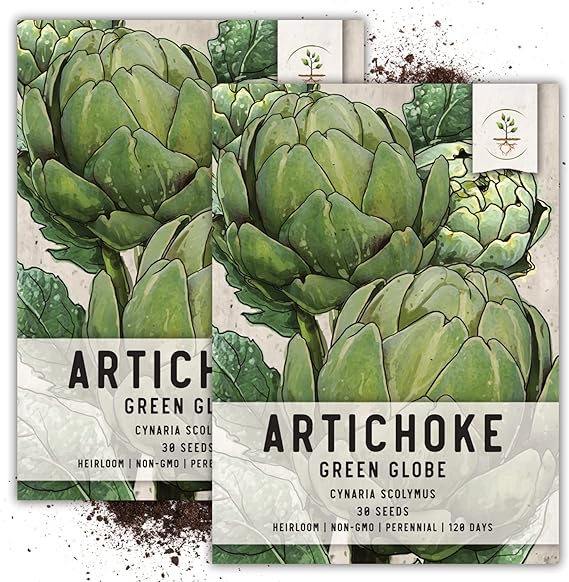
    Sow Right Seeds – Artichoke Green Globe Seeds for Planting
    $4.94

    Non-GMO Heirloom Packet with Instructions to Plant and Grow an Outdoor Home Vegetable Garden…

    Check Amazon Price
    We earn a commission if you make a purchase, at no additional cost to you.
    12/18/2025 05:02 am GMT


    Artichoke Crown

    The crown of the artichoke is the part that looks like a tuft of the leaves at the base of the stem, a bit above where it attaches to the ground. It is where the offshoots or the buds will stem out of.

    The crown is usually at the same level as the soil and can be seen when you dig the soil around the stem of the plant. The crown is a very sensitive part of the artichoke and is susceptible to rot. You need to be very careful not to destroy it when you are removing it. Be careful not to poke it unless you have to. You can use pruners to carefully separate the pups from the crown.

    The artichoke crown is the easiest part of the plant to use to propagate it. That is why most people start with the crowns. The roots sprout easily out of it, and the lovers of this thistle know they are well on their way to enjoying its juicy, bitter fruit.

    Step By Step On How To Grow Artichokes From Crowns

    Step 1: Find artichoke root crowns

    Artichoke crowns can be found on the plant if you already have it. If you do not, you can easily purchase them as they are available at many garden stores and nurseries.

    Amazon Choice
    Sow Right Seeds – Artichoke Green Globe Seeds for Planting
    $4.94

    Non-GMO Heirloom Packet with Instructions to Plant and Grow an Outdoor Home Vegetable Garden…

    Check Amazon Price
    We earn a commission if you make a purchase, at no additional cost to you.
    12/18/2025 05:02 am GMT

    Step 2: Prepare the soil in the garden spot to plant

    You will need to add potassium-rich fertilizer to the soil before planting the root crowns. Water the soil so that it is wet on the surface.

    Pot your root crowns in moist potting soil that is rich in organic matter like compost. Cover the crown only halfway above the root ball so you can leave room for the roots.

    Step 3. Plant the artichoke root crowns

    Knowing how to plant an artichoke is important. You can either plant the crown in the garden soil that you have prepared or first transplant it into pots filled with nutrient-rich potting soil. Then cover the root crowns with about 6-8 inches of soil.

    Step 4: Water well after planting

    Water the garden well after planting. This will help to dissolve the nutrients and make the nutrients quickly available to the roots.

     "where can you grow artichokes

    Step 5: Mulch the bed

    Mulch the bed or area where your artichokes are planted. This will help provide additional nutrients to the plant and prevent the growth of weeds. It will also help retain soil moisture, preventing the soil around the plant from running dry.

    Keep watering well until the plant is established which may take up to a few weeks. If your artichokes are grown in pots, you can repot them at least once every three years, but if they are in the soil they can stay for at least two more years.

    The Best Artichoke Growing Conditions

    Grow your artichokes in full sun to get the best growth out of them. They grow best in the USDA plant hardiness zones of Zone eight and higher.

    Important Considerations For Growing Artichokes From

    If you harvest large amounts of foliage from your artichokes, you can expect to harvest smaller artichokes, so keep in in mind when harvesting. Do not over harvest, give your plants room to grow

     artichoke growing conditions"

    Never let the soil completely dry out because it may interfere with photosynthesis, which produces oxygen and food from CO2, sun and chlorophyll.

    After harvesting your artichokes, cut down the leaves and pull down any remaining flower buds to keep the plant producing new leaves throughout the winter months.

    Beware of the common pest that affects artichokes, such as aphids, thrips, leafminers, gastropods, plume moths, caterpillars, beetles, and weevils. As well as diseases such as root rot, powdery mildew, drawf virus, damping off, and Botrytis. Do your research on these so you know how to notice them or recognize their symptoms before they do too much damage to your plants

    Where Can You Grow Artichokes?

    You can grow artichokes in any area that has full sun in moderately warm climates and partial sun in hot climates are best for this plant’s growth. They grow best in temperatures of 60-70 degrees F. They can be grown directly in the ground or in pots.

    Can You Grow An Artichoke Plant From An Artichoke?

    You can plant a Jerusalem artichoke from an artichoke. You cannot do it with traditional artichokes.

     can you grow an artichoke plant from an artichoke?

    Conclusion How To Grow Artichokes From Crowns

    Here you have the best step-by-step method on how to grow artichokes from crowns. We hope you will be able to use it to grow the best artichokes to use for culinary purposes, decor and any other reasons.

    Even though artichokes require a bit more care than other plants, do not despair because they are self-sustainable once they get going. And once your start enjoying the fruits of your labor, it will be the most rewarding experience.

    We hope you found this article interesting and useful, please share it with your family and friends.