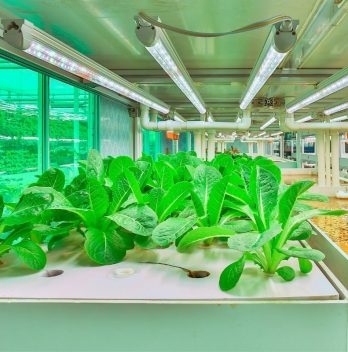
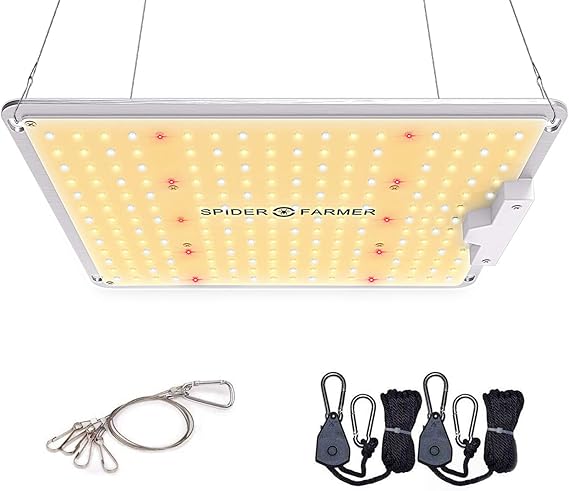
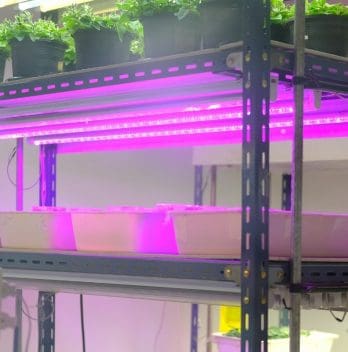
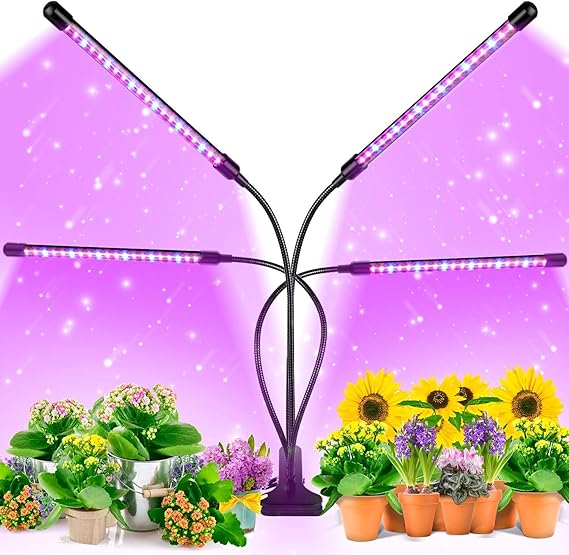
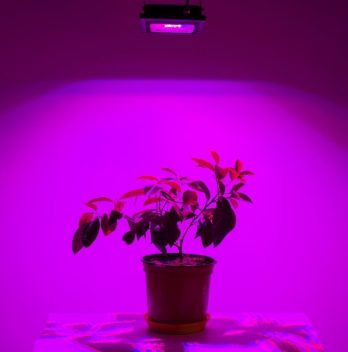
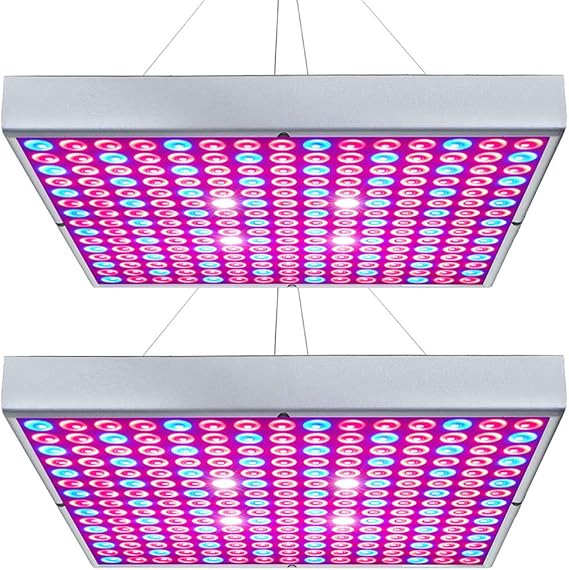
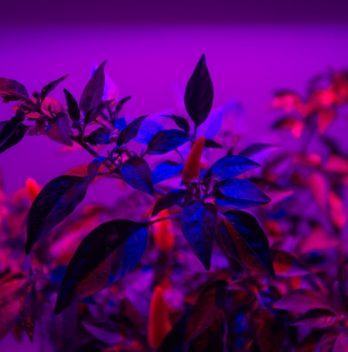
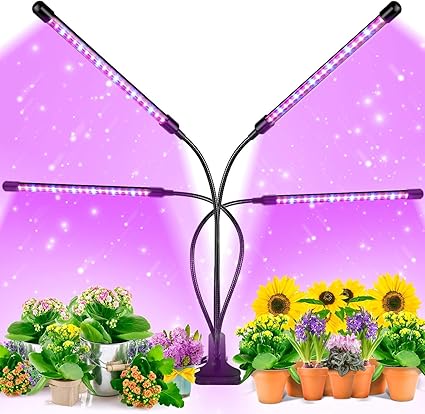
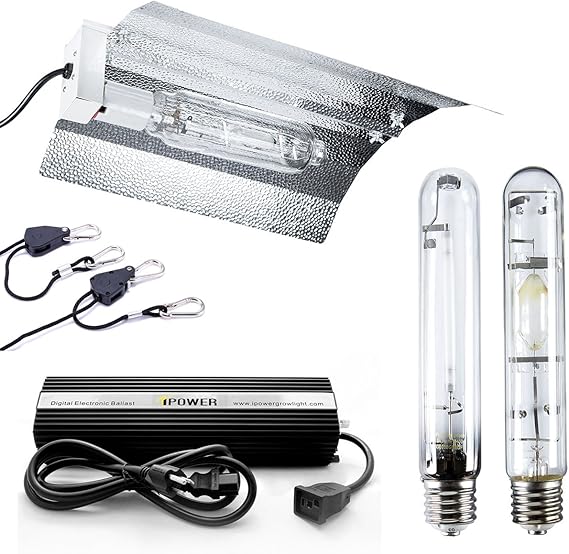
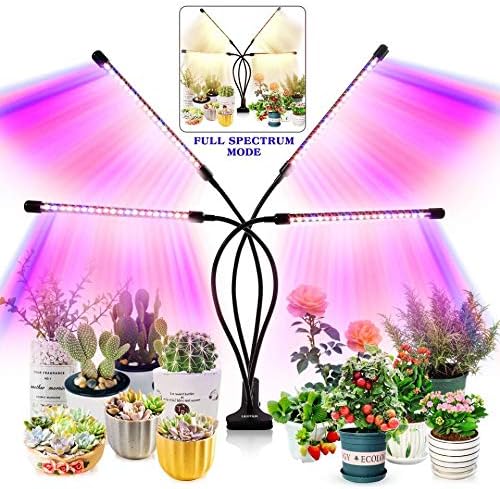
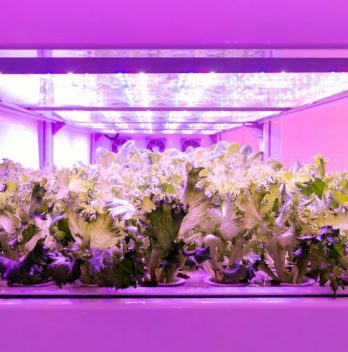
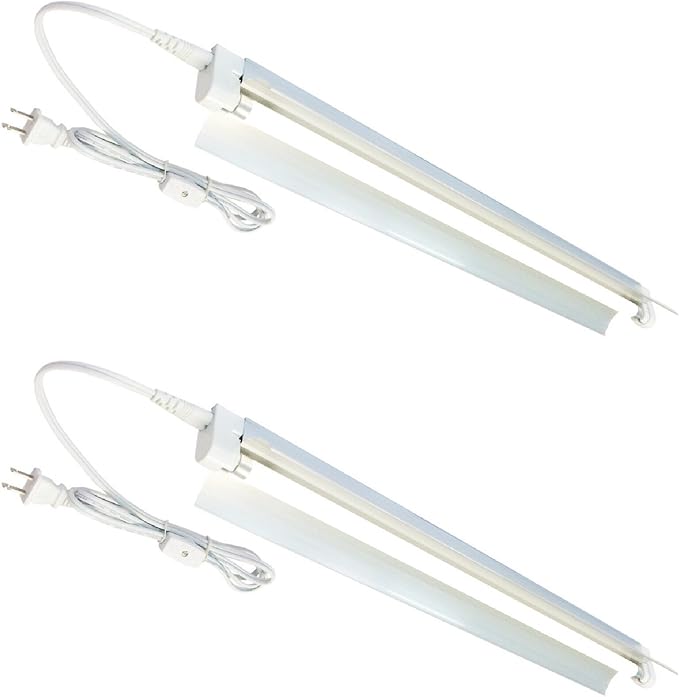
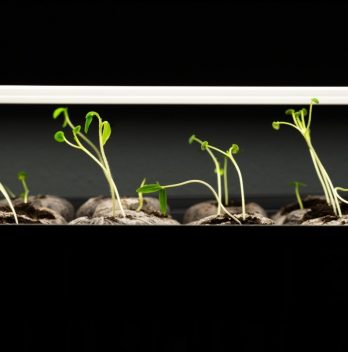
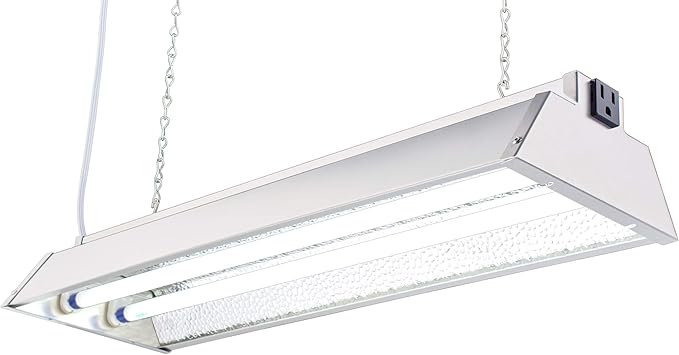
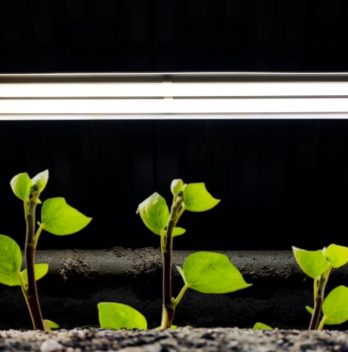
Grow lights are essential for successful indoor gardening, seed starting, and extending the growing season. Whether you’re growing herbs on your kitchen counter, starting seeds for spring transplanting, or maintaining houseplants in low-light rooms, the right grow lights make all the difference. Our grow light guides cover LED vs fluorescent options, light spectrum requirements for different plants, proper hanging height and duration, and energy-efficient setups. Learn how to choose grow lights for microgreens, seedlings, or full-season indoor vegetable production. From affordable T5 fluorescent strips to advanced full-spectrum LED panels, we’ll help you find the perfect lighting solution for your indoor garden.
Growing plants indoors has never been easier, thanks to modern LED grow lights. Whether you’re starting seeds, growing herbs year-round, or maintaining a thriving indoor garden, the right lighting makes all the difference. This guide covers the best LED grow lights for 2026 and what to look for when choosing one.
Why LED Grow Lights Are Essential for Indoor Plants
Natural sunlight provides the full spectrum of light that plants need for photosynthesis. When growing indoors, especially during winter months or in spaces without adequate natural light, LED grow lights replicate this spectrum to keep your plants healthy and productive.
LED technology has improved dramatically over the past few years. Modern grow lights are energy-efficient, produce less heat than older HID or fluorescent options, and last 50,000+ hours. If you’re starting seeds indoors or maintaining an indoor herb garden, quality lighting is non-negotiable.
Key Features to Consider
Full Spectrum vs. Targeted Spectrum
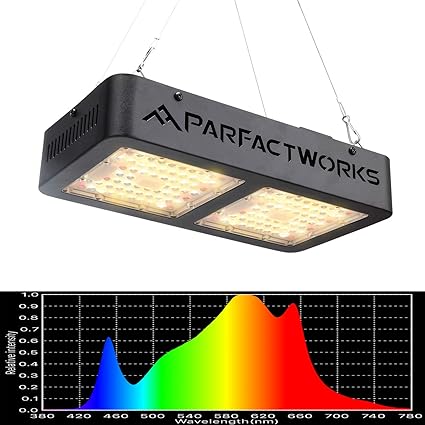
Full-spectrum LEDs mimic natural sunlight and work well for all growth stages—from seedling to flowering. Targeted spectrum lights focus on specific wavelengths (red for flowering, blue for vegetative growth). For most home growers, full-spectrum lights offer the best versatility.
Wattage and Coverage Area
Match the light’s wattage to your growing space. A 20-30 watt LED typically covers 1-2 square feet, perfect for small herb gardens or seedling trays. Larger setups need 100+ watts to properly illuminate 4-6 square feet.
Heat Output and Cooling
While LEDs run cooler than traditional grow lights, higher-wattage units still generate heat. Look for models with built-in fans or heat sinks to prevent overheating, especially in enclosed spaces.
Top LED Grow Light Picks for 2026
Best for Seedlings and Microgreens
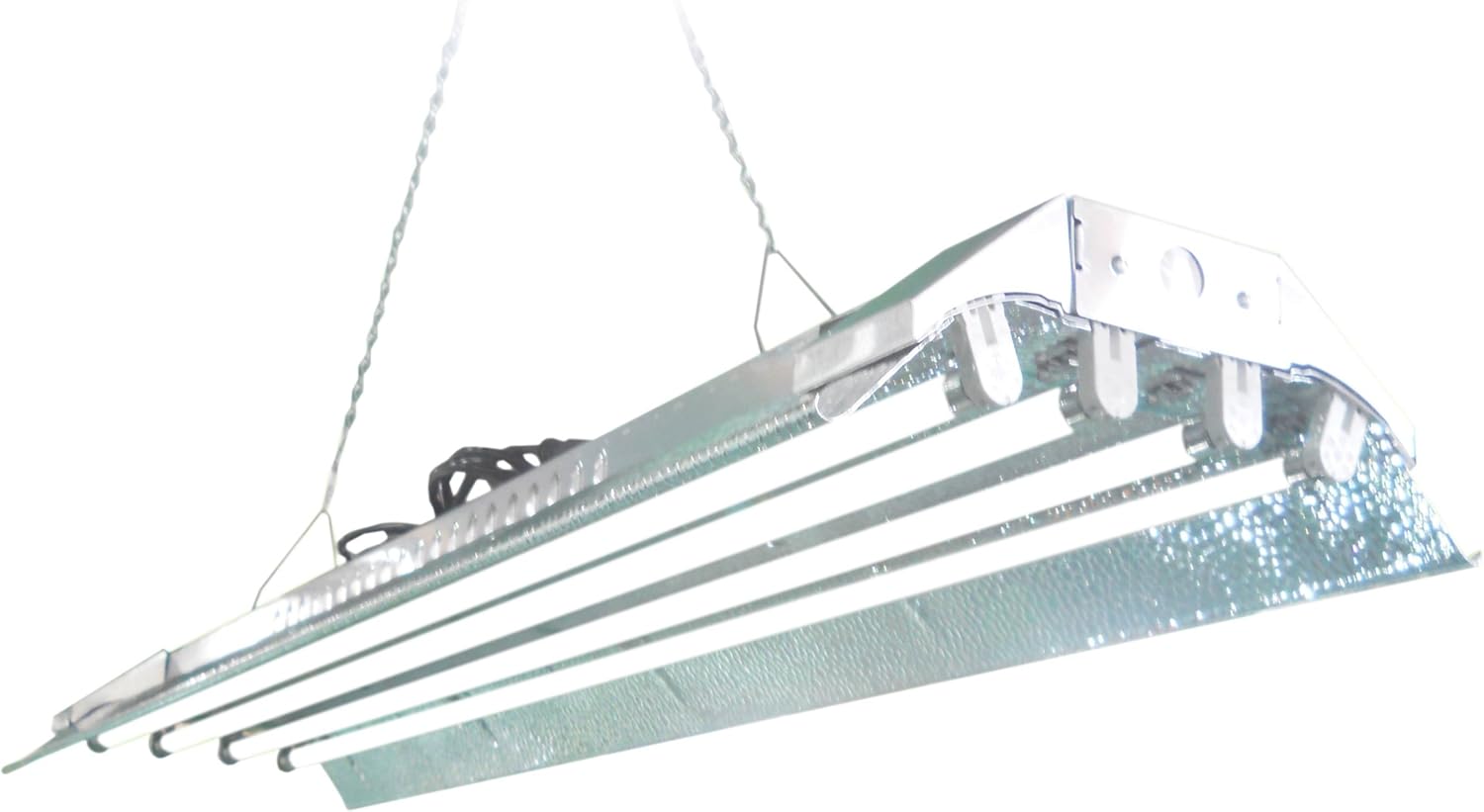
The Durolux T5 HO Grow Light excels at starting seeds and growing microgreens. Its 4-foot, 4-lamp design provides even coverage for standard seedling trays. The linking feature lets you daisy-chain multiple units as your garden expands.
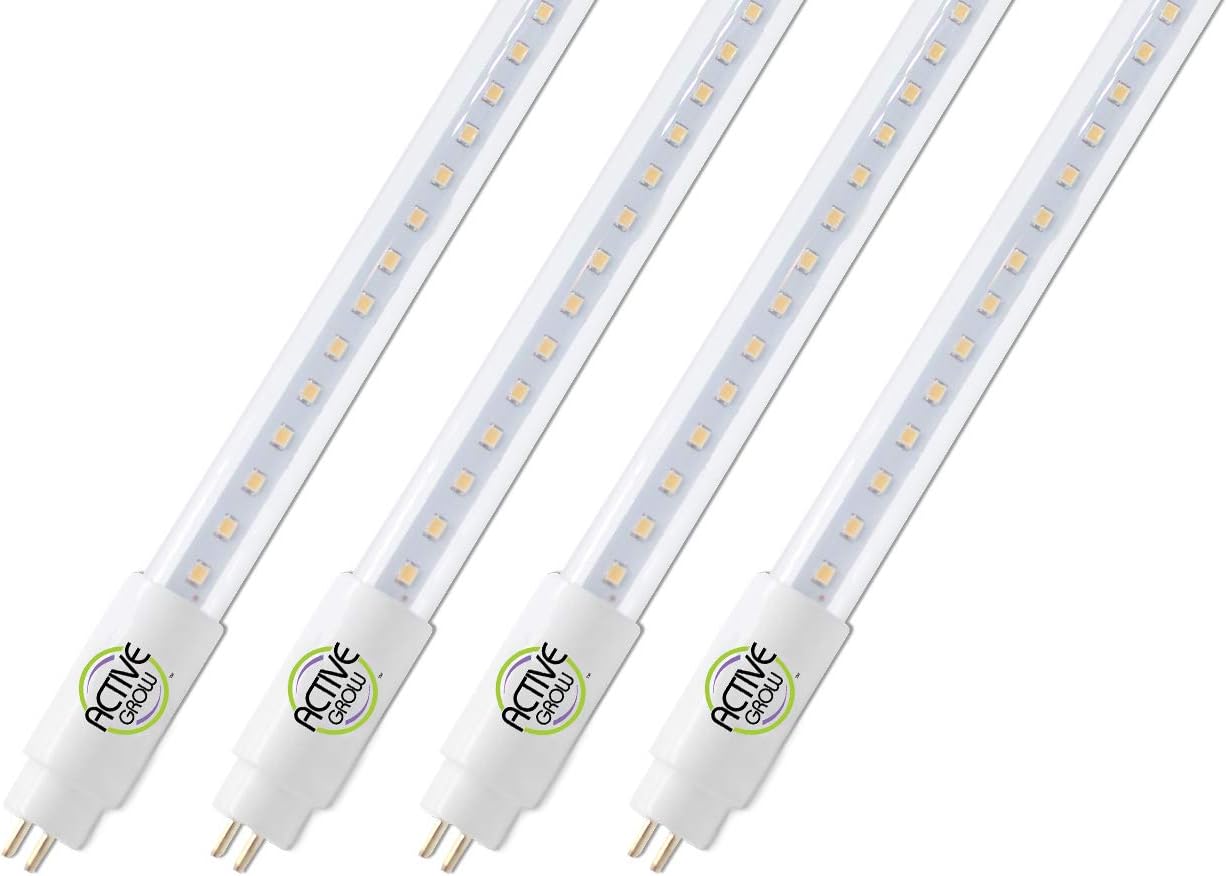
For smaller spaces, the Active Grow T8 LED Bulb fits standard fluorescent fixtures. At 22W per bulb, it’s energy-efficient and perfect for countertop gardens or growing microgreens at home.
Best Full-Spectrum Option
Full-spectrum panels work beautifully for mixed indoor gardens. Look for lights with adjustable heights so you can position them 6-12 inches above plant canopy as seedlings grow. This flexibility is crucial when growing basil indoors or maintaining herbs year-round.
Best Budget-Friendly Choice
Don’t overspend when starting out. Many affordable LED strips and panel lights under $50 perform admirably for small herb gardens or supplemental lighting. Focus on actual wattage (not “equivalent wattage” marketing), coverage area, and customer reviews.
Setup Tips for Maximum Results
Position lights correctly: Place LEDs 6-18 inches above plants depending on intensity. Seedlings need lights closer (6-8 inches), while mature plants tolerate 12-18 inches.
Timing matters: Most plants need 12-16 hours of light daily. Use a timer to maintain consistency—plants thrive on routine.
Adjust as plants grow: Raise lights as plants mature to prevent bleaching or heat stress. Check leaf color—pale or yellowing leaves often signal too much light.
Common Mistakes to Avoid
Don’t position lights too far away. Insufficient light intensity causes leggy, weak seedlings that stretch toward the light source.
Avoid leaving grow lights on 24/7. Plants need darkness for proper growth cycles—most benefit from 8-12 hours of “night.”
Don’t neglect other growing factors. Even the best grow light won’t compensate for poor soil, irregular watering, or inadequate ventilation.
Final Thoughts
The right LED grow light transforms any indoor space into a productive growing area. Whether you’re nurturing seedlings for spring transplanting or maintaining a year-round kitchen herb garden, these energy-efficient lights deliver consistent, full-spectrum illumination your plants need to thrive. Start with quality equipment matched to your space, and you’ll enjoy healthy, vigorous plants regardless of season or weather.
Fresh herbs at your fingertips—no backyard required. Whether you’re working with a tiny apartment or just want year-round access to basil and mint, indoor herb gardens are easier to set up than you might think. Here’s how to get started.
Why Grow Herbs Indoors?
Indoor herb gardens offer some serious perks:
Year-round harvesting regardless of weather
Save money on grocery store herbs (those plastic packages add up!)
Fresher flavor since you pick right before cooking
Air purification and a touch of green to brighten your space
Low maintenance compared to full vegetable gardens
Plus, there’s something satisfying about snipping fresh rosemary for your roast chicken instead of reaching for a dried jar.
6 Creative Setup Ideas
1. Classic Window Sill Garden
The simplest approach: line your sunniest window with small pots. South-facing windows work best. Use matching terra cotta pots for a clean look, or mix and match for character. Just ensure each pot has drainage holes.
2. Vertical Wall Planters
Short on counter space? Go vertical. Hanging pocket planters, wall-mounted rails, or even a repurposed shoe organizer can hold multiple herbs without eating up floor space. Perfect for kitchens where every inch counts.
3. Mason Jar Herb Garden
Mason jars look charming and work surprisingly well. Add a layer of pebbles at the bottom for drainage, fill with potting soil, and plant your herbs. Arrange them on a windowsill or mount the lids to a wooden board for a rustic wall display.
4. Tiered Stand Setup
A three-tier plant stand near a window gives you garden-style growing in a compact footprint. Rotate plants regularly so everyone gets equal light. This works great for renters who can’t drill into walls. For more on container gardening basics, check out our complete guide.
5. Hydroponic Systems
No soil, no mess. Countertop hydroponic systems like the Click & Grow Indoor Herb Garden Kit or iDOO Hydroponics Growing System handle lighting and watering automatically. Higher upfront cost, but nearly foolproof for beginners.
6. Repurposed Containers
Get creative with what you have—old tea tins, wooden crates, colanders, even coffee mugs. As long as you can add drainage (drill a few small holes in the bottom), almost anything works. Mismatched containers add personality.
Best Herbs for Indoor Growing
Not all herbs thrive indoors. Stick with these proven winners:
Basil – Loves warmth and light, grows fast
Mint – Nearly indestructible, but keep it contained or it’ll take over
Parsley – Tolerates lower light better than most
Chives – Compact and forgiving
Thyme – Drought-tolerant, great for beginners
Oregano – Thrives in containers
Cilantro – Prefers cooler temps, perfect for north-facing windows
Skip rosemary unless you have a very bright spot—it needs intense light to stay happy indoors. Our indoor gardening tips can help you choose the right herbs for your space.
Essential Growing Requirements
Light
Herbs need 6-8 hours of bright light daily. South-facing windows work best. If natural light is lacking, supplement with full-spectrum LED grow lights positioned 6-12 inches above your plants.
Watering
Most herbs prefer soil that’s slightly moist but never soggy. Water when the top inch feels dry. Overwatering kills more indoor herbs than anything else. Good drainage is non-negotiable.
Soil
Use a quality potting mix, not garden soil. Container mixes drain better and resist compaction. Add perlite if you tend to overwater—it improves drainage.
Temperature & Humidity
Most herbs are comfortable in the same temps you are: 60-70°F. Kitchens and bathrooms offer slightly higher humidity, which herbs appreciate. If your air is desert-dry, mist occasionally or use a pebble tray.
Common Mistakes to Avoid
Using decorative pots without drainage: That’s a recipe for root rot. Either drill holes or use cachepots (decorative outer pots with a plain nursery pot inside).
Crowding too many herbs together: Give each plant room to breathe. Packed pots compete for resources and increase disease risk.
Ignoring pests: Indoor herbs can still get aphids or spider mites. Check weekly and treat issues early with neem oil spray if needed. Learn more about organic pest control methods.
Never harvesting: Regular trimming keeps herbs bushy and productive. Don’t be shy—cutting encourages new growth.
Harvesting Your Herbs
Once your plants have at least six sets of leaves, start harvesting. Cut just above a leaf node (where leaves meet the stem) to promote bushier growth. Take no more than one-third of the plant at a time.
Morning harvests, right after dew dries, tend to have the strongest flavor. Use scissors for clean cuts—tearing damages stems and invites disease.
Final Thoughts
You don’t need a green thumb or fancy equipment to grow herbs indoors. Start small—pick three herbs you actually cook with, find them a bright spot, and water when needed. That’s 90% of the battle.
Your kitchen will smell better, your food will taste fresher, and you’ll save money on those overpriced grocery store herb packages. What’s not to love?
Fresh basil whenever you want it? Yes, please. Growing basil indoors isn’t complicated—you just need to give this Mediterranean herb what it craves: warmth, light, and a little attention. Here’s everything you need to keep basil thriving on your windowsill all year long.
## Best Basil Varieties for Indoor Growing
Not all basil is created equal when it comes to indoor growing. Some varieties adapt better to container life and lower light conditions than others.
**Top picks for indoors:**
– **Genovese Basil** – The classic Italian variety. Compact enough for pots, big flavor for cooking. – **Greek Basil** – Naturally small and bushy with tiny leaves. Perfect for windowsills. – **Spicy Globe Basil** – Forms a neat little mound, ideal for small spaces. – **Thai Basil** – Hardier than sweet basil and handles indoor conditions well.
Avoid large-leaf varieties like Lettuce Leaf basil indoors—they need more space and light than most homes can provide.
## Light Requirements: The Make-or-Break Factor
Here’s the truth: basil is a sun worshipper. It needs 6-8 hours of direct light daily to really thrive. A south-facing window is your best bet during spring and summer.
### Natural Light
If you have a sunny window, great! Place your basil as close to the glass as possible. Rotate the pot every few days so growth stays even. In winter, even south-facing windows often don’t cut it—days are short, and light is weak.
### Grow Lights
This is where most indoor gardeners level up. A simple LED grow light changes everything:
– Position lights 4-6 inches above plants – Run them 12-14 hours daily – Full-spectrum LEDs work best for herbs
A basic $20-30 grow light setup pays for itself in fresh basil within weeks. No more leggy, struggling plants in winter.
## Soil, Water, and Temperature Needs
### Soil
Basil wants well-draining soil—soggy roots equal dead basil. Use a quality potting mix (not garden soil) and make sure your pot has drainage holes. A 6-inch pot works great for a single plant.
Adding perlite to your mix improves drainage even more. Basil also appreciates slightly acidic to neutral soil (pH 6.0-7.0).
### Watering
The golden rule: water when the top inch of soil feels dry. Stick your finger in—if it’s dry, water thoroughly until it drains from the bottom. If it’s still moist, wait.
Common mistakes: – **Overwatering** – Leads to root rot and yellow leaves – **Underwatering** – Causes wilting and bitter-tasting leaves
Most indoor basil needs water every 3-4 days, but this varies with humidity and temperature.
### Temperature
Basil loves warmth (65-80°F is ideal). Keep it away from: – Cold drafts from windows or doors – Air conditioning vents – Temperatures below 50°F
If your basil sits near a cold window in winter, move it back a few inches at night.
## Pruning for Bushy Growth
Want a full, bushy plant instead of a tall, spindly one? Pruning is your secret weapon.
**Start early:** Once your plant has 3 sets of leaves, pinch off the top set. This forces the plant to branch out sideways instead of shooting straight up.
**Keep pinching:** Every time a stem develops 6+ leaves, pinch it back to 2 leaves. More branches mean more leaves—and more basil for you.
**Remove flowers immediately:** When basil flowers, it stops producing flavorful leaves. The moment you see flower buds forming, pinch them off.
## Harvesting Without Killing the Plant
Here’s where many people go wrong—they strip leaves from the bottom or harvest randomly. Do it right, and your plant keeps producing for months.
**The right way to harvest:**
1. Always cut from the top, just above a leaf pair 2. Never remove more than 1/3 of the plant at once 3. Harvest regularly (weekly) to encourage new growth
Think of it like giving your plant a haircut. Each cut triggers two new stems to grow from below. Harvest often, and you’ll have more basil than you know what to do with.
## Keep That Basil Going
Growing basil indoors year-round comes down to three things: enough light (get a grow light if needed), proper watering (don’t drown it), and regular pruning (pinch those tops). Nail these basics, and you’ll never buy sad grocery store basil again. Your pasta, pizza, and caprese salads will thank you.
One common issue indoor growers wrestle with heat. Ensuring your grow tents remain cool is of great importance so your plants can successfully make it to harvest time. So, we will be giving you the best tips on how to cool grow tents. Fortunately, there are various things you can do to manage heat and ensure your grow tent is kept cool. So, by the end of this article, you should be able to know how to maintain a cool grow tent for the optimal growth of your plant.
Tips on How to Cool Grow Tent
You must keep your grow tent cool and prevent building up excess heat. Too much heat can cause your plant to burn or even damage some of your growing equipment. Depending on the extent of heat you’re managing or the size of grow tent you have, you may require one or several methods to keep your grow tent cool. Therefore, ensure you take into account the extent of heat you’re handling to know the approach to take in solving the situation. However, even if the heat issue you have is not so big, we recommend you integrate more than one method for effective results. So, below are some of the best tips on how to cool grow tent:
1. Use an air conditioner
One easy and fast way to cool your grow tent is to use an air conditioner. If you’re using a small tent, you can use one small air conditioner. It can be placed outside, close to your small grow tent in the same room you placed your tent. However, if you’re using a bigger tent, you will require a bigger air conditioner. The only downside to this is that an air conditioner may cost you more electricity usage especially if your growing on a large scale. But all in all, using an air conditioner to cool your grow tent is one of the best and most effective methods you can go for.
2. Inline and exhaust fans
Another great method of cooling grow room tent is by making use of a combination of inline and exhaust fans. This will cycle in and out of the air in your tent. These fans work by bringing in fresh air into the grow tent and this is done by an inline fan. While the exhaust fan moves the inside air, which is usually hot, outside the grow tent.
3. Change your grow light to LED
If you continue to have heat problems in your grow tent, you may want to check the type of grow light you’re using. Some grow lights such as household CFL, HID, HPS, etc, produce more heat. Switching to grow light that will produce heat lesser heat (such as LED, fluorescent grow light, etc) may be required. These grow lights will even save you energy as they consume less power and are more effective for growing plants. However, if you plan to stick with other types of grow light that emits more heat, you will have to put in extra work to manage the excess heat.
4. Use oscillating fans
Ensure you set up fans inside your grow tent. If you’re using a small tent, one or two portable oscillating fans are enough. If you however have a bigger tent, you will require several oscillating fans to cool down your grow tents. As you’re planning to purchase your grow light, always add fans to these plans. The wattage of your grow light will determine how many fans to use. Higher grow light wattage will require more fans and vice versa.
5. Proper ventilation of tents
Generally, your grow tent should have proper ventilation such as inlet and outlet vents. Not just that, your grow tent should also have regular vents which may have layers of mesh covering that allow airflow. The combination of inlet and exhaust fans with these vents makes it more effective.
6. Proper ventilation for grow lights
Grow light with proper vent allows cool air to be passed across the grow light during operation. We recommend you always go for grow light that has vents on all sides. Set up the necessary fans towards your grow light vent to allow the passage of cool air across the grow light.
How to Heat Up Grow Tent
As well as cooling down your grow tent, you may also want to know how to heat your grow tent. Here are some easy ways to ensure your grow tent remains warm enough during the colder seasons.
Location. Try moving your grow tent inside to another room, or changing the ventilation. Doing one of these options will instantly provide warmth for your grow tent.
Use More Light. An easy way to get warmth is to add more light. As long as the light is evenly spread throughout your grow tent, this is a sensible option.
Heater. Heaters are only effective in smaller rooms as they don’t release too much heat. But if you have a small grow tent, this would be ideal.
Lower Your Fans. If you use your fans less often than usual, it’ll be warmer than usual. You could also install a thermostat in your grow tent, but this isn’t often recommended.
Air Diffuser. Create your own air diffuser by using ducting and running it around your grow tent.
How to Add AC to Grow Tent
The easiest way to add AC to your grow tent is to use a portable or small air conditioning unit. If you use one of these, you can simply wheel it into your grow tent. This is ideal if you don’t want to spend time installing AC units.
Best Small AC for Grow Tent
There’s a huge selection of portable AC units to use for your grow tent. However, I’ve found that some work far better than others in grow tents. Here are two of my favorites. The first is the Serene Life SLPAC10 Portable Air Conditioner. It can be used as an AC unit, fan, or dehumidifier. It can cover around 500 feet and has a voltage capacity of 120V. It works best in a 5×9 grow tent. It is known for being quite a noisy AC unit, so if you’re sleeping or working near your grow tent, this unit may not be ideal. However, it’s great at reducing humidity and controlling the temperature in the tent. The second is the Black & Decker BPACT12WT Portable Air Conditioner. It can be used as an AC unit, fan, or dehumidifier. It can cover around 500 feet and has a voltage capacity of 110V. It works best in an 8×8 grow tent. Much like the first, it is known for being noisy; but unfortunately, I’ve found this the case with most AC units. However, it’s easy to use and maintain; as well as great at controlling humidity.
DIY AC for Grow Tent
You can even make your own AC for your grow tent. To do this, you’ll need to put in time and effort and have varying equipment. For this, you’ll need the following equipment:
ducting
drill
hose
fan
bucket
cooling pads
water pump
Now all you need to do is:
Drilling. Grab your 5-gallon bucket and fill it with 2 gallons of water. Make a mark where the water reaches and drill holes just above the line you’ve marked. Only make as many holes as you can without damaging the bucket.
Cooling Pads. Cut your cooling pads to size. Around 33″x13″ is ideal. Glue together.
Hose. Connect your house by using tubing to fit the size of your pump. Make holes every 1-2 inches.
Water Pump. Use a 12V water pump and connect the hose to check it works adequately. Cover your 5-gallon bucket with a lid.
Fan. Use a 12V fan; the lower the better, as this continually be running. You can place the fan beneath the lid.
Add Ducting. Place your DIY AC unit outside the tent and add ducting to insert into the entrance of your tent.
Final Thoughts: How to Cool Grow Tent
With that said, we do hope you have learned some tips on how to keep your grow tent cool. Remember, for an effective result; ensure you go for more than one option or technique we listed above. Do you have any tips or tricks for cooling down a grow tent? If so, please feel free to let us know in the comments below. And remember, sharing is caring!
FAQs
How hot is too hot in grow tent?
The question of whether or not there’s a limit to how hot a grow tent should be has been discussed on this site many times. The problem is that the answer is different for everyone, depending on their tolerance level and what kind of grow they’re doing. I’ve seen some grow tents that are so hot that you can barely walk into them.
I’ve read that the heat should be between 55-65 degrees, but there are other sources that say that the heat should be around 50-55 degrees.
How do I keep my grow tent cool?
If you were growing outside you wouldn’t have to worry about keeping your plants cool. If your plants were outside they would naturally cool the air down in their leaves.
However, in a growe tent you do need to take precautions. There are a couple of ways you can keep your grow tent cool. You can use an AC unit to cool the room, or you can use fans to circulate the air in the room. The best way to keep your grow tent cool is to use an AC unit. A properly sized AC unit will keep your grow room cool enough for you to be comfortable in the room and keep it cool enough for your plants to thrive.
It is not always easy to find the right grow tent that will suit your needs, and this affects the way that heat is dispersed throughout the inside. Many growers end up with a grow tent that does not fit their needs or they end up having to spend money on something that is not a good investment. When selecting a grow tent you should consider the following: Size You want to make sure that you purchase a grow tent that is the correct size for your needs. It is a good idea to get a grow tent that is the same size as your current grow tent.
How do I know if my plants are too cold?
Cold temperatures can cause damage to some plants. Plants that are too cold are less likely to bloom, grow and develop healthy buds and leaves. You can tell if your plant is too cold by the way it looks, whether or not its leaves are wilting and the color of the soil.
When starting out growing various plants indoors, different questions may pop into your mind. Questions such as “how many plants can I grow per 1000 watt light?”.
Every grower wants to maximize their yield after all the hard work they put into their indoor garden. Providing your indoor plants with light is very essential for their development. High-pressure sodium (HPS) lights have been in existence for almost 50 years, and are some of the most widely used grow lights. They have been providing light energy for indoor plants growing needs.
Now, you must get the right plant coverage for the particular bulb wattage you have. This is why we are going to be looking at how many plants you can grow per 1000 watt light. We will also be looking at other grow light plant coverage for 1000w. So, read on to find out.
How Many Plants for an a1000-Wattt HPS?
The light wattage will decide how much area or the coverage area you can light up. So, for how many plants for a 1000 watt HPS bulb? The answer should be around 5 by 5-foot or 25 square feet.
Even though everyone has their methods, it all boils down to what method works for you. Some growers have boasted of growing about 6 to 9 plants using 1000-watt HPS. Some even grow smaller plants while using the SCROG and SOG techniques to manage space.
How Many Plants per 1000 Watt Light?
Various grow lights will have a coverage capacity depending on their wattage. Let’s take a look at some 1000-watt to grow lights and their plants’ coverage capacity:
· 1000 watt LED grow light plant coverage capacity
A 1000-watt LED grows light plant coverage capacity will also be around 5 by 5 feet or 25 square feet area. You should also take note of the quality of the LED to-grow light you’re using as some lights are more efficient than others. Different brands will offer different benefits to your plants.
Another important thing to understand is what is actually meant by a 1000-watt LED. The meaning of a 1000-watt LED is referred to as the equivalent of a 1000-watt HID light. The only difference is that this LED light consumes less than 1000 watts of light.
We have what we call LED actual wattage and labeled wattage. The labeled wattage of the LED growth light is written in bold words by the manufacturer. The actual wattage is the actual amount of power the LED light draws and it’s not usually up to the labeled value.
For instance, a 1000-watt LED grows light actually wattage maybe around 500 to 700 watts but will give you an output that almost equals a 1000-watt HID. You can find the actual LED wattage value if you dig through the manufacturer’s manual.
Thus, this shows that LED grgrowthights are more efficient by offering you more benefits while saving you power consumption. So, the coverage area of LED actual wattage of 500 to 700 will also be a 5 by 5-foot area.
· 1000 watts for other HID grow light plant coverage
We have looked at how many plants for a 1000 watt HPS will be. So, let’s discuss other 1000 watt HID bulb plant coverage (such as CMH and MH).
The difference between HID light coverage and LED light coverage is not so much. 1000 HID watt coverage offers roughly a close range of coverage area the only difference is the HID reflector used.
Umbrella reflectors for instance will offer you a big light coverage area. However, the light intensity will not be so great. Other focused reflectors such as a hood will offer you a smaller coverage area with more light intensity.
Taking a look at the types of HID bulbs we have, here is their plant coverage capacity:
Ceramic Metal Halide (CMH): even though 1000-watt CMH bulbs may be scarce (the common watt seen is 315w), the ones that are actually 1000 watts will have plant coverage of about 5 by 5 feet area.
Metal Halide (MH): for a metal halide bulb, the plant coverage is about 7 by 7 area feet for vegetative growth. While for the flowering phase, the coverage area is about 5 by 5 feet. However, we recommend not using a metal halide bulb for the flowering phase. You should rather use HPS grow light if you want big buds and yields.
How Many Plants per Light: Factors to Consider
Now, talking generally about the number of plants to be grown per grow light, we would say 1 to 8 plants. Make sure you don’t grow more than this number so you don’t limit your yields.
Following the right number of plants to grow per plant will give your plants a good chance to flourish thereby resulting in good yields. However, if you grow more than 8 plants using a single grow light, your plants won’t receive adequate light and space to grow.
Here are other factors to consider when deciding how many plants to be used using each grow light:
Power of grow light
You should also note that the power of your grow light will also be another determinant of how many plants you can grow using that light.
Condition of grow space
Another factor to consider when deciding how many plants to grow per light is the condition of your grow space. If your grow space already a bit receives natural light, then a not-so-strong grow light will be fine. You can even place your grow light higher to increase the coverage area.
Plant growth stage
The stage your plant is in will also have a determining fafactor inour choice of grow light. Some flowering plants require high light intensity, thus, a 5 by 5 feet coverage area should be ideal for 1000 watt light. On the other hand, vegetative plants such as lettuce can allow you to hang your light higher for larger coverage. You can use a coverage area of 7 by 7 feet for plants in their vegetative stage of growth.
1000 Watt HPS Grow Light Coverage
HPS grow lights are ideal for use in grow tents, large grow rooms, and greenhouses. 1000-watt HPS grow lights are the most powerful grow lights and have a wide coverage area of up to 49 square feet.
A 1000-watt HPS grow will effectively cover a growing area of 36 square feet. The difference between the maximum coverage area and effective coverage area is dependent on the depth and height of the plants you are growing. The denser the plants, the lower the coverage area your grow light will have.
Unlike other grow lights such as LED, HPS grow lights generate heat. So regardless of the growing area you are using the lights on, they must be mounted farther from the plants to avoid burning them.
Depending on the plants you are growing, you can mount an HPS grow light anywhere between 6 to 24 inches from the plant canopy. Make sure you do sufficient research on your plants so that you can create the ideal growing conditions for them and not burn them with grow lights. You will also need to set up an efficient ventilation system to help keep the humidity conditions right.
To even further improve your plant growth potential, you can set up your HPS grow lights with timers and light rails. The timers will help you keep the plants in a consistent light schedule. The lights will turn on and off at the same time every day. Light rails will help you to move the light fixtures along rows to ensure that all the plants get an equal amount of light in the entire growing area.
To get the best efficiency out of HPS grow lights, they should be replaced every 14 months.
LED Equivalent to 1000 Watt HPS
LED lights can be used in place of HPS. Due to the difference in the designs of these lights, however, there will be differences in the wattage replacements of these two lights.
LEDs are designed to have a lower energy consumption compared to HPS. Because of this, LEDs will have a lower wattage.
If you are looking for an LED equivalent to 1000-watt HPS, a 300-Watt LED High Bay is a good choice. Or you can replace a 1000-Watt Metal Halide Shoebox with a 300-Watt LED Shoebox. They can deliver the right amount of light required, last longer, and have reduced energy consumption.
Because of the differences in the equivalencies, it may not be best to base your decision on grow light wattage. Instead, you can use the number of lumens your plants need. Once you understand that, it becomes easy to find a replacement.
1000w DE HPS Distance From Plants
The distance at which you should place the grow light from the plants depends on the strength or intensity of the light. The stronger the light, the further you will need to hang them from the plants.
Because a 1000W DE HPS is quite a strong light, you should hang it at least 15 inches away. And if it is even stronger, place it further away but do not go farther than 30 inches. If you place the lights too far above the plants, they will love vitality.
A 1000w light produces a lot of light so you will need to err on the side of caution with this one. If your plants are starting to burn, you will notice the leaves starting to bleach. Some strains of plants will bleach easier or faster than others. So place your grow lights at an appropriate distance from your canopy to avoid heat stress. If you are using this light in a grow tent or a well-reflective light, you will not have much of a problem with this
Conclusion – How Many Plants Can I Grow per 1000 Watt Light?
Now, we have answered the question “how many plants can I grow per 1000 watt light?”, you should be well on your way to comfortable and confidently purchasing the best grow lights for your plants. Keep all considerations such as the density of the plants, grow light area, the distance between plants and light, and the height of your plants when purchasing a grow light. This way you will be guaranteed to get the best out of your grow lights while avoiding issues such as leaf burn.
So, we hope this post has been able to enlighten you on deciding your plant grow light coverage.
FAQs
How much area does a 1000 Watt HPS cover?
It isn’t set in stone, but the amount that it covers is thought to be around 49 square feet.
The best way to calculate how much area you will be heating with a HPS is by looking at the Watts. The power rating of your HPS (1000W) is divided by the number of hours in a day and the number of days in a year. If you are heating with a HPS for 24 hours a day 365 days a year, the area you are covering is about 1.5 acres.
The more you put distance between the light and the walls and ceiling the less wasted energy you will have.
How many plants can I grow with 1000 Watt HPS?
The answer is that it depends on how much light you are using, how much space you have and what your plants require. For instance, let’s say you have a 10′ x 20′ growing area. If you only use 4″ of light, you can grow about 15 plants.
This means you would need 2 bulbs to cover this area. But if you were to use 8″ of light, you could grow 50+ plants in this space. So, you could easily grow up to 200 plants with 8″ of light and a 1000 watt HPS bulb. Let’s take this one step further. Say you have a 2000 watt HPS, you could grow 500+ plants in this space. So the bottom line is you can grow just as many plants with a 1000 watt HPS as you can with a 2000 watt HPS.
So, it gets a bit tricky. The first thing you need to determine is how much light you will need. The number of plants you can grow will depend on the amount of light you have available.
How far should 1000 Watt HPS be from plants?
You should be at least one meter away. But, if you want to go further, go ahead.
What LED is equivalent to a 1000w HPS?
Black Dog PhytoMAX-2 could be easily considered an equivalent. The only issue is thet they are very expensive, and for this reason very few people go for them.
How much does it cost to run 1000 watt HPS?
You can get a 1000Watt HPS for $0.90/hour. However, you will need to do some research to find the right model and wattage, as well as getting a supply voltage of around 110V. I would recommend finding a manufacturer like Noctua or CLC or XSPC that makes HPS units for your particular requirements and then order online.
Selecting the best Kelvin for growing plants LED for your plants’ growing needs is one essential factor in an indoor garden. As we know, grow lights mimic the light provided by natural sunlight and this must be done in the presence of the correct light temperatures.
Your plants will flourish when they are exposed to the appropriate light temperatures so this is why you must ensure that you get it right. So, if you are wondering how to go about the best light temperature for your growing plants, we’ve got you covered.
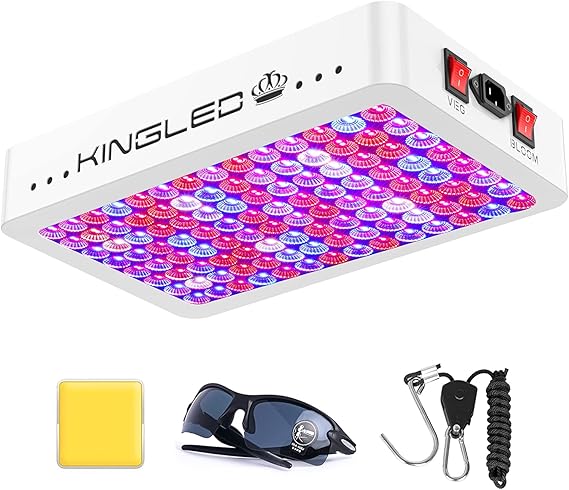
1500W LED Grow Light with Bloom and Veg Switch,Yehsence Triple-Chips (15W LED) LED Plant Growing Lamp Full Spectrum with Daisy Chained Design for Professional Greenhouse Hydroponic Indoor Plants
We earn a commission if you make a purchase, at no additional cost to you.
We are all about easy indoor gardening. So, by the end of this article, you should have an idea of the right color temperature for each of your plant growth stages and more.
What is a Grow Light Color Temp?
Grow light color temperature is the accurate light spectrum provided by a grow light and is required for each plant growth stage. It is a means of showing the appearance of the light which is supplied by a light bulb. It is essential for a grow light to contain the necessary spectrum so a plant can grow healthily and adequately.
Light is known as electromagnetic energy which is measured in wavelength. This wavelength can be seen in various visible light colors waves that vary from red, blue, and yellow, to green. Blue and red light are the colors mostly absorbed by plants for the photosynthesis process.
The color of light supplied by a particular grow light is known as color temperature and is measured in Kelvin (K). The Kelvin has a scale that ranges from 1,000 (warm or red) to 10,000 (cool or blue).
Kelvin color temperature scale
Grow light Kelvin rating or scale is a measurement of color temperature and it’s used to explain how different light temperature appears. Practically every light that comes with bulbs will be associated with Kelvin color temperature.
The Kelvin scale figures at the lower end offer hues of red. While on the other end, the Kelvin scale where the figure goes higher, it offers hues of blue.
Spectrums with low Kelvin ratings (around 2000K to 3000K) are also described as warm, while those with higher ratings (5000K or higher) are often referred to as cool.
Take, for instance, blue light is essential for vegetative growth. On the other hand, red light is required for the flowering stage and fruit production. Therefore, the color temperature will assist in deciding the best light temperature for your plant’s growing needs.
Plants contain various pigments they use in absorbing or reflecting certain light wavelengths. These pigments are used in the process of photosynthesis whereby plants make use of light energy to produce their food.
So, let’s take a look at two (chlorophyll and carotenoid) of these pigments involved in photosynthesis:
Chlorophyll: the green pigment contained in plants that allows them to manufacture their food is chlorophyll. It is the most abundant pigment found in plants, and chlorophyll A is responsible for the absorption of light energy.
Carotenoid: the second most important pigment is the carotenoid. Carotenoids also help plants take in light energy, which in turn, transfers the energy to chlorophyll.
The Best Grow Light Color Temperature For Growing Plants
Choosing the right color temperature for the various stages of your plants can be determined by the values on the Kelvin scale.
Also, different grow lights are configured in various ways. Some grow lights offer a full spectrum for your plants and will not require you to switch lights for different plant stages. Examples of such grow lights are LED lights.
While some grow lights are not configured to be full spectrum. Thus, you will be required to switch these lights as your plant enters its different growth stages. Examples of such grow lights are traditional lights such as fluorescent, HID, and so on.
Most of the LED grow lights have been we have in the market are configured with full spectrum. Therefore, you can use the same light for all your plant growth stages. The only thing you need to do is position the LED to grow lights distance to your plants’ canopy appropriately as they enter different growth stages.
So, let’s look at the required or best light temperature for your growing plants in their different growth stages:
1. Best kelvin for seedlings and clones
The best color temperature for seedlings and clones is the blue spectrum. If you’re using the traditional grow lights, choose daylight bulbs that fall on the higher end of the Kelvin scale. Use 5,000 and above Kelvin figure bulbs for your seedlings.
We recommend you use fluorescent bulbs for seedlings and clones because they don’t produce too much heat. The clone and seedling stages are the most fragile, and therefore need to be handled with care.
Other traditional lights such as the HID may also be used for your seedlings and clones. However, they produce a lot of heat. So you need to be extremely careful so they don’t burn your fragile plants.
2. Best kelvin for the vegetative stage for rowing plants
The vegetative stage of a plant also requires blue lights which are at the higher end of the Kelvin scale. Just like seedlings and clones, vegetative growth should use bulbs ranging from 5,000 to 7,500 on the Kelvin scale. However, the lighting needs to be more intense for vegetative growth.
3. Flowering and fruiting stage for growing plants
For the flowering and fruiting stage, your plant will require the red light spectrum which is at the lower end of the Kelvin scale. This light spectrum will encourage flowering, blooming, and fruiting.
Use light bulbs that range from 2,000 to 3,000 Kelvin values. HID lights such as high-pressure sodium (HPS) offer more of this red light spectrum. You can also use the LED full light spectrum for all plant stages.
Is Warm Light Good for Plants?
When shopping for grow lights, you will notice that they are labeled with numbers such as 2700K or 4000K. These numbers refer to the relative warmth or coolness of the light on the color spectrum. The higher the number, the cooler the light.
The growth of plant foliage is usually best around 6500k. However, they still need a period of warmer light of around 3000K to produce flowers, and eventually fruit.
So is warm light good for plants? The answer to this question depends on what you ultimately want to produce with your plants. If your goal is to produce seedlings, leafy green vegetables, or root crops, you need higher spectrum bulbs, which are the cooler light colors. But if you want to produce flowers, such as in the case with marijuana, or any other fruiting plants such as cucumbers, tomatoes, peppers, and lemons, you will require warm light which is in the lower spectrum. Warm white light is better and stronger on the red end of the spectrum.
Because lights require different lights for the different growth stages, it might be best if it gets a full spectrum LED, so you will not have to worry about switching lights as your plant progress.
3000K vs 5000K Grow Light
Both the 3000K and 5000K grow lights are in the white light spectrum. The difference is that 3000K is a warm white, whereas 5000K is a cool white.
A 3000K grow light bulb produces a soft white light which can also appear yellowish. One of the best uses for this light is in the bedroom as it gives a relaxing mood. For plants, a 3000K grow light is required for flowering, and thus fruit. 3000K is more efficient for flowering when counting grams per watt.
A 5000K grow light is ideal for plants in the vegetative stage of growth. The big advantage of this grow light is that it will help your plants to produce tighter internodes which will give you a more balanced distribution of light over the colas later.
Plant Light Requirements Chart
Different plants have different light requirements. Light is required by plants to produce chlorophyll for energy through photosynthesis. If they do not receive enough light, they will end up weak and pale. If a plant is overwatered, its roots will not grow enough to absorb the moisture.
To determine how much light your plant is receiving in the environment it is, there is a simple test you can use called the shadow test. This works especially well for indoor plants. Follow these steps to do so:
Get a large, blank piece of paper.
At the brightest time of the day, place the paper vertically and facing the light source, at the precise height and location you would like to place your plant.
Place your hand a few inches away from the paper.
Use the Light Requirement Chart (below) to determine the type of lighting that your plant will be receiving
Conclusion – The Best Kelvin for Growing Plants LED
This article has shown us that light temperatures are essential for plant development. It has also shown that there are suitable Kelvin ranges for the different growth stages that plants go through. It is important to make sure that you stick to the relevant Kelvins at the appropriate growth stage to get the best out of your grow lights and your plants.
Using the right Kelvin for your growing plants will also help you save costs. We hope this information will be of great help to you and your plants on your growing journey.
Happy growing!
FAQs
Is Warm light or cool light better for plants?
In the case of growing houseplants, you should be aiming to use cool light. Cool light comes from a combination of the sun and air conditioning. The sun produces light that is predominantly yellow-orange, with a very slight blue tinge, and the air conditioning adds red and far-red wavelengths.
Cool light is best for plants because it mimics sunlight, which they need to grow. The sun produces both warm light and cool light. Warm light is a combination of both blue and yellow wavelengths. Q: Do you know how to grow indoor plants in winter? A: Yes. You can grow houseplants i
Is 5000 Kelvin good for plants?
Yes, 5000K is enough for most plants. But don’t use 5000K as the maximum. You can get some plants that flower really well under 2000K, such as geraniums and some begonias. There are many other plants that need a higher light spectrum. If you want to grow plants indoors, then your best bet is to set your LED to about 5500K, but not at full power. If you do this, then you can turn the lights off for 4-8 hours at night, which will give you enough light to get by without turning on the lights. Then you’ll have a nice light spectrum in the middle of the day.
Will LED lights help plants grow?
One of the biggest questions that people have about growing plants indoors is whether it’s possible to grow plants in an LED light. The short answer is yes, you can, but there are some things to consider before you make the switch.
It’s not as simple as just putting a plant in an LED light and leaving it there all day, because not all LEDs produce the same amount of light. A lot depends on the type of LED bulb used, the wattage and the number of bulbs used. There’s also the matter of how far away your plants are from the bulbs.
Does regular LED light help plants grow?
These lights have different wavelengths that affect plant growth. Red light stimulates photosynthesis. Blue light promotes cell division. White light is a mixture of red and blue. Now, we can use all three colors together to create the spectrum of light. There are many types of LED lights. The most common type is the LED strip. It has red, blue, and white LEDs. We can also put them in groups. For example, we can use a single red LED on one side of the plant and a single white LED on the other. This will make it easier to grow plants.
The red and blue light are a great combination and they are needed as your plant matures. They are especially required for both the vegetative and flowering stages. This red and blue light combination enhances the production of more leaves and crops.
Violet Or Purple Light
Violet light or purple light is an additional light that your plants can benefit from. These colors have the shortest wavelength and high energy which enables the plant to be able to absorb them well. The light energy in the violet color results in a sweet aroma, and great plant color, and is a flavor booster in vegetables and fruits.
Therefore, you can use this light at any stage of a plant to boost its color and improve its taste. Violet light will also enhance the number of antioxidants in a plant.
Greenlight
The effect of green light on plant growth is not so significant. The reason is that most plants are already green in color and thus will reflect green rather than absorb it.
Yellow Light
Yellow light does not have much effect on the growth of a plant. It is just like green lights which are difficult for plants to absorb.
Ultraviolet Light
Ultraviolet light is known to be harmful to humans. So, just as ultraviolet light is harmful to humans, high exposure is also bad for plants. Your plants will develop with little exposure to ultraviolet light.
How Do You Use Grow Lights For Outdoor Plants?
Light is an absolute necessity for any and every plant, and adequate light is a must for the efficient growth and production of any plant.
Sunlight is the natural and most used source of light for plants. However, sometimes plants even when planted outside may not be able to receive the adequate amount of sunlight that they require to grow. This could be for example, when plants are planted or grow under taller trees or a canopy of trees. It may also be if plants are in an area of a garden that receives short hours of sunlight exposure.
The use of grow lights outdoors is not very common but can be a good way to give plants supplemental light to help improve growth and productivity.
There are several considerations to keep in mind if you are going to use grow lights outdoors;
Because these lights will be outside where they will be exposed to environmental conditions such as rain and winds, make sure you get waterproof and secure the lights properly to prevent them from blowing away.
Be careful to position the lights in a place where they won’t get interference from other plants, shade, etc.
Remember that you do not need to have to grow lights on at all times, put them on a timer so that your plants only get the light that they need. This will also help you save money.
What Plants Don’t Like Grow Lights?
Most plants need light (whether natural or artificial) to grow efficiently. This applies to both indoor and outdoor plants. Most plants would die without getting a bit of light exposure.
There are however certain plants that do well without light and are mostly planted as indoor plants, or in areas that do not have a lot of sunlight. These plants would be good for a beginner who is starting out or still learning how to take care of plants.
Here are some of these plants;
Bromeliad (Bromeliaceae)
Chinese Evergreen (Aglaonema)
Cast Iron Plant (Aspidistra elatior)
Dracaena (Dracaena)
Dumb Cane (Dieffenbachia)
English Ivy (Hedera helix)
Peace Lily (Spathiphyllum)
How Do You Put Grow Lights on Indoor Plants?
The best place to position grow lights on indoor plants is directly above the plants. This is so that the plants can grow upright.
If the lights are placed, for example on the side of the plant, it will lean towards it to “follow” the light which is not ideal. Placing the grow light on top of the plants will help ensure an even distribution of light to the plants. This is the best way to put grow lights on indoor plants.
How Long Should I Leave My Plants Under Grow Lights?
Grow lights do not need to be on all the time. The idea with them is that they should replicate the light conditions that would be provided by sunlight. They aim to create a similar day and night cycle as the natural one.
The length of time you should leave your grow lights on depends on how light-hungry your plants are. So do a bit of research to find out how much light your plant needs for optimum growth and health. Generally grow lights are left on for anywhere between 8-10 hours a day
How Far Should LED Grow Light Be From Plants?
The distance between LED grow lights and plants depends on the intensity of the light. For LEDs of 200 watts should be placed between 12-20 inches, and those of high wattage like 1000 watts should be placed 36-46 inches from the top of the plant.
Does a Plant Grow Faster in Sunlight or Artificial Light?
A plant would grow faster under artificial light than in sunlight. This is because artificial light can be adjusted to best suit the needs of the plant at that specific time, and therefore help to improve the growth and production of that plant.
Why Is Green Light Bad For Plant Growth?
Some studies suggest that green light makes plants behave as if they’re growing in poor environments that have a lot of shade. This could be the cause of plants having stunted growth and development if this green light is used on them.
Green light is reflected by plants, which is why they appear green. And because this green light is reflected, plants absorb very little of it. Because of this, it is thought to have minimal to no use for plant growth, particularly in the processes of photomorphogenesis and photosynthesis.
The role of green light for plant growth is yet to be widely explored as there are no definitive studies on its importance.
Full spectrum LED lights include green light, it is however unclear how useful it is for stimulating growth.
– The topic has yet to be widely studied. While full-spectrum LED lights include green light, it’s unclear how useful green light is for stimulating plant growth.
Currently, many growers use green LEDs to check their plants for things such as pest infestations or damage during the dark cycle of plant growth. Greenlight mimics shade or moonlight, so these lights can be used without interfering with the plant’s cycle.
How Does Blue Light Affect Plant Growth?
Blue light is referred to as radiation and has wavelengths between 400 and 500 nm. This wavelength is in the visible spectrum and has high energy which greatly affects photosynthesis, plant growth, and flowering.
Blue light is not as efficient as other lights in the electromagnetic energy wavelength, it is however still necessary for the growth of plants.
Another important function of blue light is regulating the plant stomata. Stomata are the pores in the dermis or skin of the leaves and stems of plants, which are important for gas exchange. These pores open and close, allowing the intake of carbon dioxide and the release of oxygen. As this process is essential for photosynthesis, it makes blue light necessary.
The shorter wavelength of blue light makes it very important in the processes that increase vitamin levels in plants, the quality, as well as overall plant health. Used in conjunction with red light, blue light can serve as a regulator for plant flowering.
How Does Yellow Light Affect Plant Growth?
Yellow light by itself plays a trivial role in photosynthesis and therefore plant growth or flowering, it is, however, useful in combination with other colors.
Much of the yellow light is reflected together with the green light. Because of this, placing a plant under yellow light will stunt its growth and development. If seedlings are given yellow or orange light alone, they will not be able to create carbohydrates, and so will not grow well or thrive.
In one study, however, yellow light has been found to have a positive impact on bioactive flavonoid accumulation in some herbs. This could mean that it just has not been studied enough and its effects are not well understood yet.
What Color Makes Plants Grow Faster?
Having discussed in detail all these different colors and their roles in plant growth, you are now probably wondering what the best color for plants that will affect their growth is. Simply put, the best color is a combination of red and blue light. Red light helps to increase plant biomass. The blue light on the other hand controls the flow of chloroplasts in the cells, which is responsible for oxygen transmission and also regulates the stomata opening
Blue light is ideal for the early plant stage such as seedlings. As your plant matures, the red and blue light colors are combinations excellent for your plants’ growth. That is why red-blue grow light combinations are popular on the market.
Does The Color Of Light Affect Plant Growth? – Final Say
The colors of light contribute a lot during different growth stages in a plant’s life cycle. Knowing what color grow lights to purchase, and which to use for each growth stage, as well as knowing which colors to avoid is absolutely crucial to the success of your plants.
The extensive information provided in this article will set you well on the path to success with this subject. If you go to a store and are still unsure, ask the light expert at the shop so that you can be more confident with your purchase.
The most important point to remember is that a combination of blue and red light is best for plants, colors such as green and yellow however are not ideal. Full spectrum growth lights are sold with the whole light spectrum, as the light suggests, and you will never go wrong with them.
Happy gardening.
FAQ’s
How does the color of light affect plant growth?
The most important factor in determining plant growth is sunlight. Plants need light to grow. However, the quality of light that they receive has a huge impact on their growth. Light is made up of electromagnetic radiation. The wavelength or color of light determines the color of light. For example, red light (in the visible spectrum) is longer than blue light (in the visible spectrum), which is why many plants absorb it in heaps.
The color of light affects all life on Earth. Light is composed of electromagnetic radiation, including visible light, ultraviolet light, and infrared light. These wavelengths of light are absorbed by plant chlorophyll, which helps plants process sunlight and produce energy. When light is in the blue-green range, it is called blue light. When light is in the red-orange range, it is called red light. When light is in the green range, it is called green light.
When light is in the yellow-orange range, it is called yellow light. When light is in the violet range, it is called violet light.
How does color of light affect photosynthesis?
Color of light affects photosynthesis in a plant. Green and red light stimulate the plant to grow more. Blue light stimulates the plant to grow less. If the plant is not exposed to blue light, it will grow more than if it is exposed to blue light.
What color of light is most effective for plant growth?
The answer to this question depends on the type of plant and its position in the light spectrum. Plants use light to manufacture energy from the sun’s rays, and they use light to make the food they need for survival. The light color that a plant needs is determined by its specific needs for growth and development.
Which plant uses blue light to grow more?
The answer is the plant fern. The plant fern is a small green plant that grows in moist soil. It is very similar to a plant called moss.
What color light is best for germination?
You can use any type of high intensity lighting you want, but the light spectrum emitted by your bulbs matters.
High-pressure sodium bulbs emit more blue light than other types of bulbs. This makes them effective at germination but not so good for later development. Halogen bulbs emit a lot of red and yellow light, which is useful for later growth but may not be effective for germination.
The red and blue light are a great combination and they are needed as your plant matures. They are especially required for both the vegetative and flowering stages. This red and blue light combination enhances the production of more leaves and crops.
Violet Or Purple Light
Violet light or purple light is an additional light that your plants can benefit from. These colors have the shortest wavelength and high energy which enables the plant to be able to absorb them well. The light energy in the violet color results in a sweet aroma, and great plant color, and is a flavor booster in vegetables and fruits.
Therefore, you can use this light at any stage of a plant to boost its color and improve its taste. Violet light will also enhance the number of antioxidants in a plant.
Greenlight
The effect of green light on plant growth is not so significant. The reason is that most plants are already green in color and thus will reflect green rather than absorb it.
Yellow Light
Yellow light does not have much effect on the growth of a plant. It is just like green lights which are difficult for plants to absorb.
Ultraviolet Light
Ultraviolet light is known to be harmful to humans. So, just as ultraviolet light is harmful to humans, high exposure is also bad for plants. Your plants will develop with little exposure to ultraviolet light.
How Do You Use Grow Lights For Outdoor Plants?
Light is an absolute necessity for any and every plant, and adequate light is a must for the efficient growth and production of any plant.
Sunlight is the natural and most used source of light for plants. However, sometimes plants even when planted outside may not be able to receive the adequate amount of sunlight that they require to grow. This could be for example, when plants are planted or grow under taller trees or a canopy of trees. It may also be if plants are in an area of a garden that receives short hours of sunlight exposure.
The use of grow lights outdoors is not very common but can be a good way to give plants supplemental light to help improve growth and productivity.
There are several considerations to keep in mind if you are going to use grow lights outdoors;
Because these lights will be outside where they will be exposed to environmental conditions such as rain and winds, make sure you get waterproof and secure the lights properly to prevent them from blowing away.
Be careful to position the lights in a place where they won’t get interference from other plants, shade, etc.
Remember that you do not need to have to grow lights on at all times, put them on a timer so that your plants only get the light that they need. This will also help you save money.
What Plants Don’t Like Grow Lights?
Most plants need light (whether natural or artificial) to grow efficiently. This applies to both indoor and outdoor plants. Most plants would die without getting a bit of light exposure.
There are however certain plants that do well without light and are mostly planted as indoor plants, or in areas that do not have a lot of sunlight. These plants would be good for a beginner who is starting out or still learning how to take care of plants.
Here are some of these plants;
Bromeliad (Bromeliaceae)
Chinese Evergreen (Aglaonema)
Cast Iron Plant (Aspidistra elatior)
Dracaena (Dracaena)
Dumb Cane (Dieffenbachia)
English Ivy (Hedera helix)
Peace Lily (Spathiphyllum)
How Do You Put Grow Lights on Indoor Plants?
The best place to position grow lights on indoor plants is directly above the plants. This is so that the plants can grow upright.
If the lights are placed, for example on the side of the plant, it will lean towards it to “follow” the light which is not ideal. Placing the grow light on top of the plants will help ensure an even distribution of light to the plants. This is the best way to put grow lights on indoor plants.
How Long Should I Leave My Plants Under Grow Lights?
Grow lights do not need to be on all the time. The idea with them is that they should replicate the light conditions that would be provided by sunlight. They aim to create a similar day and night cycle as the natural one.
The length of time you should leave your grow lights on depends on how light-hungry your plants are. So do a bit of research to find out how much light your plant needs for optimum growth and health. Generally grow lights are left on for anywhere between 8-10 hours a day
How Far Should LED Grow Light Be From Plants?
The distance between LED grow lights and plants depends on the intensity of the light. For LEDs of 200 watts should be placed between 12-20 inches, and those of high wattage like 1000 watts should be placed 36-46 inches from the top of the plant.
Does a Plant Grow Faster in Sunlight or Artificial Light?
A plant would grow faster under artificial light than in sunlight. This is because artificial light can be adjusted to best suit the needs of the plant at that specific time, and therefore help to improve the growth and production of that plant.
Why Is Green Light Bad For Plant Growth?
Some studies suggest that green light makes plants behave as if they’re growing in poor environments that have a lot of shade. This could be the cause of plants having stunted growth and development if this green light is used on them.
Green light is reflected by plants, which is why they appear green. And because this green light is reflected, plants absorb very little of it. Because of this, it is thought to have minimal to no use for plant growth, particularly in the processes of photomorphogenesis and photosynthesis.
The role of green light for plant growth is yet to be widely explored as there are no definitive studies on its importance.
Full spectrum LED lights include green light, it is however unclear how useful it is for stimulating growth.
– The topic has yet to be widely studied. While full-spectrum LED lights include green light, it’s unclear how useful green light is for stimulating plant growth.
Currently, many growers use green LEDs to check their plants for things such as pest infestations or damage during the dark cycle of plant growth. Greenlight mimics shade or moonlight, so these lights can be used without interfering with the plant’s cycle.
How Does Blue Light Affect Plant Growth?
Blue light is referred to as radiation and has wavelengths between 400 and 500 nm. This wavelength is in the visible spectrum and has high energy which greatly affects photosynthesis, plant growth, and flowering.
Blue light is not as efficient as other lights in the electromagnetic energy wavelength, it is however still necessary for the growth of plants.
Another important function of blue light is regulating the plant stomata. Stomata are the pores in the dermis or skin of the leaves and stems of plants, which are important for gas exchange. These pores open and close, allowing the intake of carbon dioxide and the release of oxygen. As this process is essential for photosynthesis, it makes blue light necessary.
The shorter wavelength of blue light makes it very important in the processes that increase vitamin levels in plants, the quality, as well as overall plant health. Used in conjunction with red light, blue light can serve as a regulator for plant flowering.
How Does Yellow Light Affect Plant Growth?
Yellow light by itself plays a trivial role in photosynthesis and therefore plant growth or flowering, it is, however, useful in combination with other colors.
Much of the yellow light is reflected together with the green light. Because of this, placing a plant under yellow light will stunt its growth and development. If seedlings are given yellow or orange light alone, they will not be able to create carbohydrates, and so will not grow well or thrive.
In one study, however, yellow light has been found to have a positive impact on bioactive flavonoid accumulation in some herbs. This could mean that it just has not been studied enough and its effects are not well understood yet.
What Color Makes Plants Grow Faster?
Having discussed in detail all these different colors and their roles in plant growth, you are now probably wondering what the best color for plants that will affect their growth is. Simply put, the best color is a combination of red and blue light. Red light helps to increase plant biomass. The blue light on the other hand controls the flow of chloroplasts in the cells, which is responsible for oxygen transmission and also regulates the stomata opening
Blue light is ideal for the early plant stage such as seedlings. As your plant matures, the red and blue light colors are combinations excellent for your plants’ growth. That is why red-blue grow light combinations are popular on the market.
Does The Color Of Light Affect Plant Growth? – Final Say
The colors of light contribute a lot during different growth stages in a plant’s life cycle. Knowing what color grow lights to purchase, and which to use for each growth stage, as well as knowing which colors to avoid is absolutely crucial to the success of your plants.
The extensive information provided in this article will set you well on the path to success with this subject. If you go to a store and are still unsure, ask the light expert at the shop so that you can be more confident with your purchase.
The most important point to remember is that a combination of blue and red light is best for plants, colors such as green and yellow however are not ideal. Full spectrum growth lights are sold with the whole light spectrum, as the light suggests, and you will never go wrong with them.
Happy gardening.
FAQ’s
How does the color of light affect plant growth?
The most important factor in determining plant growth is sunlight. Plants need light to grow. However, the quality of light that they receive has a huge impact on their growth. Light is made up of electromagnetic radiation. The wavelength or color of light determines the color of light. For example, red light (in the visible spectrum) is longer than blue light (in the visible spectrum), which is why many plants absorb it in heaps.
The color of light affects all life on Earth. Light is composed of electromagnetic radiation, including visible light, ultraviolet light, and infrared light. These wavelengths of light are absorbed by plant chlorophyll, which helps plants process sunlight and produce energy. When light is in the blue-green range, it is called blue light. When light is in the red-orange range, it is called red light. When light is in the green range, it is called green light.
When light is in the yellow-orange range, it is called yellow light. When light is in the violet range, it is called violet light.
How does color of light affect photosynthesis?
Color of light affects photosynthesis in a plant. Green and red light stimulate the plant to grow more. Blue light stimulates the plant to grow less. If the plant is not exposed to blue light, it will grow more than if it is exposed to blue light.
What color of light is most effective for plant growth?
The answer to this question depends on the type of plant and its position in the light spectrum. Plants use light to manufacture energy from the sun’s rays, and they use light to make the food they need for survival. The light color that a plant needs is determined by its specific needs for growth and development.
Which plant uses blue light to grow more?
The answer is the plant fern. The plant fern is a small green plant that grows in moist soil. It is very similar to a plant called moss.
What color light is best for germination?
You can use any type of high intensity lighting you want, but the light spectrum emitted by your bulbs matters.
High-pressure sodium bulbs emit more blue light than other types of bulbs. This makes them effective at germination but not so good for later development. Halogen bulbs emit a lot of red and yellow light, which is useful for later growth but may not be effective for germination.
The red and blue light are a great combination and they are needed as your plant matures. They are especially required for both the vegetative and flowering stages. This red and blue light combination enhances the production of more leaves and crops.
Violet Or Purple Light
Violet light or purple light is an additional light that your plants can benefit from. These colors have the shortest wavelength and high energy which enables the plant to be able to absorb them well. The light energy in the violet color results in a sweet aroma, and great plant color, and is a flavor booster in vegetables and fruits.
Therefore, you can use this light at any stage of a plant to boost its color and improve its taste. Violet light will also enhance the number of antioxidants in a plant.
Greenlight
The effect of green light on plant growth is not so significant. The reason is that most plants are already green in color and thus will reflect green rather than absorb it.
Yellow Light
Yellow light does not have much effect on the growth of a plant. It is just like green lights which are difficult for plants to absorb.
Ultraviolet Light
Ultraviolet light is known to be harmful to humans. So, just as ultraviolet light is harmful to humans, high exposure is also bad for plants. Your plants will develop with little exposure to ultraviolet light.
How Do You Use Grow Lights For Outdoor Plants?
Light is an absolute necessity for any and every plant, and adequate light is a must for the efficient growth and production of any plant.
Sunlight is the natural and most used source of light for plants. However, sometimes plants even when planted outside may not be able to receive the adequate amount of sunlight that they require to grow. This could be for example, when plants are planted or grow under taller trees or a canopy of trees. It may also be if plants are in an area of a garden that receives short hours of sunlight exposure.
The use of grow lights outdoors is not very common but can be a good way to give plants supplemental light to help improve growth and productivity.
There are several considerations to keep in mind if you are going to use grow lights outdoors;
Because these lights will be outside where they will be exposed to environmental conditions such as rain and winds, make sure you get waterproof and secure the lights properly to prevent them from blowing away.
Be careful to position the lights in a place where they won’t get interference from other plants, shade, etc.
Remember that you do not need to have to grow lights on at all times, put them on a timer so that your plants only get the light that they need. This will also help you save money.
What Plants Don’t Like Grow Lights?
Most plants need light (whether natural or artificial) to grow efficiently. This applies to both indoor and outdoor plants. Most plants would die without getting a bit of light exposure.
There are however certain plants that do well without light and are mostly planted as indoor plants, or in areas that do not have a lot of sunlight. These plants would be good for a beginner who is starting out or still learning how to take care of plants.
Here are some of these plants;
Bromeliad (Bromeliaceae)
Chinese Evergreen (Aglaonema)
Cast Iron Plant (Aspidistra elatior)
Dracaena (Dracaena)
Dumb Cane (Dieffenbachia)
English Ivy (Hedera helix)
Peace Lily (Spathiphyllum)
How Do You Put Grow Lights on Indoor Plants?
The best place to position grow lights on indoor plants is directly above the plants. This is so that the plants can grow upright.
If the lights are placed, for example on the side of the plant, it will lean towards it to “follow” the light which is not ideal. Placing the grow light on top of the plants will help ensure an even distribution of light to the plants. This is the best way to put grow lights on indoor plants.
How Long Should I Leave My Plants Under Grow Lights?
Grow lights do not need to be on all the time. The idea with them is that they should replicate the light conditions that would be provided by sunlight. They aim to create a similar day and night cycle as the natural one.
The length of time you should leave your grow lights on depends on how light-hungry your plants are. So do a bit of research to find out how much light your plant needs for optimum growth and health. Generally grow lights are left on for anywhere between 8-10 hours a day
How Far Should LED Grow Light Be From Plants?
The distance between LED grow lights and plants depends on the intensity of the light. For LEDs of 200 watts should be placed between 12-20 inches, and those of high wattage like 1000 watts should be placed 36-46 inches from the top of the plant.
Does a Plant Grow Faster in Sunlight or Artificial Light?
A plant would grow faster under artificial light than in sunlight. This is because artificial light can be adjusted to best suit the needs of the plant at that specific time, and therefore help to improve the growth and production of that plant.
Why Is Green Light Bad For Plant Growth?
Some studies suggest that green light makes plants behave as if they’re growing in poor environments that have a lot of shade. This could be the cause of plants having stunted growth and development if this green light is used on them.
Green light is reflected by plants, which is why they appear green. And because this green light is reflected, plants absorb very little of it. Because of this, it is thought to have minimal to no use for plant growth, particularly in the processes of photomorphogenesis and photosynthesis.
The role of green light for plant growth is yet to be widely explored as there are no definitive studies on its importance.
Full spectrum LED lights include green light, it is however unclear how useful it is for stimulating growth.
– The topic has yet to be widely studied. While full-spectrum LED lights include green light, it’s unclear how useful green light is for stimulating plant growth.
Currently, many growers use green LEDs to check their plants for things such as pest infestations or damage during the dark cycle of plant growth. Greenlight mimics shade or moonlight, so these lights can be used without interfering with the plant’s cycle.
How Does Blue Light Affect Plant Growth?
Blue light is referred to as radiation and has wavelengths between 400 and 500 nm. This wavelength is in the visible spectrum and has high energy which greatly affects photosynthesis, plant growth, and flowering.
Blue light is not as efficient as other lights in the electromagnetic energy wavelength, it is however still necessary for the growth of plants.
Another important function of blue light is regulating the plant stomata. Stomata are the pores in the dermis or skin of the leaves and stems of plants, which are important for gas exchange. These pores open and close, allowing the intake of carbon dioxide and the release of oxygen. As this process is essential for photosynthesis, it makes blue light necessary.
The shorter wavelength of blue light makes it very important in the processes that increase vitamin levels in plants, the quality, as well as overall plant health. Used in conjunction with red light, blue light can serve as a regulator for plant flowering.
How Does Yellow Light Affect Plant Growth?
Yellow light by itself plays a trivial role in photosynthesis and therefore plant growth or flowering, it is, however, useful in combination with other colors.
Much of the yellow light is reflected together with the green light. Because of this, placing a plant under yellow light will stunt its growth and development. If seedlings are given yellow or orange light alone, they will not be able to create carbohydrates, and so will not grow well or thrive.
In one study, however, yellow light has been found to have a positive impact on bioactive flavonoid accumulation in some herbs. This could mean that it just has not been studied enough and its effects are not well understood yet.
What Color Makes Plants Grow Faster?
Having discussed in detail all these different colors and their roles in plant growth, you are now probably wondering what the best color for plants that will affect their growth is. Simply put, the best color is a combination of red and blue light. Red light helps to increase plant biomass. The blue light on the other hand controls the flow of chloroplasts in the cells, which is responsible for oxygen transmission and also regulates the stomata opening
Blue light is ideal for the early plant stage such as seedlings. As your plant matures, the red and blue light colors are combinations excellent for your plants’ growth. That is why red-blue grow light combinations are popular on the market.
Does The Color Of Light Affect Plant Growth? – Final Say
The colors of light contribute a lot during different growth stages in a plant’s life cycle. Knowing what color grow lights to purchase, and which to use for each growth stage, as well as knowing which colors to avoid is absolutely crucial to the success of your plants.
The extensive information provided in this article will set you well on the path to success with this subject. If you go to a store and are still unsure, ask the light expert at the shop so that you can be more confident with your purchase.
The most important point to remember is that a combination of blue and red light is best for plants, colors such as green and yellow however are not ideal. Full spectrum growth lights are sold with the whole light spectrum, as the light suggests, and you will never go wrong with them.
Happy gardening.
FAQ’s
How does the color of light affect plant growth?
The most important factor in determining plant growth is sunlight. Plants need light to grow. However, the quality of light that they receive has a huge impact on their growth. Light is made up of electromagnetic radiation. The wavelength or color of light determines the color of light. For example, red light (in the visible spectrum) is longer than blue light (in the visible spectrum), which is why many plants absorb it in heaps.
The color of light affects all life on Earth. Light is composed of electromagnetic radiation, including visible light, ultraviolet light, and infrared light. These wavelengths of light are absorbed by plant chlorophyll, which helps plants process sunlight and produce energy. When light is in the blue-green range, it is called blue light. When light is in the red-orange range, it is called red light. When light is in the green range, it is called green light.
When light is in the yellow-orange range, it is called yellow light. When light is in the violet range, it is called violet light.
How does color of light affect photosynthesis?
Color of light affects photosynthesis in a plant. Green and red light stimulate the plant to grow more. Blue light stimulates the plant to grow less. If the plant is not exposed to blue light, it will grow more than if it is exposed to blue light.
What color of light is most effective for plant growth?
The answer to this question depends on the type of plant and its position in the light spectrum. Plants use light to manufacture energy from the sun’s rays, and they use light to make the food they need for survival. The light color that a plant needs is determined by its specific needs for growth and development.
Which plant uses blue light to grow more?
The answer is the plant fern. The plant fern is a small green plant that grows in moist soil. It is very similar to a plant called moss.
What color light is best for germination?
You can use any type of high intensity lighting you want, but the light spectrum emitted by your bulbs matters.
High-pressure sodium bulbs emit more blue light than other types of bulbs. This makes them effective at germination but not so good for later development. Halogen bulbs emit a lot of red and yellow light, which is useful for later growth but may not be effective for germination.
Different Color Grow Lights And Their Functions
Blue, red, green, yellow, and a couple of other light colors are essential in the plant’s life cycle. Let’s take a look at some of these colors and how they will affect the growth of your plant:
Blue Light
Blue light has a short wavelength and high energy in the color spectrum which makes it easy for plants to absorb it. It is very important for the early plant stage such as seedlings and some seeds may not germinate if this blue light is not present. This is the light to be used when your plants are beginning to sprout.
Blue light is easily assimilated by plants which they convert to energy to attain maturity faster. A blue light will also enhance the quantity of chlorophyll that is produced by your plant.
Red Light
Red light has a long wavelength therefore their energy level is not so great for plants. Now, red light is usually very effective on plants when combined with other light colors such as blue. The combination is ideal for mature plants that may be undergoing phases such as the flowering phase.
The red and blue light are a great combination and they are needed as your plant matures. They are especially required for both the vegetative and flowering stages. This red and blue light combination enhances the production of more leaves and crops.
Violet Or Purple Light
Violet light or purple light is an additional light that your plants can benefit from. These colors have the shortest wavelength and high energy which enables the plant to be able to absorb them well. The light energy in the violet color results in a sweet aroma, and great plant color, and is a flavor booster in vegetables and fruits.
Therefore, you can use this light at any stage of a plant to boost its color and improve its taste. Violet light will also enhance the number of antioxidants in a plant.
Greenlight
The effect of green light on plant growth is not so significant. The reason is that most plants are already green in color and thus will reflect green rather than absorb it.
Yellow Light
Yellow light does not have much effect on the growth of a plant. It is just like green lights which are difficult for plants to absorb.
Ultraviolet Light
Ultraviolet light is known to be harmful to humans. So, just as ultraviolet light is harmful to humans, high exposure is also bad for plants. Your plants will develop with little exposure to ultraviolet light.
How Do You Use Grow Lights For Outdoor Plants?
Light is an absolute necessity for any and every plant, and adequate light is a must for the efficient growth and production of any plant.
Sunlight is the natural and most used source of light for plants. However, sometimes plants even when planted outside may not be able to receive the adequate amount of sunlight that they require to grow. This could be for example, when plants are planted or grow under taller trees or a canopy of trees. It may also be if plants are in an area of a garden that receives short hours of sunlight exposure.
The use of grow lights outdoors is not very common but can be a good way to give plants supplemental light to help improve growth and productivity.
There are several considerations to keep in mind if you are going to use grow lights outdoors;
Because these lights will be outside where they will be exposed to environmental conditions such as rain and winds, make sure you get waterproof and secure the lights properly to prevent them from blowing away.
Be careful to position the lights in a place where they won’t get interference from other plants, shade, etc.
Remember that you do not need to have to grow lights on at all times, put them on a timer so that your plants only get the light that they need. This will also help you save money.
What Plants Don’t Like Grow Lights?
Most plants need light (whether natural or artificial) to grow efficiently. This applies to both indoor and outdoor plants. Most plants would die without getting a bit of light exposure.
There are however certain plants that do well without light and are mostly planted as indoor plants, or in areas that do not have a lot of sunlight. These plants would be good for a beginner who is starting out or still learning how to take care of plants.
Here are some of these plants;
Bromeliad (Bromeliaceae)
Chinese Evergreen (Aglaonema)
Cast Iron Plant (Aspidistra elatior)
Dracaena (Dracaena)
Dumb Cane (Dieffenbachia)
English Ivy (Hedera helix)
Peace Lily (Spathiphyllum)
How Do You Put Grow Lights on Indoor Plants?
The best place to position grow lights on indoor plants is directly above the plants. This is so that the plants can grow upright.
If the lights are placed, for example on the side of the plant, it will lean towards it to “follow” the light which is not ideal. Placing the grow light on top of the plants will help ensure an even distribution of light to the plants. This is the best way to put grow lights on indoor plants.
How Long Should I Leave My Plants Under Grow Lights?
Grow lights do not need to be on all the time. The idea with them is that they should replicate the light conditions that would be provided by sunlight. They aim to create a similar day and night cycle as the natural one.
The length of time you should leave your grow lights on depends on how light-hungry your plants are. So do a bit of research to find out how much light your plant needs for optimum growth and health. Generally grow lights are left on for anywhere between 8-10 hours a day
How Far Should LED Grow Light Be From Plants?
The distance between LED grow lights and plants depends on the intensity of the light. For LEDs of 200 watts should be placed between 12-20 inches, and those of high wattage like 1000 watts should be placed 36-46 inches from the top of the plant.
Does a Plant Grow Faster in Sunlight or Artificial Light?
A plant would grow faster under artificial light than in sunlight. This is because artificial light can be adjusted to best suit the needs of the plant at that specific time, and therefore help to improve the growth and production of that plant.
Why Is Green Light Bad For Plant Growth?
Some studies suggest that green light makes plants behave as if they’re growing in poor environments that have a lot of shade. This could be the cause of plants having stunted growth and development if this green light is used on them.
Green light is reflected by plants, which is why they appear green. And because this green light is reflected, plants absorb very little of it. Because of this, it is thought to have minimal to no use for plant growth, particularly in the processes of photomorphogenesis and photosynthesis.
The role of green light for plant growth is yet to be widely explored as there are no definitive studies on its importance.
Full spectrum LED lights include green light, it is however unclear how useful it is for stimulating growth.
– The topic has yet to be widely studied. While full-spectrum LED lights include green light, it’s unclear how useful green light is for stimulating plant growth.
Currently, many growers use green LEDs to check their plants for things such as pest infestations or damage during the dark cycle of plant growth. Greenlight mimics shade or moonlight, so these lights can be used without interfering with the plant’s cycle.
How Does Blue Light Affect Plant Growth?
Blue light is referred to as radiation and has wavelengths between 400 and 500 nm. This wavelength is in the visible spectrum and has high energy which greatly affects photosynthesis, plant growth, and flowering.
Blue light is not as efficient as other lights in the electromagnetic energy wavelength, it is however still necessary for the growth of plants.
Another important function of blue light is regulating the plant stomata. Stomata are the pores in the dermis or skin of the leaves and stems of plants, which are important for gas exchange. These pores open and close, allowing the intake of carbon dioxide and the release of oxygen. As this process is essential for photosynthesis, it makes blue light necessary.
The shorter wavelength of blue light makes it very important in the processes that increase vitamin levels in plants, the quality, as well as overall plant health. Used in conjunction with red light, blue light can serve as a regulator for plant flowering.
How Does Yellow Light Affect Plant Growth?
Yellow light by itself plays a trivial role in photosynthesis and therefore plant growth or flowering, it is, however, useful in combination with other colors.
Much of the yellow light is reflected together with the green light. Because of this, placing a plant under yellow light will stunt its growth and development. If seedlings are given yellow or orange light alone, they will not be able to create carbohydrates, and so will not grow well or thrive.
In one study, however, yellow light has been found to have a positive impact on bioactive flavonoid accumulation in some herbs. This could mean that it just has not been studied enough and its effects are not well understood yet.
What Color Makes Plants Grow Faster?
Having discussed in detail all these different colors and their roles in plant growth, you are now probably wondering what the best color for plants that will affect their growth is. Simply put, the best color is a combination of red and blue light. Red light helps to increase plant biomass. The blue light on the other hand controls the flow of chloroplasts in the cells, which is responsible for oxygen transmission and also regulates the stomata opening
Blue light is ideal for the early plant stage such as seedlings. As your plant matures, the red and blue light colors are combinations excellent for your plants’ growth. That is why red-blue grow light combinations are popular on the market.
Does The Color Of Light Affect Plant Growth? – Final Say
The colors of light contribute a lot during different growth stages in a plant’s life cycle. Knowing what color grow lights to purchase, and which to use for each growth stage, as well as knowing which colors to avoid is absolutely crucial to the success of your plants.
The extensive information provided in this article will set you well on the path to success with this subject. If you go to a store and are still unsure, ask the light expert at the shop so that you can be more confident with your purchase.
The most important point to remember is that a combination of blue and red light is best for plants, colors such as green and yellow however are not ideal. Full spectrum growth lights are sold with the whole light spectrum, as the light suggests, and you will never go wrong with them.
Happy gardening.
FAQ’s
How does the color of light affect plant growth?
The most important factor in determining plant growth is sunlight. Plants need light to grow. However, the quality of light that they receive has a huge impact on their growth. Light is made up of electromagnetic radiation. The wavelength or color of light determines the color of light. For example, red light (in the visible spectrum) is longer than blue light (in the visible spectrum), which is why many plants absorb it in heaps.
The color of light affects all life on Earth. Light is composed of electromagnetic radiation, including visible light, ultraviolet light, and infrared light. These wavelengths of light are absorbed by plant chlorophyll, which helps plants process sunlight and produce energy. When light is in the blue-green range, it is called blue light. When light is in the red-orange range, it is called red light. When light is in the green range, it is called green light.
When light is in the yellow-orange range, it is called yellow light. When light is in the violet range, it is called violet light.
How does color of light affect photosynthesis?
Color of light affects photosynthesis in a plant. Green and red light stimulate the plant to grow more. Blue light stimulates the plant to grow less. If the plant is not exposed to blue light, it will grow more than if it is exposed to blue light.
What color of light is most effective for plant growth?
The answer to this question depends on the type of plant and its position in the light spectrum. Plants use light to manufacture energy from the sun’s rays, and they use light to make the food they need for survival. The light color that a plant needs is determined by its specific needs for growth and development.
Which plant uses blue light to grow more?
The answer is the plant fern. The plant fern is a small green plant that grows in moist soil. It is very similar to a plant called moss.
What color light is best for germination?
You can use any type of high intensity lighting you want, but the light spectrum emitted by your bulbs matters.
High-pressure sodium bulbs emit more blue light than other types of bulbs. This makes them effective at germination but not so good for later development. Halogen bulbs emit a lot of red and yellow light, which is useful for later growth but may not be effective for germination.
A commonly asked question among growers is; “does the color of light affect plant growth?” The answer is yes! Light color sure affects plant growth and we will be discussing why this is so.
Light is one crucial factor required for the optimal growth of plants. It is important for the reaction and activities that go on in your plants, which are required for their proper development. The color of light affects the growth and productivity of plants in many ways and we will be discussing this in more detail.
How Does The Color Of Light Affect Plant Growth?
The light that your grow light emits comes in different spectra for use towards your plants’ growth. The color of grow light you supply your plant will not only affect your plants’ growth but will also determine the result of their development.
The process of photosynthesis where plants make their food requires the use of light. Also, chlorophyll is responsible for the green pigmentation of leaves and stems. It requires light to transform carbon dioxide into food and this is done by the energy provided by light.
Different Color Grow Lights And Their Functions
Blue, red, green, yellow, and a couple of other light colors are essential in the plant’s life cycle. Let’s take a look at some of these colors and how they will affect the growth of your plant:
Blue Light
Blue light has a short wavelength and high energy in the color spectrum which makes it easy for plants to absorb it. It is very important for the early plant stage such as seedlings and some seeds may not germinate if this blue light is not present. This is the light to be used when your plants are beginning to sprout.
Blue light is easily assimilated by plants which they convert to energy to attain maturity faster. A blue light will also enhance the quantity of chlorophyll that is produced by your plant.
Red Light
Red light has a long wavelength therefore their energy level is not so great for plants. Now, red light is usually very effective on plants when combined with other light colors such as blue. The combination is ideal for mature plants that may be undergoing phases such as the flowering phase.
The red and blue light are a great combination and they are needed as your plant matures. They are especially required for both the vegetative and flowering stages. This red and blue light combination enhances the production of more leaves and crops.
Violet Or Purple Light
Violet light or purple light is an additional light that your plants can benefit from. These colors have the shortest wavelength and high energy which enables the plant to be able to absorb them well. The light energy in the violet color results in a sweet aroma, and great plant color, and is a flavor booster in vegetables and fruits.
Therefore, you can use this light at any stage of a plant to boost its color and improve its taste. Violet light will also enhance the number of antioxidants in a plant.
Greenlight
The effect of green light on plant growth is not so significant. The reason is that most plants are already green in color and thus will reflect green rather than absorb it.
Yellow Light
Yellow light does not have much effect on the growth of a plant. It is just like green lights which are difficult for plants to absorb.
Ultraviolet Light
Ultraviolet light is known to be harmful to humans. So, just as ultraviolet light is harmful to humans, high exposure is also bad for plants. Your plants will develop with little exposure to ultraviolet light.
How Do You Use Grow Lights For Outdoor Plants?
Light is an absolute necessity for any and every plant, and adequate light is a must for the efficient growth and production of any plant.
Sunlight is the natural and most used source of light for plants. However, sometimes plants even when planted outside may not be able to receive the adequate amount of sunlight that they require to grow. This could be for example, when plants are planted or grow under taller trees or a canopy of trees. It may also be if plants are in an area of a garden that receives short hours of sunlight exposure.
The use of grow lights outdoors is not very common but can be a good way to give plants supplemental light to help improve growth and productivity.
There are several considerations to keep in mind if you are going to use grow lights outdoors;
Because these lights will be outside where they will be exposed to environmental conditions such as rain and winds, make sure you get waterproof and secure the lights properly to prevent them from blowing away.
Be careful to position the lights in a place where they won’t get interference from other plants, shade, etc.
Remember that you do not need to have to grow lights on at all times, put them on a timer so that your plants only get the light that they need. This will also help you save money.
What Plants Don’t Like Grow Lights?
Most plants need light (whether natural or artificial) to grow efficiently. This applies to both indoor and outdoor plants. Most plants would die without getting a bit of light exposure.
There are however certain plants that do well without light and are mostly planted as indoor plants, or in areas that do not have a lot of sunlight. These plants would be good for a beginner who is starting out or still learning how to take care of plants.
Here are some of these plants;
Bromeliad (Bromeliaceae)
Chinese Evergreen (Aglaonema)
Cast Iron Plant (Aspidistra elatior)
Dracaena (Dracaena)
Dumb Cane (Dieffenbachia)
English Ivy (Hedera helix)
Peace Lily (Spathiphyllum)
How Do You Put Grow Lights on Indoor Plants?
The best place to position grow lights on indoor plants is directly above the plants. This is so that the plants can grow upright.
If the lights are placed, for example on the side of the plant, it will lean towards it to “follow” the light which is not ideal. Placing the grow light on top of the plants will help ensure an even distribution of light to the plants. This is the best way to put grow lights on indoor plants.
How Long Should I Leave My Plants Under Grow Lights?
Grow lights do not need to be on all the time. The idea with them is that they should replicate the light conditions that would be provided by sunlight. They aim to create a similar day and night cycle as the natural one.
The length of time you should leave your grow lights on depends on how light-hungry your plants are. So do a bit of research to find out how much light your plant needs for optimum growth and health. Generally grow lights are left on for anywhere between 8-10 hours a day
How Far Should LED Grow Light Be From Plants?
The distance between LED grow lights and plants depends on the intensity of the light. For LEDs of 200 watts should be placed between 12-20 inches, and those of high wattage like 1000 watts should be placed 36-46 inches from the top of the plant.
Does a Plant Grow Faster in Sunlight or Artificial Light?
A plant would grow faster under artificial light than in sunlight. This is because artificial light can be adjusted to best suit the needs of the plant at that specific time, and therefore help to improve the growth and production of that plant.
Why Is Green Light Bad For Plant Growth?
Some studies suggest that green light makes plants behave as if they’re growing in poor environments that have a lot of shade. This could be the cause of plants having stunted growth and development if this green light is used on them.
Green light is reflected by plants, which is why they appear green. And because this green light is reflected, plants absorb very little of it. Because of this, it is thought to have minimal to no use for plant growth, particularly in the processes of photomorphogenesis and photosynthesis.
The role of green light for plant growth is yet to be widely explored as there are no definitive studies on its importance.
Full spectrum LED lights include green light, it is however unclear how useful it is for stimulating growth.
– The topic has yet to be widely studied. While full-spectrum LED lights include green light, it’s unclear how useful green light is for stimulating plant growth.
Currently, many growers use green LEDs to check their plants for things such as pest infestations or damage during the dark cycle of plant growth. Greenlight mimics shade or moonlight, so these lights can be used without interfering with the plant’s cycle.
How Does Blue Light Affect Plant Growth?
Blue light is referred to as radiation and has wavelengths between 400 and 500 nm. This wavelength is in the visible spectrum and has high energy which greatly affects photosynthesis, plant growth, and flowering.
Blue light is not as efficient as other lights in the electromagnetic energy wavelength, it is however still necessary for the growth of plants.
Another important function of blue light is regulating the plant stomata. Stomata are the pores in the dermis or skin of the leaves and stems of plants, which are important for gas exchange. These pores open and close, allowing the intake of carbon dioxide and the release of oxygen. As this process is essential for photosynthesis, it makes blue light necessary.
The shorter wavelength of blue light makes it very important in the processes that increase vitamin levels in plants, the quality, as well as overall plant health. Used in conjunction with red light, blue light can serve as a regulator for plant flowering.
How Does Yellow Light Affect Plant Growth?
Yellow light by itself plays a trivial role in photosynthesis and therefore plant growth or flowering, it is, however, useful in combination with other colors.
Much of the yellow light is reflected together with the green light. Because of this, placing a plant under yellow light will stunt its growth and development. If seedlings are given yellow or orange light alone, they will not be able to create carbohydrates, and so will not grow well or thrive.
In one study, however, yellow light has been found to have a positive impact on bioactive flavonoid accumulation in some herbs. This could mean that it just has not been studied enough and its effects are not well understood yet.
What Color Makes Plants Grow Faster?
Having discussed in detail all these different colors and their roles in plant growth, you are now probably wondering what the best color for plants that will affect their growth is. Simply put, the best color is a combination of red and blue light. Red light helps to increase plant biomass. The blue light on the other hand controls the flow of chloroplasts in the cells, which is responsible for oxygen transmission and also regulates the stomata opening
Blue light is ideal for the early plant stage such as seedlings. As your plant matures, the red and blue light colors are combinations excellent for your plants’ growth. That is why red-blue grow light combinations are popular on the market.
Does The Color Of Light Affect Plant Growth? – Final Say
The colors of light contribute a lot during different growth stages in a plant’s life cycle. Knowing what color grow lights to purchase, and which to use for each growth stage, as well as knowing which colors to avoid is absolutely crucial to the success of your plants.
The extensive information provided in this article will set you well on the path to success with this subject. If you go to a store and are still unsure, ask the light expert at the shop so that you can be more confident with your purchase.
The most important point to remember is that a combination of blue and red light is best for plants, colors such as green and yellow however are not ideal. Full spectrum growth lights are sold with the whole light spectrum, as the light suggests, and you will never go wrong with them.
Happy gardening.
FAQ’s
How does the color of light affect plant growth?
The most important factor in determining plant growth is sunlight. Plants need light to grow. However, the quality of light that they receive has a huge impact on their growth. Light is made up of electromagnetic radiation. The wavelength or color of light determines the color of light. For example, red light (in the visible spectrum) is longer than blue light (in the visible spectrum), which is why many plants absorb it in heaps.
The color of light affects all life on Earth. Light is composed of electromagnetic radiation, including visible light, ultraviolet light, and infrared light. These wavelengths of light are absorbed by plant chlorophyll, which helps plants process sunlight and produce energy. When light is in the blue-green range, it is called blue light. When light is in the red-orange range, it is called red light. When light is in the green range, it is called green light.
When light is in the yellow-orange range, it is called yellow light. When light is in the violet range, it is called violet light.
How does color of light affect photosynthesis?
Color of light affects photosynthesis in a plant. Green and red light stimulate the plant to grow more. Blue light stimulates the plant to grow less. If the plant is not exposed to blue light, it will grow more than if it is exposed to blue light.
What color of light is most effective for plant growth?
The answer to this question depends on the type of plant and its position in the light spectrum. Plants use light to manufacture energy from the sun’s rays, and they use light to make the food they need for survival. The light color that a plant needs is determined by its specific needs for growth and development.
Which plant uses blue light to grow more?
The answer is the plant fern. The plant fern is a small green plant that grows in moist soil. It is very similar to a plant called moss.
What color light is best for germination?
You can use any type of high intensity lighting you want, but the light spectrum emitted by your bulbs matters.
High-pressure sodium bulbs emit more blue light than other types of bulbs. This makes them effective at germination but not so good for later development. Halogen bulbs emit a lot of red and yellow light, which is useful for later growth but may not be effective for germination.
Choosing the best Kelvin for flowering growth of plants is essential when it comes to hydroponic farming.
As your plant graduates into different stages of its life cycle such as the seedling phase, vegetative phase, flowering phase, and fruiting phase, there will be a need for light color switching to suit each of these growth stages.
So, if you’re wondering what the best Kelvin is for the flowering growth phase of plants, we will let you know in this post.
TheKelvin Scale and Light Colors
It’s no news that light is one of the most important components for the growth of plants and you need to be aware of the accurate Kelvin for each of the plant stages. Light (be it natural sunlight or other types of artificial light) is needed by plants for photosynthesis. For hydroponic gardening, this light needs to be recreated to mimic the light that comes from natural sunlight.
The light that is provided by artificial grow lights falls in a certain light spectrum. This spectrum can also be associated with the light temperature that is measured using a Kelvin scale. The Kelvin, usually abbreviated K, has a scale of 1,000 to 10,000. The Kelvin color temperature scale for commercial grow lights are usually in the range of about 2000K to 6500K.
Kelvin Scale
As we mentioned earlier, the color temperature in bulbs is measured in Kelvin. The Kelvin scale has tones of the red and orange light spectrum or warm white further down the scale. The other part of the Kelvin scale has a blue light spectrum or cool white.
The red light spectrum is the nighttime tones while the other end which is the blue light spectrum is the daylight tones.
TheBest Kelvin for Flowering Growth Phase
From the Kelvin scale, the best Kelvin for the flowering phase is in the red light spectrum otherwise known as cool white. This is the further end of the Kelvin scale and is the required light for the flowering stage of the plant life cycle. This type of light is low in energy and will enhance flowering and blooming.
The best Kelvin to support the fruiting and flowering phases of plants is in the range of 3,500 to 4,500 Kelvin. Red light, when combined with blue light allows plants to flower. So cool fluorescent light is excellent for growing plants indoors.
As the temperature goes higher, it gives a cooler light spectrum. The cool light falls above 5,000k on the Kelvin scale. Meaning the light has more blue tones than red and this is not ideal for the flowering phase. What we want is a Kelvin scale of red tones (warmer tones) for our flowering phase.
Your bulbs should be around 2,000 to 3,000 in Kelvin for the best Kelvin range for the flowering stage. We recommend you mix some tones of light, such as blue in addition to the red light spectrum.
The flowering phase can also benefit from moderate amounts of orange, blue, green, yellow, green, and some other colors. This will result in a better flowering or blooming rate.
Types of Grow Lights for Flowering
The most common types of grow light used in the flowering phase are LED, high-intensity discharge light bulbs, and T5 lights.
1. LED
LED is an excellent grow light you can use to provide light for the flowering growth phase of your plants as well as all the other growth cycles. Most LED growth lights contain the full light spectrum, which means they are dedicated to supplying your plant with the light spectrum for all growth stages of the entire cycle. Therefore, there’s no stress of changing light as your plants progress throughout the various growth stages. For the entire plant life cycle, the total light spectrum package of the LED grow light should include:
-ultraviolet (UV) from 200 to 400 nm, blue from 400 to 500 nm, green from 500 to 600 nm, red from 600 to 700 nm, near-infrared (NIR) from 700 to 800 nm, and finally infrared (IR) from 800 to 1200 nm.
High–intensity discharge light is another cool grow light you can use in your indoor hydroponics system. However, they emit less red light for your plant. So, as your plant is reaching its flowering phase, you may need to change or switch to high-pressure sodium bulbs for a higher red light spectrum.
3. T5 grow light
T5 grow light is another good option for your flowering plant stages. A T5 grow light can be used for plants in pots as well as aquaponics. Some of the benefits of this type of light are that they do not produce a lot of heat. And because they stay cool, you can place them just a few inches above your plants.
How Long Should I Leave My Grow Lights On For to Encourage Fruiting?
What is the ideal time to keep your grow lights on if you want to encourage your plants to go into fruiting? During the flowering stage, you should increase the light intensity and decrease the daylight intensity. You should provide your plants with a photoperiod of 12 hours during the flowering stage. During the vegetative stage, they will do better with a higher light exposure of 18 hours.
It is important to understand the plant growth cycles and the different stages so that you can know what stage of growth your plants are at and provide them with the best growing conditions.
What is The Best Temperature For Flowering Stage?
Temperature is absolutely crucial for plants. It influences plant development and helps dictate the speed and efficiency with which photosynthesis, transpiration, respiration, germination, and flowering happen.
It might be tempting to think the higher the temperature is, the better plants will perform. This is not true. There is an ideal range of temperatures that suit different plants at different growth stages.
Yes, an increase in temperature will increase the rates of photosynthesis, transpiration, and respiration but only to a certain point. When the temperature gets too high, it can hurt photosynthesis and water use efficiency, and then plants will struggle to reach their full potential.
In the flowering stage, temperatures in the range of 65-80 degrees Fahrenheit are ideal. At night, most plants prefer temperatures of between 68-75 degrees Fahrenheit. A 10-15 degrees Fahrenheit fluctuation is okay, anything larger than that may hamper the growth of your plants. So if you need to install lights or some sort of heating to buffer against large temperature fluctuations, do that.
If the temperature in your grow room is too low, your plant’s metabolism will slow down, which will negatively affect the growth of your plants. As a result of this slow metabolism, the root system of your plants will not perform as it should and will leave your plants stunted because they are not getting enough nutrients for healthy growth.
On top of the right temperature to maintain plant flowering, you need to maintain the right humidity. Relative humidity of 35-45% should be maintained and even lower by about 30% for the last couple of weeks before harvest. Maintaining the right humidity will help you avoid issues such as mold, bud rot, and powdery mildew that can occur because of high humidity.
Summary of The Best Kelvin for Flowering Growth
So, let’s take a look at some key points we listed above:
The best Kelvin for the flowering phase is 2,000 to 3,000.
The appropriate light colors for the flowering phase of your plant are the red and orange light tones of the spectrum.
You can have a blend of other light colors in moderation to boost your flowering phase.
The most common grow light for your plant life cycle is LED, high-intense light discharge (HID), and T5 grow light.
FAQ’s
What colour light is best for flowering?
Generally, red light is best for flowers. It is important to remember that your plants need the correct amount of light to flower. If you are growing a houseplant from seed and want it to flower, then you can use a regular incandescent bulb. However, if you want a flower to flower, then you should be using a plant light. A plant light is the type of bulb that is used in the growroom. The type of bulb you use is very important when you are growing plants for flowers. The type of bulb you use will also have an impact on the amount of light your plants get. Some people like to use fluorescent bulbs, which are a type of light that gives off the same spectrum as sunlight. These bulbs are very popular, but they are not the best type of bulb to use for growing flowers. You can buy different types of plant lights, and there are many different kinds of bulbs. For example, some lights can be placed directly over your plants, while others are designed to be used in a grow room. You can find lights with different wattages and different spectrums. The amount of light your plants get will depend on how close they are to the bulb, as well as the size of the bulb.
Is 4000K good for flowering?
You should be fine with that kind of light, as long as you don’t make it too bright, and as long as you’re careful to protect your honey supers from overheating. In general, it’s best to start out with the brightest lights you can afford, and if you find you need to dim them down a bit.
Is 3000K enough for plants?
If you are using only 3000K, your plants will be fine. 300k are requited for flowering.
What color light is best for buds?
The red light is best for buds. If you’re going to be growing indoors, then it’s best to keep your plants away from direct sun. You can have them under a grow light (which usually look like a strip of fluorescent tubes) or under artificial lighting. You can find LED grow lights that are good for growing indoors, and they’re generally much more efficient than fluorescent tubes. I’m using a T5HO, but there are many other types of grow lights out there. I wouldn’t use any fluorescent tube light, because they have a high heat output and can damage your plants’ leaves. LED lights are also great, and they don’t give off that much heat (so they won’t burn your plants).
What color LED is best for plants?
The different color temperatures are important and that it’s better to have them in the red than blue spectrum.
Plants do not like bright lights. They need low-light conditions to grow. They get light from the sky and from the sun, which is reflected off of the ground and into the leaves. This is called photosynthesis. When you place your plant in bright lights, it will burn up all of the energy that it has stored in its leaves. This is why your plant is looking so yellow. If you want to give it a better environment, you should keep the lights on low. You should also make sure that your plant has plenty of water. There are two kinds of plants: those that have chlorophyll and those that don’t. Chlorophyll absorbs the light energy from the sun and uses it to convert carbon dioxide into sugars. These sugars are stored as starch in the plant’s cells. Plants without chlorophyll cannot convert sunlight into energy.
Are you ready to learn about growing light color temperatures for plants? Let’s get started. When it comes to indoor hydroponic gardening, one crucial aspect is the growth light color temperature. A grow light provides plants with light that mimics natural sunlight so that the plants can still be able to carry out all the processes required for photosynthesis to facilitate growth and development.
For plants in hydroponics to grow well, you need to get the right to grow light color temperature for the specific growth stage they are at.
It can be quite confusing to understand these different light requirements. However, all hydroponic growers need to understand all your plant’s light needs. This is why we will be enlightening you on color temperature, light spectrum pigments, their requirement for various plant growth stages, and more. So, read on to learn.
The Light Color Spectrum
Let’s talk about the color spectrum of sunlight. Normally, plants make use of natural sunlight to photosynthesize, when planted where they can access it. The colors we see sunlight produce are usually white light or yellowish-white light.
These white colors the sunlight produces are a mix of several colors of a rainbow and the mixture gives the white or yellowish-white colors. Therefore, the graphical display of all these colors is known as the light color spectrum.
Grow Light Color Temperature
Plants develop and progress throughout their life cycle from the seedling stage to the vegetative phase, flowering, and then to the fruiting phase. Therefore, different colors of light are required for all these stages of a plant’s life cycle.
The grow light color temperature comes in different hues of spectrum required for your various plant growth stages.
The color temperature of any light source is the tones or colors of light seen by the human eye. We measure the light from the bulb of these grow lights by color temp and color temperature is measured in degrees Kelvin.
Kelvin Scale Of Temperatures
Let’s take a look at the Kelvin scale which is expressed in color temperature. From the Kelvin scale, we can see the soft tones of the red light spectrum at the lower end. These red light tones are required for the flowering and fruiting phases of the plant’s growth cycle.
There is the tone of the blue light spectrum on the other end of the Kelvin scale. The vegetative phase of a plant requires this light. Grow light such as HID and fluorescence makes use of this scale.
Grow Light Color Temperature: HID & Fluorescence Grow Light
HID (high-pressure sodium and metal halide) lights are the traditional grow lights we know of. They are pretty different from LED grow lights in that they don’t give out single colors the way LED lights do.
For these HID and fluorescence grow lights, the light they emit usually has yellowish soft hues. The grow light fluorescence bulb has its color temp as either cool white (which has more blue hues) or warm white (which has more red hues).
Grow Light Color Temperature: LED
LED grow lights are one of the most precise types of lighting. This is because they will supply you with the exact or accurate grow light color temp your plants need. The LED grow light will offer your plants a full spectrum. This implies there’s no stress of changing the lights as your plants progress through their flowering and fruiting stages.
An appropriate LED should possess these colors for all your plant life cycle in the right measurements: Red LEDs (600 to 700 nm), Blue LEDs (400 to 500 nm), white LEDs, and infrared LEDs (700 to 800 nm).
Light Color Spectra Pigment That Plants Use
Plants make use of light for the photosynthesis process and this is made possible by some chemicals or pigments present in the plant leaves. Examples of these pigments include Chlorophyll A and B, carotenoids, etc.
So, let’s take a look at what some of these pigments do with light:
Chlorophyll: plants are quite rich in chlorophyll. Chlorophyll is one crucial pigment that plants use for photosynthesis. They use chlorophyll and light energy to produce plant energy for use in growth and production.
Carotenoid: another abundant chemical or pigment found in plants is the carotenoid. It works hand in hand with chlorophyll. They help plants absorb light at the same time sending the energy back to chlorophyll. Carotenoid also serves as protection for chlorophyll from photodamage especially when the plant is predisposed to too much light.
3000K vs 4000K grow light, Which One is Better For Plants?
Two of the most popular color temperatures for grow lights are the 3000K and the 4000K. The 3000K is slightly warmer than the 4000K. The colors of the 4000K are also slightly warmer but still yellow. If we put the two lights side by side, the 3000K has a slightly darker tone of yellow-white light, while the 4000K appears to have a lighter shade.
So when is the time to use 3000K and when to use 4000K lighting? Both lights produce relatively warm light, but if your plants are in the vegetative and flowering phases, the 3000K light is better suited. If you only need the light for the vegetative stage of growth, then the 4000K lighting is the best of the two options. Both lights will work well, but the 3000K is better for encouraging flowering.
Lights in the 3000K and 4000K are great for plants as they are slightly cooler. Anything beyond 4000K and the blue color starts dominating, which is not ideal for the vegetative and fruiting stages of plants. Lights with 5000K and 6000K are closer to white, daylight color light.
Best Color Temperature For Grow Lights
Light is electromagnetic energy that is measured in wavelengths. Interpreting it this way just makes it easier to make distinctions between the different regions of the wavelengths, by assigning color temperatures to them to understand their different roles or functions in plants. To better understand the relationship between color temperature and wavelength, you can read more here.
So why is light important to plants and why do they have different preferences for the color of the light? Well, color affects plant growth in different ways. As we have already mentioned, blue light is important for vegetative growth while red light helps to promote flowering and fruit production. The color temperature of a grow light helps you to understand whether the output of the grow light leans more toward blue or red.
While plants primarily use the blue and red light spectra, there is research that suggests that some species of plants perform best with the full spectrum of light. This may suggest that it can be helpful to choose a grow light that has the full spectrum for your plants.
Choose a full spectrum to grow light that has a color temperature in the blue (in the range of 5000 – 7000K) for the vegetative phase of growth and a color temperature in the red range (5000 – 7000K) to help promote the fruiting and flowering phases of growth.
When you purchase your grow lights, remember that different plants have different Kelvin preferences for growth, so if you are unsure, it might be best to consult a grow light specialist who will be able to provide more insight and help make you more comfortable with your purchase.
Conclusion – Grow Light Color Temperature
The plant life cycle will require the various color of light for different stages of the life cycle. All hydroponic gardeners need to know about growing light colors and their suitability for the different stages of growth, so they can get the best production out of their plants.
So, we do hope you have learned some things on grow light color temperatures.
Happy growing!
FAQ’s
What is the best color temperature for grow lights?
The best color temperature for growing plants is between 4,000K and 5,500K. The range of light that a plant needs to survive is 4,000K to 8,000K. This range is called the “thermal optimum” range. Plants are much more sensitive to light than you might think. For example, if you move a plant from a low light setting to a bright, high light setting, it will usually not die, but it may have to adapt.
If you are unsure of what color temperature to use, just use the color temperature on a light that is as bright as you can get it. You do not need to worry about the color temperature. As long as the light you are using is in the thermal optimum range, your plants should be fine.
If you move a plant from a high light setting to a dimmer light setting, it can die. This is why we often see plants in florescent lights, which provide very little light, and grow more vigorously than they would if they were in regular fluorescent lights. If your plant is getting too much light, or is receiving no light at all, it will stop growing.
What kind of light source should I use?
LEDs are an excellent option for growing plants because they last longer than HID and CFLs. You can purchase LED bulbs in both high intensity and low intensity. Low intensity bulbs provide lower light output, but are more efficient.
High intensity bulbs provide higher light output, but are more expensive. The most important thing to consider is the number of watts you need. LEDs have a lifespan of 25,000 hours. This means that you can use them for 20 years or more if you use them sparingly. LED bulbs also have better heat dissipation. CFLs and HIDs have a lifespan of 1,000-2,000 hours. If you have a room with no ventilation, you may want to use HIDs or CFLs.
What does color temperature mean?
The color temperature (K) of a light bulb is the perceived color of the light as compared to the other colors in the spectrum.
For example, a 3000K light is orange/yellowish and will warm up the color of your plants. A 5500K light is more blue/purple and will cool the plant down. The difference between the two would be like going from a 4000K light bulb to a 2000K light bulb. The same goes for the grow tent, which is probably similar to having a 4000K grow light but without the ability to adjust it. You could also get a grow light with an adjustable color temperature and use it in conjunction with a grow tent that has an even higher color temperature.
You’ve probably heard of spectrum light and how it plays a key role in the stages of your plant growth. If you are a newbie or have little experience with grow light, and you are wondering what the best Kelvin for growing plants is that a bulb should have, you have come to the right place.
This article will enlighten you on how to go about selecting the accurate light spectrum, color temperature, and many more key points to consider when purchasing grow lights for your plants. So, read on to gain some knowledge.
Plants are generally required to grow under sunlight and for indoor gardens, we make use of grow light to accomplish the purpose of sunlight. Some grow lights such as fluorescent bulbs have various colors of light required for various stages of the plant life cycle.
Before we dive into what the best Kelvin for growing plants is in a light bulb, let’s have a brief introduction to various colors of light.
A Brief Introduction to Light Colors And Kelvins
One of a plant’s basic needs is light. This can be in the form of natural sunlight, artificial light provided by grow lights, or any other type of light that can mimic sunlight. It is essential to supply your indoor plants with the correct light spectrum at their various stages (such as the vegetative period) for optimal growth.
It may seem reasonable to think because the sun supplies white light in full-spectrum, and therefore our grow lights should do the same. This is not true. Sunlight produces different colors of light and the plant receives all these colors.
Therefore, grow light should have these various colors of light. Plants, however, perform well with red and blue light with a little bit of green and yellow. Because sunlight and other forms of light generally consist of various colors. A simple illustration of the light appearance is through growing light color temperature and it can be delivered or provided by light bulbs.
The measurement of bulb color temperature in a source of light is measured in Kelvin, usually abbreviated K, and has a scale of 1,000 to 10,000, with certain specialized lights having even higher values.
As an indoor gardener, you need to familiarize yourself with the various color temperatures of bulbs for your plant growth. From the Kelvin scale, the lower-end scale has the soft hues of the red spectrum or cool white. On the other hand of the Kelvin end scale, we have the blue light spectrum otherwise known as warm white.
The red spectrum of light is required for the flowering and fruiting period in a plant cycle. It is the blue spectrum of the opposite end Kelvin scale, which is the daylight hue that is required for the vegetative period.
What Kelvin Do Plants Generally Need to Thrive?
What light Kelvin do plants need for optimal growth? The most important thing to remember is that plants typically absorb red and blue light for photosynthesis and that natural sunlight is in the range of 2,700 to 7,000 Kelvin.
Plants need different Kelvins to thrive, depending on the stage of growth that they are at. To promote fruiting and flowering, go for lights that are in the range of 3,500 – 4,500 Kelvin.
Keep in mind however that what is provided here is a wide range. Different plants have different specific Kelvin needs to thrive. So before you purchase indoor lights, it might be best to check with a grow light expert to help you gain more confidence in the grow light that you choose to purchase.
There are LED lights that are available in the range of 4,100 and 10,000 Kelvin. There is a very low chance you would ever need these types of bulbs but it is good to know that they are available, if there is ever a small chance that you require them. Lights that provide light that is about 4,100 Kelvin are neutral looking and will promote the growth of the leaf and stem. This light would not beneficial for the vegetative or flowering stages of growth.
What Kelvin Should a Light Be For The Vegetative Period Of Plants?
Now let’s get to know how many Kelvin a bulb should have in the vegetative period. The vegetative stage of a plant is between seed germination and the flowering stage of plant development. During this period, the plant is busy carrying out photosynthesis and accumulating the resources that will be required for the flowering stage.
Plants undergo vegetative growth during daylight hours, so it is beneficial to give indoor plants light that mimics daylight so that they can successfully vegetate.
The best kelvin for vegetative growth is in the range of 5,000 to 7,500 Kelvin. They use blue light at the extreme end of the Kelvin scale, the daylight hue. It is the daylight hours plants go through during their vegetative period.
Grow Light Bulb
We can refer to grow light bulbs as multitasking light bulbs. They mimic the effect of sunlight function on the various stages of your plants’ cycle.
T5 and T8 LED tubes are the most conventional grow light bulbs used in most indoor gardens. The Kelvin range of these bulbs usually comes in about 6,500 Kelvin more or less. So this is the color daylight temperature required by plants, especially during their vegetative period.
There are other types of excellent grow lights also. Another light bulb-like LED light is obtainable in 4,100 and 10,000 Kelvin. Note that a bulb that supplies light of 4,100 Kelvin is known as neutral-looking light. They really don’t do much work with plants that are undergoing vegetative stages.
How Long Should Your Grow Lights Be On For?
All plants have different requirements for light color and light intensity. When it comes to the duration of exposure, most vegetables and flowering plants need between 12 to 16 hours of light per day, with flowering plants requiring more time. Indoor plants should be given a minimum of 8 hours a day. This is to try and simulate the natural daylight cycle that they would typically experience per day if they were planted outdoors.
Putting automated timers on your grow lights would help make this process easier, so you wouldn’t have to worry about turning the lights on or off.
Where to Put Grow Lights
What is the best place or spot to place your grow lights? Ideally, the closer the grow light is to the plant, the better because it will receive more light. A grow light or bulb should be placed within a couple of feet of the plants so that they receive enough light, but not too much that they can get burned. Directly above the plants is usually best. If a light is placed more to the side rather than directly on top, it can cause the plant/s to lean over to try and “reach” for the light,
For other types of plants, however, such as those grown on a trellis, the placement of the lights will be different depending on the direction you want them to grow.
Conclusion – The Best Kelvin For Growing Plants
You must get the color of light for every stage of your plants right to that they can reach their maximum growth potential. The journey of plant growth and maturity from their seedling to adult, flowering, and fruiting phases require different colors of the light spectrum.
We conclude that the Kelvin range that a grow light or bulb should have for plants in their vegetative period is from 5,000 to 7,500 Kelvin. This is the blue spectrum on the Kelvin scale and the daylight hue. Also, for the flowering and fruiting stage in a plant cycle, the red spectrum is required.
The different light spectra may be needed to fulfill different functions, but both provide essential support for healthy and strong growing plants. Provide your plants with light that mimics the sun’s natural light and you will have happy healthy plants.
FAQ’s
Is 4000K good for veg?
4000K bulb is that better for plants. It’s the most common type of light used in greenhouses.
How many Kelvin does a plant need?
I believe it’s the same as in your home, or at least in mine. There are different theories of how much heat is needed to grow a plant.
The “Kelvin” theory says that each individual plant needs a different amount of heat. It’s been estimated that a plant needs between 4 and 20°C above its ideal growth temperature to grow normally. But this is only an estimate. That’s because the plant will adjust its rate of growth to match the temperature. The “Thermal Time” theory says that plants need to absorb enough heat to bring them up to the right temperature, then stay there for the time it takes to complete one cycle of growth and then go back down again. So they need more than one degree of heat to do that. The “Time and Temperature” theory says that you don’t need to give your plant any more than the time it takes to complete one cycle of growth and then go back down again. This means that the amount of heat is less than the time and temperature theory
What color temperature is best for vegetative growth?
The best color temperature range from 5000K to 7000K.
What is vegetative growth?
Plants grow in two ways: by means of a shoot and by means of a root. A plant’s shoot, or stem, is the part of the plant that grows above ground. The shoot is used to produce leaves, flowers, fruits, and roots. A plant’s root is the part of the plant that grows underground. The root is used to take up water, nutrients, and minerals from the soil. All plants grow by means of photosynthesis. Photosynthesis is the process by which plants use sunlight to make food. The process takes place in leaves, and it is carried out by chlorophyll molecules. During photosynthesis, carbon dioxide (CO2. from the air and water from the soil combine to form glucose, which is stored in the cells of the plant.
Plants use sunlight to make food out of carbon dioxide and water. Plants grow vegetatively to increase their size and to provide more food for themselves. Vegetative growth also allows plants to grow taller.
What stimulates vegetative growth?
As with other organisms, plants grow in response to a combination of internal and external factors. Internal factors include: temperature, moisture, light, nutrients, hormones, and growth regulators (e.g., phytohormones). External factors include: nutrients, light, water, soil pH, and microbes. The plant hormone auxin is responsible for initiating the vegetative phase of growth in many plants. Auxin also regulates other hormones involved in growth. Nutrients Plants need both carbon (C) and nitrogen (N) to grow. When soil is depleted of these nutrients, the plant will stop growing until more C and N are available. The root system absorbs C and N from the soil, so as long as the roots are healthy, the plant should be able to grow. Some plants have special mechanisms for extracting nutrients from the soil. For example, peas and lentils store nutrients in their seeds, which are then released to the soil when the seed germinates. The amount of C and N needed by a plant depends on the species and variety. In general, most plants require 1-2% N and 1-2% C. However, some plants such as tomatoes, peppers, and eggplants require more N than C. Light Light is necessary for photosynthesis. Plants use light energy to convert water and carbon dioxide into sugars.
Timber grow lights is a US brand that manufactures and sells grow lights in America. They may be a bit high priced than other imported brands because they are made following the high standards of the American market.
Grow lights are necessary and can be used for a variety of purposes but the most common use is to provide light to your plants. Plants require light in order to photosynthesize, which is the process of converting sunlight into energy for the plant. This process occurs in the leaves, stems, and roots of the plant.
Light is also required to trigger flowering and fruiting. Light is also important in helping the plant determine when it is time to produce seeds. The timing of these events will vary based on the specific species.
General Info About Timber Grow Lights For Plants
When you buy a grow light for plants, you should know how many watts you need to use. This is determined by the size of your growing area.
You also need to know if you want to run your grow light 24 hours a day or if you want to use it during the day and turn it off at night. If you are going to run your grow light 24 hours a day, you need to make sure that your grow light will be able to produce the amount of light that you need.
If you are going to use it during the day, you will want to look at the light spectrum that you can provide to the plants. You may be able to get away with running a fluorescent bulb at full power, but if you are going to use a high-intensity discharge (HID) bulb, you will need a ballast to run it.
Some lights have built-in ballasts, so you don’t need to purchase one. Most grow lights come with their own ballasts, so you just need to plug them in. The light spectrum that you choose for your grow light should depend on what kind of plants you are growing.
When it comes to providing light to your plants, you must provide light that is as close to sunlight as possible. Plants that are grown indoors are not going to receive enough sunlight to grow properly, so you will need to provide them with light that is as close to sunlight as possible.
The most effective way to do this is to use a grow light. There are many types of grow lights on the market, so you should look at what you can afford and what kind of light you want to provide. The best lights for indoor plants are those that have a high lumen output. This means that they provide a lot of light for your money.
Choosing Timber Grow Lights For Plants
There are many factors that you will need to consider when choosing a Timber Grow Light. Some of these factors will be discussed below.
Location and sunlight
The first thing to decide is where you will be growing your plants and what time of year you will be growing plants. The light must be able to reach the plants at this time of year. If you want to grow in the winter, then you must select a grow light that can provide enough light to ensure the plant has all the nutrients it needs.
Size of the grow light
When choosing a grow light, you will first need to determine the size of the light that you need. The size of your light will be determined by the size of the plants that you want to grow. The size of your plants will determine the distance between your light and your plants.
The distance between your grow lights and your plants will determine how much light you can get into your plants. For example, if you have small plants and they are located close to your grow lights, then you will only be able to get a limited amount of light into your plants. If, however, you have large plants that are far away from your grow lights, then you will be able to get more light into your plants.
How much power is required to run the light? It is important to make sure that you are getting the best quality light for your budget. The higher the wattage, the more expensive it will be. You should also make sure that the light is energy efficient. You should look for a light that uses less electricity than a traditional lamp.
Placement
The next thing to consider is where you will be placing the grow light. You will need to decide on where in the house you want to put it. You may want to place it near your plants or you may prefer to place it in a corner of the room. You may also want to position the light at an angle so that it is not too high or too low.
In Summary – Timber Grow Lights
Choosing the best grow lights for your plants is a sure step to enabling proper growth for your plants indoors. Timber grow lights are just some of the grow lights you will find in the market. Know what you are looking for before making this important decision for your plants.
FAQs
How to wire timber grow lights?
You can purchase a 3-in-1 connector (used for outdoor, indoor and LED grow lights) from most hardware stores. This will make wiring much easier than if you use the standard three prong connectors found in the United States. You can easily switch between different light sources by simply plugging in your light into the 3-in-1 connector.
Are timber grow lights good?
Timber Grow Lights are safe, powerful, and efficient. The grow light is specifically designed to provide optimal light for cannabis plants. Timber Grow Lights are made with a strong aluminium frame that withstands the rigors of your outdoor environment.
They come with a long-life light bulb (60+ hours) that provides plenty of light for your plants. The grow light features an innovative design that allows it to be used in both indoor and outdoor environments.
The design of the grow light allows it to be easily mounted on a garden trellis, post, or pole. The grow light also features an easy-to-use push-button switch that makes it possible to turn the light on and off from any location.
What type of grow light is best?
There are two types of grow lights: Full Spectrum and Low-Heat. In general, Full Spectrum lights will produce more bud per watt than Low Heat grow lights. However, it is important to note that the spectrum of light produced by a grow light depends on how close the light is to the plant.
How many watts should a grow light be?
The amount of wattage required for your specific grow room depends on a variety of factors such as the size of the grow room, how far away the light source is from the plants, the number of plants you have, the time of day you are growing, and whether or not you are using a nutrient solution. The wattage of a grow light can vary widely.
If you are looking for the highest wattage grow light, then you may want to consider purchasing a full spectrum grow light. A full spectrum light will produce more bud per watt than a low heat grows light.
What exactly is the catch with T5 LED grow light? Is it necessary for you to switch to T5 LED grow lights? Let’s answer these questions and more in this post. T5 LED lights are another excellent type of fluorescent grow light that can be used to supply light to your indoor growing plants.
T5 fluorescent lights alone are a great choice for seeding, vegging, and cloning. Now when you make use of T5 LED grow lights, they tend to offer even better work. Everything the normal fluorescent does is what T5 LED grow light does but they do it in a better way. This means they offer the same out and spectra as well as flexibility.
Now, let’s delve in further and see what T5 LED grow light is all about and how it can benefit our indoor growing crops.
T5 LED Grow Lights: What Are They?
T5 LED grow lights are a type of fluorescent grow light that has LED lighting features. This grow light performs all that a normal fluorescent grow light will do but they do it in a better or more efficient way.
Another great catch is that T5 LED grow light makes use of lesser power or half the power. For this reason, they release lesser heat and offer better durability.
Types Of T5 LED Grow Light
We have two types of T5 LED grow lights. They are:
T5 equivalent LED light
This type of grow light can perfectly replace a T5 fluorescent light and they come with a fixture. Therefore, they can be used as a standalone light.
T5 LED direct replacement tubes
These types of grow lights are light tubes. Hence, they need a fixture to work. However, they can still use any standard T5 fluorescent fixtures available to you. Therefore, you don’t need to purchase a new fixture if you already have one.
So, the advantage of using this tube is that you can use any fixture. However, to make it more efficient, just make use of LED tubes rather than fluorescent tubes.
You may often wonder if you should or should not switch to T5 grow lights. Well, the answer will generally depend on your plants’ basic needs. Both T5 grow light and T5 LED light featured grow lights are great to be used for indoor gardens.
So, we know that the normal T5 fluorescent lights are great to be used for indoor gardens. T5 LED grow lights however are better fixtures that can offer even better features.
T5 LED grow lights even make use of lesser power or half the power and this implies that they tend to emit minimal heat. So, even though T5 grow light costs a bit more, you can however recover the invested money quickly from the cost of saving power. They are also inclined to last longer.
This also means you won’t have to change bulbs too often than saving half of the electricity will help you save a lot of money.
How Is T5 LED Grow Light Better Than The Standard Fluorescent Bulb
LED tubes offer 3 great benefits when we compare them to their fluorescent counterparts. Let’s look into them:
Durability: T5 LED grow light tends to last longer. Hence, you get to save some money and it reduces the stress of replacing bulbs often.
Half Power Usage: the fact that T5 LED grow lights only consume half power, again helps you save money.
The Heat Emission is Minimal: the heat released by this grow light tends to be in a minimal form. However, there may be heat issues only if you are using a lot of this grow light.
There is however a few downsides to T5 LED grow light and this is their price. They tend to be at a higher price compared to the equivalent T5 tubes.
The good news is that you can quickly make back the cost this high cost because they consume lesser power which saves you electricity. It will also last you for a longer time. Therefore, the issue of changing bulbs frequently is reduced. You may not even need to get a new bulb for many years.
Active grow light active tubes are one of the most favored types of T5 LED grow light. They are so loved because they can work with the ballast with most features. This implies that you can replace the fluorescent bulbs with these bulbs. Other complete lightning on the other hand usually requires you to rewire the fixture to disconnect the ballast.
This grows light also has a high output with an excellent spectrum option that allows you to offer your plant exactly what it requires.
The downside to this grow light is that it isn’t compactable with all types of ballast.
This is a 4-foot Barinna integrated light bar that includes both the bulb and the fixture. No other thing is required once you have this light. Hence, this makes this type of grow light an easy way to add T5 LED to your grow light should in case you don’t already have a T6fixture.
The downside to using this grow light is that it lacks a reflector. This implies that light tends to spread out in a 270-degree angle.
Now, we can see how T5 LED grow light benefits our indoor garden. T5 LED lights are excellent lights that can supply your indoor plant with the necessary light required for your plants to thrive and grow adequately.
FAQ’s
Which is better LED or T5?
Although both LED lights and T5 are great lights, we can still say LED lights are a bit better than T5 in regards to efficiency.
Are T5 lights good for growing?
Yes T5 lights are good for growing.
What is a T5 LED grow light?
T5 LED grow light is a type of LED featured light that works just like a standard fluorescent light would, but T5 LED lights tend to perform better.
T5 led grow lights how far from young plants?
You can start with a hanging distance of about 5 to 10 inches. Then adjust the distance either away or towards them depending on how well your plant takes the grow light distance as they grow.
When we make use of grow light in our indoor garden, it is an artificial way of providing light to our plants. HID grow lights are lights that are used for indoor gardens and it mimics the work done by sunlight.
When it comes to indoor gardening, growers need to choose suitable grow lights that will help boost plant growth and yield. As a grower, you need to know the appropriate type of grow light to use for your indoor garden.
Although, LED and fluorescent grow lights are still one of the leading types of grow light. HID grow lights are still great lights you can use apart from other types of grow lights. So, let’s look into some things you need to know about using HID grow lights in our indoor gardens.
What Are HID Grow Lights?
First, HID stands for high-intensity discharge lights. Hence, this type of grow light is used to grow plants that need a higher intensity of light compared to other types of low intensifying lights. HID grow lights are also fairly affordable compared to other types of grow lights such as LED lights.
To put it in an easy way, HID is a type of light bulb and it is usually a big light bulb about the size of your forearm. HID light is a sealed tube filled with gas and it generates gas once the gas is ignited.
The regular household bulb is a bit similar to HID bulb. For the regular household bulb, it has this small metal filament inside that lights up. The bulb in HID on the other hand has two electrodes that arc electric current between them and this lights up the gas.
Also, HID bulbs are usually defined by the type of gas used in the bulb. The major types of HID used for plant cultivation are:
Metal halide (MH) and
High-pressure sodium (HPS)
The Main Components Of HID Grow Lights
There are 3 major components of HID lighting system. They include:
Then a reflector or a hood is used to maximize the efficiency of the bulb (and this is done by directing the light over the surface of the plant).
The Two Types Of HID Grow Light
As we’ve mentioned, there are two types of HID grow light that can be used for indoor cultivation. They include:
1. Metal Halide (MH)
So, metal halide grow is a type of high-intensity discharge (HID) lighting. The lamp of this metal halide contains a quartz tube filled with a noble gas.
The bulb off MH comprises metal halide and the gas burns with a cool white light that has a huge amount of light in the blue wavelengths.
Metal halide bulbs can last for long hours (up to 20,000 hours). However, they tend to degrade long before this period and become less effective as grow lights.
All in all, metal halide bulbs are quite efficient, but they aren’t as efficient as high-pressure sodium or ceramic metal halide bulbs. Metal halide grow light can be used by any indoor grower of all skill levels.
Metal halide grow lights are used for the vegetative stage of a plant. But they are known to generate lots of heat so caution needs to be taken when using them so they don’t burn our plants.
2. High Pressure sodium (HPS)
HPS tends to produce red light spectrum and they are easy to use and they are affordable. HPS are great to be used by any indoor grower of all skill levels.
Normally, once your plants have entered their flowering stage, HPS grow lights are used to replace metal halide bulbs to boost flowering.
When you’ve decided to use high-pressure sodium for your indoor gardening, you should use the wattage to figure out the grow room size the HPS lamp can cover. This is to ensure you get optimal results.
For instance, 150-watt HPS grow lights are ideal small room sizes of around 4 square feet. This 150-watt HPS grow light can be used to grow lettuce, herbs, as well as other small plants. Then 400 watts of HPS grow lights can cover up to 16 square feet and thus they are able to produce high yield.
We also have up to 1000 watts of HPS grow light and these are the most powerful ones that can cover a wider area of about 49 square feet.
However, the downside to these lights is that they tend to emit heat especially the ones with higher wattage. Hence, they should be positioned a bit far away from your plants to avoid plant burns.
More About HID Grow Lights
You should know that both metal halide and high-pressure sodium emit heat. So the right distance to mount these grow lights should be noted.
For instance, HPS grow lights can be positioned between 6 to 34 inches and this distance will also depend on the type of plant you’re growing. Therefore, it is crucial you fully research the type of plant you will be growing when using this type of grow light and get to know the ideal distance to mount your grow light.
Although most HPS grow lights are meant to be used in combination with MH bulbs, there are still a few cases where you can still use these bulbs as a stand-alone grow light.
For instance, some HPS grow lights have been designed to have a higher blue light spectrum. Now, this allows your plant benefits from the vegetative stage which in turn removes the need to use metal halide grow lights.
Led Grow Light Strips
LED strips can help boost the growth of our indoor plants. However, using them alone won’t be bright enough to help most seedlings to develop. So, LED lights are usually used alongside other brighter and bigger bulbs.
Conclusion
High-intensity grow lights are great to be used for our various indoor gardening for all kinds of skill level growers. HID grow lights may not be the best of the best grow lights, but they can still do good work for our indoor plants.
There are two types of HID grow lights namely metal halide and high-pressure sodium and these two lights are usually used in combination to produce a nice yield.
FAQ’s
How long do hid grow lights last?
The bulbs of HID grow lights can last for about 10,000 hours for MH, then 18,000 hours for HPS.
What kinds of plants grow under hid lights?
Different plants can be grown under HID light, Some of them includes lettuce, herbs, tomatoes, cucumbers, tomatoes, strawberries, and so on.
How much hid grow lights increase production?
A higher wattage of HID grow light tends to increase production. But you need to match the right type of plants for a particular grow light wattage.
An LED grow light distance chart is essential to help every gardener determine how much light the plants receive from grow lights.
During the winter months, many LED grow lights enthusiasts use panels closer than their usual distances for an extended period to ensure successful growth indoors under limited natural sun exposure. Although this technique does work, LED plant lights should only be used closer for limited periods and not left on plants 24/7.
A single LED lamp tends to dissipate its energy in all directions, thus creating a sphere of light around the actual lamp itself. Therefore, if positioned too close (over 2-3″/5-7 cm)to the top of the plant canopy, these lamps can scorch or burn leaves and flowers.
The LED grow light distance chart is the most useful resource for finding out how far your garden lighting should be from plants.
Another factor that determines LED grow light distance is the wattage of each lamp you are using. Lamps with high wattage (100 watts +) will need to be placed further away than lower wattage lamps so as not to damage sensitive the garden foliage.
How To Use The LED Grow Light Distance Chart
This is a very simple exercise that will let you know how far away your plants are from your LED lamps so that they receive the optimum amount of light without being burnt by an excess of heat.
Simply place one or two LED garden lamps on the floor at equal distances between each other, then look up at the top interior side of your canopy, which is where the grow light fixture should be hanging.
Then measure the distance between LED lights and your plant, but make sure you use a tape measure as this will ensure consistency of the measurements taken.
After which you should check against the LED grow light distance chart to determine whether or not you are within range of your garden lamps.
Found on most LED lighting manufacturers’ sites, they can tell you how far away from the plants your grow bulbs need to be so that they do not burn them. This is essential if you want to avoid scorching or burning of the foliage.
To calculate how far your plants are from the LED bulb, follow these steps:
Measure the distance between LED grow light and plant so that you can use that as your X measurement in the grow light distance formula.
Next, measure the distance of the LED panel to the plant up top near the hood, which is where the garden lights should be placed according to this grow light chart.
Now take those amounts of inches (or cm’s) and divide them by two (in case there are two bulbs on your LED panel).
For example: If your LED lamp is 36 inches away from your plant.. divide 36 by 2; now you will have 18 inches. . Then look at the LED grow light distance chart below to determine if it is too close or not.
This LED grow light distance chart will ensure that your plants receive enough light, especially during winter months when there is limited sun exposure outdoors.
Using LED lights for growing vegetation indoors does have its advantages, but only if they are positioned at the right distances away from plants to avoid scorching of the leaves and flowers.
This is one of many LED grow light distance charts that focus on the lights for young seedlings.
One of the LED grow light distance charts helps you identify how far your grow lights are from your plants.
There are plenty of factors that go into the correct measurements needed for each plant in your indoor garden. This makes it essential that you have an LED grow light distance chart seedlings at all times so that you can ensure optimum growth conditions leading up to outdoor harvesting.
The ability to utilize the LED grow light distance chart seedlings is something many grow light enthusiasts will find extremely useful.
Full-spectrum LED Grow Light Distance Chart
The full spectrum LED grow light distance chart provides you with detailed information on these lights so that you can place them correctly in your garden.
If your LED grow light is too far away, your plants will not receive enough light to photosynthesize, while a light placed too close can cause the burning of leaves.
This is why it’s important to know how far away to keep LED lamps from the plants, while at the same time receiving just enough full-spectrum lights for proper growth conditions.
There are plenty of factors that go into measuring LED plant lights correctly, with many gardening companies making LED grow light distance charts for this purpose.
For example, make sure you are using a tape measure when taking measurements between LED lamps and your plants, as this will ensure consistency of LED grow measurements.
Most LED grow light distance charts focus on the lamps for garden plants specifically. However, some of these charts provide detailed information that can be useful to anyone wanting to know the distance of the correct light between their grow lights and the plants.
This 600W LED grow light distance chart 600w is one of many LED grow light distance charts that can be found online.
Many gardening enthusiasts find the 600W LED grow light distance chart useful for this reason, it can provide detailed information that has been collected over time by experienced LED gardeners.
While many LED light distance charts provide grow measurements in inches, the plant height can vary quite a bit when these lights are involved. For this reason, make sure you know the exact height of the LED lamps when using the 600w grow light distance chart led to getting accurate readings.
Most gardeners will find that their plants need less than 18 inches in distance from LED lighting within the first few weeks following germination. During flowering and vegetation periods, most indoor plants will require over 10 inches of space between an LED lamp and a plant for best results.
Final Thoughts
The LED grow light distance chart is a tool that every grow light enthusiast should have available to use even as gardening becomes more popular. Knowing the correct wattage and how far away you should place LED lamps from the plants will ensure optimum conditions for your garden.
You can take measurements either with a tape measure or ruler when using an LED grow light distance chart. This information will be useful if you’re planning on growing indoor plants.
FAQ’s
How far should plants be from LED grow lights?
Most LED light distance charts will advise you to keep the lamps at least 2-4 inches away from plants, with 18-24 inches being optimal.
How far away should LED grow lights be from seedlings?
Most LED grow lights distance charts Recommend that the garden plants under 2-3 inches be kept at least 3-4 inches away from the growing lights.
How far apart should grow lights be from each other?
On average, most growers will want to leave about 6 inches between LED lights during vegetation periods (with the exception of flowering periods, which usually require more space).
The height of grow light above plants needs to be positioned appropriately for your plants to absorb adequate light and at the same time prevent plant burns. With the various types of grow light available in the market, each of them has a specific distance to be obeyed so your plants can flourish.
All the stages of a plants’ life cycle, be it vegetative, flowering, fruiting, or even seedlings require the correct grow light distance to grow adequately. This shows the distance you give between your grow light and plants will have a say on the overall indoor garden yield. So, let’s get right into discussing grow height above plants.
How Close Should Grow Lights Be To Plants?
Even though determining the exact grow light height above plants cannot be specifically ascertained: we can still give a good starting point. What will help is to begin with trial and error. Then you gradually move the grow light closer to or farther away till you get the appropriate distance that suits your plant’s growing needs.
Like we said, various grow lights have different hanging distances. So, each of this grow lights will determine the distance to your plants’ canopy. The wattage (which is one of the determinants of the strength of a grow light) of the grow light will as well decide how far or how close the distance will be.
For example, grow lights that generate more heat will require them to be hung a bit far from the plants’ canopy to avoid plant burns. At the same time, some grow light generates powerful spectrum that requires them to be hung a bit far from plants’ canopy to prevent bleaching. (I.e. leaves turning white)
Let’s take a look at the grow light height above plants for LED, HID, and T5 fluorescent lights. We will also look at how far your grow light should be during various plant stages such as seedlings, vegetative, flowering, and fruiting stage.
1. HID Grow Light Height Above Plants
HID grow lights are known to generate more heat. Thus, they should be positioned at least 12 inches from your plants’ canopy. Also, if your grow light is powerful say for instance 1000 watt, it should be hanged at least 15 inches away. Lesser HID wattage lights of 400 or 600 watts can be hanged around 20 to 25 inches respectively. This grow light distance is ideal for all plants stage.
2. LED Grow Light Height Above Plants
Even though LED lights don’t emit too much heat, their light spectrums are very powerful. They can be too overwhelming on some types of plants that they may suffer bleaching if positioned too close.
Grow light of 900 watts and above should be positioned 26 to 42 inches away from plants’ canopy. Then 600 to 850 wattage of LED light should be positioned 24 to 26 inches away. 450 to 550 watts LED grow light should be hung 20 to 30 inches away from plants. And 240 to 400 watts needs 16 to 30 inches LED grow light distance.
While this LED grow light height above plants is obeyed, it is necessary for LED lights to be moved closer to the plant during the flowering phase. This is because they will require more light intensity during this stage.
3. Fluorescent Grow Light Height Above Plants
Fluorescent grow lights are one of the most efficient lights to use as they offer smooth blended energy and spectrum. They are low generating heat which makes them safe to be placed close to plants’ canopy. Placing them too far from the plants will reduce their light intensity thus; reducing the energy the plants receive.
Although fluorescent light comes in various shapes and sizes, we will generally recommend a distance of at least 12 inches away from your plants. Ensure the height does not exceed 12 inches as this can reduce the light energy your plants receive.
However, you can do a trial by starting at a grow light distance of 5 inches. If you notice any discomfort symptoms shown by your plants you can move the grow light a bit higher. Do this until you find the perfect spot that will suit your plants.
You can use the stated grow light distance using fluorescent light for all plant stages.
Grow Light Distance Seedlings
Seedlings are known to be pretty fragile. So this is why we need to know the appropriate grow light hanging distance to these seedlings. However, seedlings also need to be supplied with a good amount of light so they can grow efficiently. Depriving seedlings of adequate light will cause slow development and leggy growth.
For LED grow lights, you can do a distance of 8 to 12 inches away from your seedlings. While for T5 fluorescent grow lights, you can do a distance of 5 to 6 inches away from your seedlings.
How Much Light For Seedlings
Let’s determine the amount of light seedlings require using PAR (Photosynthetically Active Radiation). We will be looking at achieving 120 to 150 micromoles per second per meter square of PAR delivered to your seedlings. Also, you can supply your seedlings light for 12 to 18 hours per day.
FAQ’s
Do Grow lights have to be above plants?
Grow lights can be placed above the plants. Grow lights can be placed at any height from ground level to 15 feet or more. I would recommend that you do not place your grow light directly on the soil as this will cause your plant to burn and eventually die. The best way to position a grow light is to have it over a pot so that the roots are just barely touching the sides of the pot and the rest of the plant is in shade. This will keep the plant healthy and happy. You can also hang a hanging plant holder with a light bulb in it over a pot. Any wattage will do as long as it produces enough light to promote growth. A good wattage light would depend on what type of plants you are growing, how much space you have and your budget. There is no “best” wattage light. It depends on your own personal preference and budget. Grow lights are available in a wide variety of wattages, from 1 watt to 50 watts. The higher the wattage, the more light is emitted.
How do you tell if grow light is too close?
There are many ways to tell if a grow light is too close to the plants. You’ll want to consider the distance from the light fixture to the plant, and the height of the light fixture. If the light fixture is high enough, it will not be visible above the top of the pot or growing substrate. This can be a problem with fluorescent lights, which are very high. If the fixture is too low, you’ll see shadows cast by the light fixture on the plants. You can measure the amount of light your plants get by measuring how far the light has to be moved to get the same amount of light on the plants. The first thing to look for is light color. If the light is very yellow, then it is too close. If the light is blue, then it is too far away. This is because red light penetrates deeper into the plant and makes it grow faster, while blue light makes the plants more spindly. Another way to tell if the grow light is too close is to look at the reflection on the leaves. If there are little lights reflected on the leaf, then it is too close. If you see a lot of refl
Can grow lights be too bright?
Grow lights can be an important part of growing indoor plants. However, some growers have noticed that their plants seem to grow a bit more slowly when the lights are on, and they also grow a bit larger. Growers sometimes use light intensity to control the size and shape of their plants. Your choice will depend on how much light you need, the type of light you want to use, and your budget. The three main types of lights are fluorescents, metal halide and high-pressure sodium lamps. Fluorescents are the cheapest, but have a very narrow color spectrum, which can cause problems if you’re using plants that require more than one color of light. Metal halide is the most expensive, but has a broad color spectrum, and produces a lot of heat,. High-pressure sodium lamps are the least expensive of the three, and they have a broad color spectrum, they produce less heat, and the spectrum is similar to natural sunlight.
Final Note On Grow Light Height Above Plants
Determining the appropriate grow light height above plants is not so difficult to tell if you have the right knowledge. Different grow lights are built differently and they have their various hanging distance that must be followed. Follow our guidelines on the right distance to hang your grow light.
Also, some of these grow lights have the manufacturers’ recommended hanging distance stated on the grow light package. You can also start with that and later adjust your grow light until you get the appropriate distance.
Note that once you purchase a new grow light, it is recommended you keep a close eye on your garden to see how your plants receive this new light. This way, you can quickly notice any slight change in your plants’ response to the light and make the right adjustments accordingly.
If you’re into indoor gardening, you should know that using grow lights is one key to growing successfully. One of the best grow lights to use is the LED lights and another important criterion is the grow light hanging distance. So, if you’re wondering what LED light distance from the canopy is ideal, we’ve got the answer for you here.
If you position some grow lights too low to your plants’ canopy, they might burn your plants. On the other hand, if you hang them too high, they will grow weak and get stretched because they aren’t receiving adequate light intensity.
This is why you must be enlightened on the right hanging distance from your plants’ canopy. So, let’s get right into it.
Grow Light Height
We have various grow lights in the market and you need to know exactly the type you have and their features. We have light-emitting diodes (LED) lights, high-intensity discharge light (HID), fluorescent lights, and so on.
Each of these lights has its different characteristics. Some emit more heat and some emit lesser heat. Also, some of these grow lights offer a better spectrum than the other, and so on. But generally, LED grow light is known to emit minimal heat. This doesn’t mean LED lights can be hung very close to your plants as their spectrum can be very overwhelming and may cause your plant to bleach.
Each of these lights needs to be positioned at different heights from your plants’ canopy. So, let’s take a look at the LED light distance from your plants’ canopy.
Know The Right LED Light Distance From Your Plants’ Canopy
Now, let’s look at how close your LED grow lights should be to your plants. It may be a little tricky deciding what distance your LED light should be from your plants’ canopy. This is because all the various LED light brands vary.
However, you can look through and follow the manufacturers’ manual first to see how your plants fair. After trying the manufacturers’ LED light distance instruction and you feel there’s a need to readjust your light, you can go ahead and do so.
But let’s take a look at some general tips and requirements you can use in deciding the LED light distance from your plants’ canopy:
A general rule advises you to position your LED grow light 12 to 30 inches from your plant canopy.
LED light distance also varies with your grow light wattage and how powerful the light source is. A higher light wattage that has a powerful light source should be hung far from the plants’ canopy and vice versa.
The type of plants (either low light or high light plant requirement) will determine the distance of your LED grow light. Low light requiring plants can have their light placed high above the canopy and high requiring plants can have their light placed close to the plant.
Another criterion to deciding how to hang your LED grow light is reflective walls. Using reflective walls will reflect the light back to your plants thus limiting light loss from placing the grow light high. Therefore, you can position your LED light higher and not worry about light loss because they will mostly be reflected back to within your grow room or tent.
How Far Should LED Grow Lights Be From Plants In Each Growth Stage
Again, you should have in mind that when it comes to LED light placements, there’s no general rule. Different LED lights have their style and manufacturers’ instruction which should be tried first. So, we can now go into how far LED lights placement should be for each growth stage.
For various plant stages, LED light placement will differ as your plant transition. If you’re using dimmable LED lights, you can simply dim the intensity for different stages. However, if you’re not making use of a dimmable LED grow light, then you have to adjust the heights as your plant transitions to different stages.
So here are the LED Light placements suggestions for your various plant stages:
1. LED Light Distance From Plants’ Canopy For Seedling Stage
The seedling stage of a plant is its most fragile stage. Thus, they will require a gentler light approach. This implies they require a lesser light intensity at their early stage and should be placed higher from the seedlings canopy.
We recommend you do a canopy distance of about 24 to 36 inches and this will depend on the strength of your LED grow light. As your seedlings begin to germinate, you can now move your grow light closer. This will be around 2 or 3 weeks after they have started sprouting.
During the vegetative phase, your LED light should be placed closer to the plant canopy. They will require light for photosynthesis and plant maturation. Increasing their light intensity at this stage will encourage strong and healthy stems and roots.
3. LED Light Placement For Flowering Stage
The final stage of the plant growth cycle is the flowering stage and this is where fruit production commences. At this stage, your plant will require the LED light should be at their highest intensity for them to harden off.
However, as you increase the LED light intensity by bringing it close to your plant. You want to keep a close eye on them. Your plants’ response will always indicate their satisfaction or displeasure with light intensity. So, do the right adjustments immediately you notice any changes in your plants.
LED Light Distance From Plants’ Canopy For Clones
For LED light distance for your clones, you will need to place them closer to your plants’ canopy. This is because clones require intense light for their development.
You can position your LED grow light around 14 to 36 inches from your plants’ canopy. This distance will depend on the strength of your light and their maturity.
FAQ’s
How close should my LED light be to my plants?
It depends on your situation. There are many factors involved in growing plants. How much sunlight do you have? What kind of plants do you want to grow? What size do they need to be? Do you want to grow them in soil or hydroponics? Do you want them to grow tall or short? Some plants need lots of sun to get their nutrients, some need less. I would say to start small. You don’t want to get in over your head and end up in a situation where you have no idea what you’re doing. You can always add more later, if you find you need it. LED lights are generally used for indoor growing, as they are cheaper than natural lighting and can be controlled to adjust the amount of light that they give off. There are different kinds of LED lights, but the most common type is an LED strip light.
I would say your lights should be at least 18 inches above the tops of the plants. You can adjust this as you see fit. However, this does not mean that you need to put the light exactly 18 inches up from the top of the plants, or even from the bottom of the pots. The more distance you have between the plant and the light, the better. It will also be a lot easier to move the lights around when they are further away from the plants. I would say your lights should be at least 18 inches above the tops of the plants. You can adjust this as you see fit. However, this does not mean that you need to put the light exactly 18 inches up from the top of the plants, or even from the bottom of the pots. The more distance you have between the plant and the light, the better. It will also be a lot easier to move the lights around when they are further away from the plants.
How high should my lights be above my plants?
Lights are an important part of the growing process. If you don’t have enough light, your plants will grow slowly and not develop their full potential. The light must be as close to the plant as possible. This means that if you are using a fluorescent or HID fixture, you want to raise the fixture at least 12 inches above the soil level. If you are using a T5 or T8 fluorescent, you want to raise the fixture at least 18 inches above the soil level. If you are using a metal halide or high-pressure sodium, you want to raise it at least 6 inches above the soil level.
Do plants grow faster under 24 hours of light?
No. The reason why they don’t grow faster is that plants have an internal clock, which regulates their growth and development according to the length of day. Plants are designed so that they can develop optimally with day lengths between 12 and 14 hours.A 24-hour day will prevent them from growing at their optimum speed. Plants have a circadian rhythm that regulates their growth and development according to the length of day.
LED Light Distance From Canopy Final Thoughts
The hanging distance for your LED light is crucial to your plants’ development. Ensure you get the correct LED light placement for your plants so they can flourish and won’t miss out on the best yield.
Also, note that when it comes to using fluorescent grow lights, anything higher than 12 inches from your plants’ canopy may mean your plants aren’t getting good light energy. This is because fluorescent light strength decreases when the height is too far from the plants’ canopy. So, ensure they are close enough to your plant as they are safe to be positioned close to plants.
How Far Should LED Grow Light Be From Plants?
LED grow lights are one of the most popular lights to use for indoor gardening. They are also safe to use at an appropriate close range on plants and they don’t emit much heat. LED grow lights are as well strong and efficient and can be used for different plant growth stages. They are majorly used in the flowering and fruiting stages.
When it comes to using LED grow lights, there is no particular rule to their positioning. But as a recommended tip, they can be placed around 12 to 18 inches above the plants’ canopy.
However, there are many types and brands of LED grow light that offers different output so deciding the appropriate distance may be tricky. The good thing is most times when you purchase LED grow lights, the manufacturer usually puts a recommended hanging height to follow. You can start with the manufacturer’s recommended hanging distance.
After trying the manufacturer’s recommended hanging distance, you can go ahead and move it a bit closer to get the perfect distance. Do these until you get to a point where your plants start to bleach. Also, you need to always monitor your plants when trying new grow lights. Move them back immediately when you notice any signs of discomfort in the plants.
By doing this, you will have mastered the right hanging distance for your plants for them to receive optimal light for their growing needs. Also, you may need to adjust the grow light upwards as your plants grow taller and develop.
When choosing an HPS light, it should not be about wattage. Instead of paying attention to the wattage of the grow light, it is more important to understand how the light spectrum works. This is so you can know which grow light and light spectrum to get for the stage of growth that your plants are at.
The grow light spectrum is measured in micromoles (µmol). Generally, you will need a light spectrum in the range of 180 to 1300 µmol. This is quite a wide range, therefore you would need to determine the light requirements of your plants. The more light-hungry your plants are, the higher the light spectrum you should get.
Certain plant families such as those of the Cannabaceae are on the upper end of the spectrum. They need a minimum of 800 µmol to reach 85% of their growth potential and up to 1300 µmol to reach their full potential. Other plants such as herbs, salad greens, and other leafy plants only require between 180-380 µmol to grow efficiently.
To determine the light intensity of your plants if you don’t know it, you can use a PAR meter for the spectral range that is suitable for growing plants.
What Size Room For 1000-Watt HPS?
In general, a 1000-watt grow light is used to cover an area that is 5 x 5 total foot area. HPS grow lights are however more powerful. A 1000-watt HPS grow light can cover a much wider area of about 49 square feet in size.
The actual area of coverage of a 1000-watt grow light, or any grow light for that matter depends on several factors such as the type of the light, the specific light requirements of the plants being grown, and the design and type of the grow space.
How Hot Does a 1000w HPS Light Get?
HPS lights operate at very high temperatures of up to 54000F. The majority of this light gets turned to infrared (IR) radiation. This is the type of radiation that causes molecules to vibrate and heat up when it comes into contact with them. This IR radiation is directed toward plants the same way visible light radiation does.
Regular users of HPS grow lights are well aware of this fact, and for this reason, they do not put the grow lights too close to their plants as it would kill the plants in a very short space of time.
How Many Lumens Does a 1000w HPS Produce?
Normally, when we go to the shop to buy light bulbs, we buy them based on how much energy (usually in watts) they use. Lately, however, there has been more knowledge that has led to people buying light based on the amount of light they can provide.
Lumens are a measure of how much light you will get from a light bulb. The higher the lumens, the brighter the light you will get. The opposite is true for fewer lumens.
The best way to shop for bulbs is to look for lumens instead of watts, that way you will be able to tell which bulb will give you more light.
A 1000-watt high-output HPS bulb produces 150 000 lumens. This is more than the standard HPS bulb which produces only 140 000 lumens.
Conclusion – 1000w HPS Distance From Plants
Different hanging distances are recommended for various grow lights. We have concluded that the ideal distance from plants for 1000w HPS should be around 20 to 36 inches.
Whenever you purchase a new grow light, you can start with the recommended hanging distance and monitor your plants closely. You should back off the lights if you notice any bleaching of leaves. If you however notice your plants are fine with the distance, you can bring them a little closer so they can get optimal lights for their growth.
In all this, always keep a close eye on your plants’ response anytime you are using a new grow light on your plants. You should be able to obtain the appropriate hanging heights for your grow lights.
How far should my 1000 HPS lights be from my plants?
If you look at a picture of a HPS (high pressure sodium) light fixture, you’ll notice that there are two metal reflectors, one on top of the other. This design keeps the heat from dissipating and helps to direct the light toward the plants. The light fixture itself is mounted on a stand with a ballast. You’ll find that the ballast is usually mounted between 8-10 feet from the fixture itself. The distance will vary depending on the type of ballast you purchase. Most people recommend a minimum of 15 feet of separation between plants and HPS lights. If you’ve got enough room, I’d say go for it.
What does the ballast do?
A ballast regulates the flow of power to the lamp, which provides a constant voltage and frequency to the lamp. The ballast usually includes circuitry for sensing lamp current and voltage and for turning the lamp on and off to minimize energy waste. The ballast may also include circuitry for dimming the lamp by varying the frequency or phase of the alternating current.
How do you know if a light is too close to a plant?
It’s important to remember that we are not looking at the plant itself, we are looking at the light. If it is shining directly onto the leaves, or even the top of the plant, then the light is too close and you should move the light away.
If the plant looks a little wilted and the leaves are turning yellow, then you may need to adjust your light to make sure that the light is not shining directly on the leaves.
When is the right distance the most important for a 1000w HPS?
You want to pay the most attention to this during the flowering stage. This type of light is highly recommended for this stage in the growing process. As a matter of fact, many people only use this light for this stage in the growing process. Sometimes after applying a MH grow light beforehand.
Can you have too much light in a cannabis grow tent?
Yes you can, and the plants will show signs of this. This is why it is very important to keep not only the right amount of lights, but the right distance between them and the plants.
Also, note that when it comes to using fluorescent grow lights, anything higher than 12 inches from your plants’ canopy may mean your plants aren’t getting good light energy. This is because fluorescent light strength decreases when the height is too far from the plants’ canopy. So, ensure they are close enough to your plant as they are safe to be positioned close to plants.
How Far Should LED Grow Light Be From Plants?
LED grow lights are one of the most popular lights to use for indoor gardening. They are also safe to use at an appropriate close range on plants and they don’t emit much heat. LED grow lights are as well strong and efficient and can be used for different plant growth stages. They are majorly used in the flowering and fruiting stages.
When it comes to using LED grow lights, there is no particular rule to their positioning. But as a recommended tip, they can be placed around 12 to 18 inches above the plants’ canopy.
However, there are many types and brands of LED grow light that offers different output so deciding the appropriate distance may be tricky. The good thing is most times when you purchase LED grow lights, the manufacturer usually puts a recommended hanging height to follow. You can start with the manufacturer’s recommended hanging distance.
After trying the manufacturer’s recommended hanging distance, you can go ahead and move it a bit closer to get the perfect distance. Do these until you get to a point where your plants start to bleach. Also, you need to always monitor your plants when trying new grow lights. Move them back immediately when you notice any signs of discomfort in the plants.
By doing this, you will have mastered the right hanging distance for your plants for them to receive optimal light for their growing needs. Also, you may need to adjust the grow light upwards as your plants grow taller and develop.
When choosing an HPS light, it should not be about wattage. Instead of paying attention to the wattage of the grow light, it is more important to understand how the light spectrum works. This is so you can know which grow light and light spectrum to get for the stage of growth that your plants are at.
The grow light spectrum is measured in micromoles (µmol). Generally, you will need a light spectrum in the range of 180 to 1300 µmol. This is quite a wide range, therefore you would need to determine the light requirements of your plants. The more light-hungry your plants are, the higher the light spectrum you should get.
Certain plant families such as those of the Cannabaceae are on the upper end of the spectrum. They need a minimum of 800 µmol to reach 85% of their growth potential and up to 1300 µmol to reach their full potential. Other plants such as herbs, salad greens, and other leafy plants only require between 180-380 µmol to grow efficiently.
To determine the light intensity of your plants if you don’t know it, you can use a PAR meter for the spectral range that is suitable for growing plants.
What Size Room For 1000-Watt HPS?
In general, a 1000-watt grow light is used to cover an area that is 5 x 5 total foot area. HPS grow lights are however more powerful. A 1000-watt HPS grow light can cover a much wider area of about 49 square feet in size.
The actual area of coverage of a 1000-watt grow light, or any grow light for that matter depends on several factors such as the type of the light, the specific light requirements of the plants being grown, and the design and type of the grow space.
How Hot Does a 1000w HPS Light Get?
HPS lights operate at very high temperatures of up to 54000F. The majority of this light gets turned to infrared (IR) radiation. This is the type of radiation that causes molecules to vibrate and heat up when it comes into contact with them. This IR radiation is directed toward plants the same way visible light radiation does.
Regular users of HPS grow lights are well aware of this fact, and for this reason, they do not put the grow lights too close to their plants as it would kill the plants in a very short space of time.
How Many Lumens Does a 1000w HPS Produce?
Normally, when we go to the shop to buy light bulbs, we buy them based on how much energy (usually in watts) they use. Lately, however, there has been more knowledge that has led to people buying light based on the amount of light they can provide.
Lumens are a measure of how much light you will get from a light bulb. The higher the lumens, the brighter the light you will get. The opposite is true for fewer lumens.
The best way to shop for bulbs is to look for lumens instead of watts, that way you will be able to tell which bulb will give you more light.
A 1000-watt high-output HPS bulb produces 150 000 lumens. This is more than the standard HPS bulb which produces only 140 000 lumens.
Conclusion – 1000w HPS Distance From Plants
Different hanging distances are recommended for various grow lights. We have concluded that the ideal distance from plants for 1000w HPS should be around 20 to 36 inches.
Whenever you purchase a new grow light, you can start with the recommended hanging distance and monitor your plants closely. You should back off the lights if you notice any bleaching of leaves. If you however notice your plants are fine with the distance, you can bring them a little closer so they can get optimal lights for their growth.
In all this, always keep a close eye on your plants’ response anytime you are using a new grow light on your plants. You should be able to obtain the appropriate hanging heights for your grow lights.
How far should my 1000 HPS lights be from my plants?
If you look at a picture of a HPS (high pressure sodium) light fixture, you’ll notice that there are two metal reflectors, one on top of the other. This design keeps the heat from dissipating and helps to direct the light toward the plants. The light fixture itself is mounted on a stand with a ballast. You’ll find that the ballast is usually mounted between 8-10 feet from the fixture itself. The distance will vary depending on the type of ballast you purchase. Most people recommend a minimum of 15 feet of separation between plants and HPS lights. If you’ve got enough room, I’d say go for it.
What does the ballast do?
A ballast regulates the flow of power to the lamp, which provides a constant voltage and frequency to the lamp. The ballast usually includes circuitry for sensing lamp current and voltage and for turning the lamp on and off to minimize energy waste. The ballast may also include circuitry for dimming the lamp by varying the frequency or phase of the alternating current.
How do you know if a light is too close to a plant?
It’s important to remember that we are not looking at the plant itself, we are looking at the light. If it is shining directly onto the leaves, or even the top of the plant, then the light is too close and you should move the light away.
If the plant looks a little wilted and the leaves are turning yellow, then you may need to adjust your light to make sure that the light is not shining directly on the leaves.
When is the right distance the most important for a 1000w HPS?
You want to pay the most attention to this during the flowering stage. This type of light is highly recommended for this stage in the growing process. As a matter of fact, many people only use this light for this stage in the growing process. Sometimes after applying a MH grow light beforehand.
Can you have too much light in a cannabis grow tent?
Yes you can, and the plants will show signs of this. This is why it is very important to keep not only the right amount of lights, but the right distance between them and the plants.
Also, note that when it comes to using fluorescent grow lights, anything higher than 12 inches from your plants’ canopy may mean your plants aren’t getting good light energy. This is because fluorescent light strength decreases when the height is too far from the plants’ canopy. So, ensure they are close enough to your plant as they are safe to be positioned close to plants.
How Far Should LED Grow Light Be From Plants?
LED grow lights are one of the most popular lights to use for indoor gardening. They are also safe to use at an appropriate close range on plants and they don’t emit much heat. LED grow lights are as well strong and efficient and can be used for different plant growth stages. They are majorly used in the flowering and fruiting stages.
When it comes to using LED grow lights, there is no particular rule to their positioning. But as a recommended tip, they can be placed around 12 to 18 inches above the plants’ canopy.
However, there are many types and brands of LED grow light that offers different output so deciding the appropriate distance may be tricky. The good thing is most times when you purchase LED grow lights, the manufacturer usually puts a recommended hanging height to follow. You can start with the manufacturer’s recommended hanging distance.
After trying the manufacturer’s recommended hanging distance, you can go ahead and move it a bit closer to get the perfect distance. Do these until you get to a point where your plants start to bleach. Also, you need to always monitor your plants when trying new grow lights. Move them back immediately when you notice any signs of discomfort in the plants.
By doing this, you will have mastered the right hanging distance for your plants for them to receive optimal light for their growing needs. Also, you may need to adjust the grow light upwards as your plants grow taller and develop.
When choosing an HPS light, it should not be about wattage. Instead of paying attention to the wattage of the grow light, it is more important to understand how the light spectrum works. This is so you can know which grow light and light spectrum to get for the stage of growth that your plants are at.
The grow light spectrum is measured in micromoles (µmol). Generally, you will need a light spectrum in the range of 180 to 1300 µmol. This is quite a wide range, therefore you would need to determine the light requirements of your plants. The more light-hungry your plants are, the higher the light spectrum you should get.
Certain plant families such as those of the Cannabaceae are on the upper end of the spectrum. They need a minimum of 800 µmol to reach 85% of their growth potential and up to 1300 µmol to reach their full potential. Other plants such as herbs, salad greens, and other leafy plants only require between 180-380 µmol to grow efficiently.
To determine the light intensity of your plants if you don’t know it, you can use a PAR meter for the spectral range that is suitable for growing plants.
What Size Room For 1000-Watt HPS?
In general, a 1000-watt grow light is used to cover an area that is 5 x 5 total foot area. HPS grow lights are however more powerful. A 1000-watt HPS grow light can cover a much wider area of about 49 square feet in size.
The actual area of coverage of a 1000-watt grow light, or any grow light for that matter depends on several factors such as the type of the light, the specific light requirements of the plants being grown, and the design and type of the grow space.
How Hot Does a 1000w HPS Light Get?
HPS lights operate at very high temperatures of up to 54000F. The majority of this light gets turned to infrared (IR) radiation. This is the type of radiation that causes molecules to vibrate and heat up when it comes into contact with them. This IR radiation is directed toward plants the same way visible light radiation does.
Regular users of HPS grow lights are well aware of this fact, and for this reason, they do not put the grow lights too close to their plants as it would kill the plants in a very short space of time.
How Many Lumens Does a 1000w HPS Produce?
Normally, when we go to the shop to buy light bulbs, we buy them based on how much energy (usually in watts) they use. Lately, however, there has been more knowledge that has led to people buying light based on the amount of light they can provide.
Lumens are a measure of how much light you will get from a light bulb. The higher the lumens, the brighter the light you will get. The opposite is true for fewer lumens.
The best way to shop for bulbs is to look for lumens instead of watts, that way you will be able to tell which bulb will give you more light.
A 1000-watt high-output HPS bulb produces 150 000 lumens. This is more than the standard HPS bulb which produces only 140 000 lumens.
Conclusion – 1000w HPS Distance From Plants
Different hanging distances are recommended for various grow lights. We have concluded that the ideal distance from plants for 1000w HPS should be around 20 to 36 inches.
Whenever you purchase a new grow light, you can start with the recommended hanging distance and monitor your plants closely. You should back off the lights if you notice any bleaching of leaves. If you however notice your plants are fine with the distance, you can bring them a little closer so they can get optimal lights for their growth.
In all this, always keep a close eye on your plants’ response anytime you are using a new grow light on your plants. You should be able to obtain the appropriate hanging heights for your grow lights.
How far should my 1000 HPS lights be from my plants?
If you look at a picture of a HPS (high pressure sodium) light fixture, you’ll notice that there are two metal reflectors, one on top of the other. This design keeps the heat from dissipating and helps to direct the light toward the plants. The light fixture itself is mounted on a stand with a ballast. You’ll find that the ballast is usually mounted between 8-10 feet from the fixture itself. The distance will vary depending on the type of ballast you purchase. Most people recommend a minimum of 15 feet of separation between plants and HPS lights. If you’ve got enough room, I’d say go for it.
What does the ballast do?
A ballast regulates the flow of power to the lamp, which provides a constant voltage and frequency to the lamp. The ballast usually includes circuitry for sensing lamp current and voltage and for turning the lamp on and off to minimize energy waste. The ballast may also include circuitry for dimming the lamp by varying the frequency or phase of the alternating current.
How do you know if a light is too close to a plant?
It’s important to remember that we are not looking at the plant itself, we are looking at the light. If it is shining directly onto the leaves, or even the top of the plant, then the light is too close and you should move the light away.
If the plant looks a little wilted and the leaves are turning yellow, then you may need to adjust your light to make sure that the light is not shining directly on the leaves.
When is the right distance the most important for a 1000w HPS?
You want to pay the most attention to this during the flowering stage. This type of light is highly recommended for this stage in the growing process. As a matter of fact, many people only use this light for this stage in the growing process. Sometimes after applying a MH grow light beforehand.
Can you have too much light in a cannabis grow tent?
Yes you can, and the plants will show signs of this. This is why it is very important to keep not only the right amount of lights, but the right distance between them and the plants.
1000w HPS Distance From Plants: Additional Say
It is important to give your grow light and indoor plants the appropriate distance so they can flourish. Now, if you’re wondering what distance from your plants you should give 1000w HPS grow light, we will let you know in this post.
Various grow lights have different placements that need to be followed. High-pressure sodium (HPS) lights are great for providing light for your indoor plants. Following the right positioning for this type of grow light is essential so you don’t end up causing harm to your indoor plants.
In this article, we will be looking at how far should 1000w HPS distance be from plants. We will also be looking at the appropriate hanging distance for other grow lights. So, continue reading to learn more about this.
How Far Should 1000W HPS Distance Be From Plants?
Hanging HPS grow light too low can burn your plants. Also, placing them too high can cause your plants not to receive an adequate light supply making them grow leggy and stretchy.
Another criterion to look at when considering the distance to hang your HPS grow light is the power of the grow light. The stronger the grow light, the farther it should be from your plants.
So, for 1000w HPS light, the appropriate hanging distance from plants should be about 20 to 36 inches above your plant canopy. Then you can gradually move the light closer while monitoring them as your plant strengthens and develops. However, you should ensure the heat emitted is bearable for your plants so they don’t burn them.
You can do a simple backhand test by putting your hand between your HPS grow light and plant to feel the heat. If they don’t burn the back of your hand, then your plants are safe. Nevertheless, always do the proper adjustments if you notice any changes as your plants develop.
For seedlings, the 1000w HPS distance from plants should be around 5 feet. However, you should be very careful when using HPS for your fragile seedlings especially high power such as a 1000w.
For other HPS grow lights lower than 1000w, the hanging distance will continue to decrease as the bulb wattage value decreases. However, various grow lights have their distance range to be followed.
Other Grow Light Hanging Distance
As we said earlier, various grow lights have a specific hanging distance that must be followed so your plants can grow optimally. Let’s take a look at how far fluorescent and LED distances should be from their plants’ canopy.
Fluorescent Light Distance From Plants
Fluorescent lights are one of the safest lights to use because they don’t emit too much heat compared to other grow lights. Therefore, they can be positioned close to your plant canopy.
It would be best if you hung your fluorescent grow light about 4 to 6 inches above the plant canopy for the vegetative and flowering phases. For seedlings, position your fluorescent to grow light a little farther. You can do 6 to 10 inches for seedlings and gradually move them closer as they mature.
Also, note that when it comes to using fluorescent grow lights, anything higher than 12 inches from your plants’ canopy may mean your plants aren’t getting good light energy. This is because fluorescent light strength decreases when the height is too far from the plants’ canopy. So, ensure they are close enough to your plant as they are safe to be positioned close to plants.
How Far Should LED Grow Light Be From Plants?
LED grow lights are one of the most popular lights to use for indoor gardening. They are also safe to use at an appropriate close range on plants and they don’t emit much heat. LED grow lights are as well strong and efficient and can be used for different plant growth stages. They are majorly used in the flowering and fruiting stages.
When it comes to using LED grow lights, there is no particular rule to their positioning. But as a recommended tip, they can be placed around 12 to 18 inches above the plants’ canopy.
However, there are many types and brands of LED grow light that offers different output so deciding the appropriate distance may be tricky. The good thing is most times when you purchase LED grow lights, the manufacturer usually puts a recommended hanging height to follow. You can start with the manufacturer’s recommended hanging distance.
After trying the manufacturer’s recommended hanging distance, you can go ahead and move it a bit closer to get the perfect distance. Do these until you get to a point where your plants start to bleach. Also, you need to always monitor your plants when trying new grow lights. Move them back immediately when you notice any signs of discomfort in the plants.
By doing this, you will have mastered the right hanging distance for your plants for them to receive optimal light for their growing needs. Also, you may need to adjust the grow light upwards as your plants grow taller and develop.
When choosing an HPS light, it should not be about wattage. Instead of paying attention to the wattage of the grow light, it is more important to understand how the light spectrum works. This is so you can know which grow light and light spectrum to get for the stage of growth that your plants are at.
The grow light spectrum is measured in micromoles (µmol). Generally, you will need a light spectrum in the range of 180 to 1300 µmol. This is quite a wide range, therefore you would need to determine the light requirements of your plants. The more light-hungry your plants are, the higher the light spectrum you should get.
Certain plant families such as those of the Cannabaceae are on the upper end of the spectrum. They need a minimum of 800 µmol to reach 85% of their growth potential and up to 1300 µmol to reach their full potential. Other plants such as herbs, salad greens, and other leafy plants only require between 180-380 µmol to grow efficiently.
To determine the light intensity of your plants if you don’t know it, you can use a PAR meter for the spectral range that is suitable for growing plants.
What Size Room For 1000-Watt HPS?
In general, a 1000-watt grow light is used to cover an area that is 5 x 5 total foot area. HPS grow lights are however more powerful. A 1000-watt HPS grow light can cover a much wider area of about 49 square feet in size.
The actual area of coverage of a 1000-watt grow light, or any grow light for that matter depends on several factors such as the type of the light, the specific light requirements of the plants being grown, and the design and type of the grow space.
How Hot Does a 1000w HPS Light Get?
HPS lights operate at very high temperatures of up to 54000F. The majority of this light gets turned to infrared (IR) radiation. This is the type of radiation that causes molecules to vibrate and heat up when it comes into contact with them. This IR radiation is directed toward plants the same way visible light radiation does.
Regular users of HPS grow lights are well aware of this fact, and for this reason, they do not put the grow lights too close to their plants as it would kill the plants in a very short space of time.
How Many Lumens Does a 1000w HPS Produce?
Normally, when we go to the shop to buy light bulbs, we buy them based on how much energy (usually in watts) they use. Lately, however, there has been more knowledge that has led to people buying light based on the amount of light they can provide.
Lumens are a measure of how much light you will get from a light bulb. The higher the lumens, the brighter the light you will get. The opposite is true for fewer lumens.
The best way to shop for bulbs is to look for lumens instead of watts, that way you will be able to tell which bulb will give you more light.
A 1000-watt high-output HPS bulb produces 150 000 lumens. This is more than the standard HPS bulb which produces only 140 000 lumens.
Conclusion – 1000w HPS Distance From Plants
Different hanging distances are recommended for various grow lights. We have concluded that the ideal distance from plants for 1000w HPS should be around 20 to 36 inches.
Whenever you purchase a new grow light, you can start with the recommended hanging distance and monitor your plants closely. You should back off the lights if you notice any bleaching of leaves. If you however notice your plants are fine with the distance, you can bring them a little closer so they can get optimal lights for their growth.
In all this, always keep a close eye on your plants’ response anytime you are using a new grow light on your plants. You should be able to obtain the appropriate hanging heights for your grow lights.
How far should my 1000 HPS lights be from my plants?
If you look at a picture of a HPS (high pressure sodium) light fixture, you’ll notice that there are two metal reflectors, one on top of the other. This design keeps the heat from dissipating and helps to direct the light toward the plants. The light fixture itself is mounted on a stand with a ballast. You’ll find that the ballast is usually mounted between 8-10 feet from the fixture itself. The distance will vary depending on the type of ballast you purchase. Most people recommend a minimum of 15 feet of separation between plants and HPS lights. If you’ve got enough room, I’d say go for it.
What does the ballast do?
A ballast regulates the flow of power to the lamp, which provides a constant voltage and frequency to the lamp. The ballast usually includes circuitry for sensing lamp current and voltage and for turning the lamp on and off to minimize energy waste. The ballast may also include circuitry for dimming the lamp by varying the frequency or phase of the alternating current.
How do you know if a light is too close to a plant?
It’s important to remember that we are not looking at the plant itself, we are looking at the light. If it is shining directly onto the leaves, or even the top of the plant, then the light is too close and you should move the light away.
If the plant looks a little wilted and the leaves are turning yellow, then you may need to adjust your light to make sure that the light is not shining directly on the leaves.
When is the right distance the most important for a 1000w HPS?
You want to pay the most attention to this during the flowering stage. This type of light is highly recommended for this stage in the growing process. As a matter of fact, many people only use this light for this stage in the growing process. Sometimes after applying a MH grow light beforehand.
Can you have too much light in a cannabis grow tent?
Yes you can, and the plants will show signs of this. This is why it is very important to keep not only the right amount of lights, but the right distance between them and the plants.
CFLs are one of the most common grow lights used among indoor growers. It is the wish of every grower to satisfy the lighting needs of their plants. So, if you want to know how many CFLs are required per plant, we will let you know in this post.
Now, we can’t just answer this question without obtaining more about your garden information. We will require some information such as the wattage of the bulb, the size of each of your plants, and grow room size.
So, keep reading to learn how many CFLs are required per plant.
Growing With CFLs Light
Indoor gardening with compact fluorescent light (CFL) bulbs is a nice source of light supplements you can provide your plants. They will offer your plants awesome growing benefits such as affordability, easy to use, minimal heat, consumes lesser power, and so on. With CFL lights, you can be sure your plants receive the appropriate light wavelengths for them to flourish.
The compact fluorescent light bulb does not emit too much heat, unlike the conventional incandescent bulbs or fluorescents. However, they only supply moderate light intensity in contrast to sunlight. Therefore, your plants may need multiple bulbs for your plants’ growing needs.
How Many CFLs Is Required Per Plant
Like we said earlier, we need to know the plant size and bulb wattage to determine how many CFLs are required per plant.
The general standard we use in determining the plant’s lighting requirements is the plant size and it is measured in square feet. If we know the square foot of the plant size, we can deduce how many CFLs are required per plant. Also, it’s better to answer this question using square feet of space rather than how many plants.
How Many CFL Watts Per Plant?
How many CFL watts per plant are around 60 to 100 watts per square foot. This is ideal especially for high light demanding plants. You can however go a bit higher even as high as 150 watts. We recommend these values for the flowering phase.
When considering the vegetative phase, seedlings phase, or cloning, you can use half of this value for your plant’s growing needs. This value can as well be used for low light-demanding plants.
In a similar fashion, when we’re looking at about 2 to 3 plants which usually contain 1 square foot, then 150 wattages or less will be required.
Actual Wattage vs. Listed Wattage
Most grow lights usually have two different wattages: the actual wattage it draws from light and the wattage listed by the manufacturer.
For instance, if you see your CFL grow light labeled 500 watts, that’s not the actual wattage consumed. If you dig through and search your package, you will find the actual wattage used. Usually, if it’s stated that a grow light is 500 wattages, it may actually consume just about 150 or 200 wattages.
The labeled 500 watts is the amount the grow light offers while consuming lesser power. This implies you get more output with lesser power consumption.
Therefore, when you are considering how many CFLs per plant are required, focus on the actual wattage, not the labeled wattage.
As we mentioned earlier, CFL grows light only supplies moderate light intensity. Thus, if you want to get more light intensity, you may need to use multiple bulbs.
This is why CFL grow lights are ideal for only small plants. When you start using 10 or even 5 bulbs to attain that better lumen, you may have to put in extra work by readjusting the lights as your plants develop.
So, when you decide to plant more than one or two plants, we recommend you obtain an affordable LED grow light or a T5 fixture to ease the stress.
CFL Grow Setup
There is an ideal way to set up your CFL grow light so your plants can get adequate light intensity for their growing needs. Your CFL bulbs should be positioned on every side so your plants can receive good lightning. You can place the CFL grow light close to your plants because they are safe and will not emit too much heat.
For seedlings, you can position your CFL grow light at least an inch away from your plants. Once they begin to grow, you should move them a little farther from the plants. Ideally, for bushier and short plans you can place your CFL grow light close to the plants. On the other hand, for taller plants, the CFL grow light will need to be positioned farther away as the plants grow.
However, you can do a test using the back of your hand to feel the heat emitted from your CFL grow light. Place your hands between your plants and grow light for about 20 seconds. When you notice it feels hot, push the grow light a little further from your plants to avoid burns. On the other hand, if the heat is minimal on your hand, then it’s safe at that distance.
Generally, the recommended distance around 2 inches to 4 inches. Also, you want to always keep a close watch on your plants and how they receive the grow lights. As they grow taller, it is ideal you continue to move the grow light away from them.
FAQ’s
What CFL light is best for growing?
There are many options for CFL light bulbs. CFL stands for compact fluorescent lamp, a bulb that emits a similar amount of energy as an incandescent bulb but uses less power and produces a brighter light. There are several types of CFL bulbs available, including standard CFL bulbs, daylight CFL bulbs, energy-saving CFL bulbs and LED bulbs. All CFL bulbs produce the same amount of light, but some have a longer lifespan than others.
The most powerful CFLs are the ones with the most lumens, so a 100W light bulb would be better than a 25W bulb. A lot of the higher wattage bulbs do not have as much lumen output as lower wattage bulbs, but some of the higher wattage bulbs have more color spectrum than lower wattage bulbs. For example, the 100W bulb may have a little more red light, while the 35W bulb may have a little more blue light.
I prefer warm white CFL bulbs (2700K) but I’ve also seen people say they work well with cooler CFLs. I’ve also heard of people using CFLs for other things like making tea or cooking. I would assume that CFLs would be best for those uses, but they don’t seem to be much different from the incandescent bulbs that are usually recommended for growing plants.
How many CFLs are needed for seedlings?
It’s easy to calculate the number of CFLs needed. Let’s say the number of square feet of your seedling room is 10′ x 12′.
The number of CFLs needed is:
10′ x 12′ x 1/4″ = 120 square feet 1 cubic foot of seedlings = 240 seeds, so the number of CFLs needed is: 240 x 1/4″ = 60 square feet So you’ll need at least 60 square feet of CFLs to cover the seedlings.
If you’re talking about seedlings (like lettuce) and not plants, the answer is two per plant. For example, I have 2-4 seedlings per plant in a 1 gallon pot. In the case of seedlings, they’re usually grown in flats with two per flat. They can also be grown in individual pots, but that’s more of an exception than a rule.
What kinds of works well with CFL’s?
For seeds I would recommend using a CFL with an output of 150 watts or less (150W, 75W, 35W, 15W, etc.). This is the minimum for a CFL bulb to provide enough light for plant growth.
How far away should CFLs be from plant?
You want to keep them anywhere between 4 to 6 inches away from your plants. If you put them any farther away they won’t receive enough to grow properly.
How Many CFLs Per Plant: Final Say
We have concluded that how many CFLs watts per plant required is about 150 watts or less per square foot. CFL lights will produce less heat making it safe to be placed close to your plants. Therefore, they are especially great for tight space.
They are affordable and easily accessible. However, their light intensity does not do so great. Additional bulbs may be required to achieve the required light intensity. They are also not ideal for a large setup but great for a small setup.
Growing with fluorescent grow lights is great for your plants. However, there are different types of fluorescent grow lights that perform different operations. In this article, we will be discussing growing with T12 fluorescent lights.
It is crucial you choose the right type of fluorescent light for your plants’ needs. This is so your plants can receive the appropriate light to develop. So, let’s look into growing with T12 fluorescent lights and how they affect your plants’ growth.
Fluorescent lights are also ideal for growing plants that do not demand too much light intensity. It will supply the appropriate type of light needed by your plants without causing any harm. They are especially ideal for growing vegetables, herbs, spinach, lettuce, and the likes. They are also great for vegetative growth and flowering growth.
There are various types of fluorescent tube lights you can choose for your indoor garden but not all fluorescent lights are the same. You can distinguish them by their diameters and they are represented by the “T” letter. The T letter indicates the bulb has a tube shape.
We have from T4 to T12 fluorescent light tubes and we will be discussing the T12 fluorescent lights. The 12 in this T12 bulb indicates that the bulb is 12/8 in diameter or 1.5 inches.
Growing With T12 Fluorescent Lights
Although T12 is not so great amongst the other T fluorescent lights we have, nevertheless, T12 can supply your plants with lights for their growing needs.
T12 fluorescent light has been in existence for a long and they are regarded as older technology. It may be a little scarce to find them in the market as they are been discontinued by some manufactures. However, you can find the ones used for residential purposes still available.
The T12 fluorescent lights usually absorb more wattage and they will only supply you with fewer lumens or brightness. They are not so long-lasting as other fluorescents. Thus, using T12 fluorescent lights might cost you to always replace them very often and they are not so efficient unlike other types of T fluorescent lights.
We will not recommend you depend on T12 lights only for growing. You can have other types of fluorescent lights such as T5 and T8 to get optimal plant production.
You can however rely on T12 fluorescent grow light if you’re using them for only small seedlings germination. Small seedlings germination does not require too much light intensity.
GE plant and aquarium fluorescent F20T12 grow light is ideal for some plants and aquariums. It features 750 lumens, 20 watts, warm white, bi-pin base, and it measures 1.5-inch diameter.
This is a T12 type of fluorescent grow light that can supply your indoor plants with light. They are especially great for indoor vegetable garden seedlings.
GE Lighting (Pack of 4) Fluorescent F20T12 Daylight, 24 inch, 20 watt T12, Fluorescent Light Bulb
We earn a commission if you make a purchase, at no additional cost to you.
10/19/2025 02:04 am GMT
It can also provide light to your aquatic vegetation. The fluorescent bulb comprises a combination of phosphorous and this will supply plenty of red and blue lights. The bulb can last you up to 4 years if you follow the 6 hours daily usage.
Although they may not provide a wide range of the light spectrum, they can still be utilized on plants that require lesser light intensity.
The active grow light is a type of T8/T12 tube your indoor plants can utilize. It features 22 watts and sun white full spectrum. The bulbs are great as they offer bright light for your plants’ growth. The brightness is twice as bright compared to older fluorescent lamps.
This grow light is especially ideal for seed germination and microgreens. It is also ideal for vertical farming and can be used on houseplants.
Active Grow T8/T12 High Output 4FT LED Grow Light Bulb T8 Grow Lights for Indoor Plants, Germination & Microgreens 22W Sun White Full Spectrum High CRI 95 Ballast …
We earn a commission if you make a purchase, at no additional cost to you.
03/20/2026 05:04 am GMT
This grow light is energy-saving and the lamp features are durable. The heat emitted is also moderate thus, safe for your plants.
FAQ’s
Can I use T12 as grow lights?
T12’s are not really meant to be used as grow lights. They are not designed for that purpose, and are not as efficient as other lighting technologies.
They are intended to be used as a general lighting fixture in the home, similar to an incandescent bulb. The average T12 has a rated output of about 700-1000 lumens (lm). For comparison, a 600W incandescent bulb has an output of about 30 lm. If you were to use a T12 as a grow light, you would have to replace it every year or two because the light output will decrease over time due to a chemical reaction.
Can I use a regular fluorescent light as a grow light?
Yes, you can. Fluorescent bulbs are the most common type of lighting used in homes and offices today. They are compact, low energy consuming, durable, and easy to operate. They can be found at any hardware store or home improvement store. You can choose between incandescent and fluorescent bulbs for your grow room. The only issue you will have with using a regular fluorescents is that the light will not be as bright as it could be. You can still use a regular fluorescent bulb for plants if you are growing indoors. The amount of light that your plants get depends on how close they are to the bulb.
Which is better for plants LED or fluorescent?
LEDs are superior for plant lighting, but they’re not perfect. They don’t have the same color temperature (which you may want in your garden) as florescent tubes, and they aren’t quite as efficient. The problem is that LEDs are based on semiconductors, which can be easily damaged by moisture, so you’ll need to keep them well-ventilated.
LEDs can also be pricey, so it may be worth considering a florescent tube instead of an LED if your budget allows.
Can I leave my grow light on 24 hours?
Yes, you can leave your grow light on 24/7 and it will not damage your plants. But, there are a few things you should be aware of if you do so. The first thing is that you need to make sure you have a good ventilation system in place to avoid a buildup of carbon dioxide. If the carbon dioxide levels get too high, you could end up with a greenhouse effect. This could cause your plants to look like they are under stress and could even kill them. Also, make sure you have adequate humidity levels in your closet, as well as a temperature monitor. These will help you keep track of how much heat your grow light is giving off and how much humidity you’re creating.
What light bulb is closest to natural sunlight?
I think the closest you’re going to get is a “daylight” bulb. There are bulbs that are closer, but they are still far from perfect. This one is rated at 2700K and has a color rendering index (CRI) of 92, which is very good for a bulb in this range.
Fluorescent Grow Lights Bulbs Conclusion
Growing with T12 fluorescent lights may not be the best of the best but they can be used on certain plants that require low light intensity. They can also be used on small germinating seedlings.
You may have come across some color temperature values especially these two options: 5000k and 6500k. Now, the question is which better option when it comes to 5000k vs 6500k for your plants growth?
Different people or even experts may recommend you go for either one because they are better and you end up getting confused. But in the actual sense, which one is really better in 5000k vs 6500k for your plants?
To answer your troubling questions, we have put together this article for you to know the difference between 5000k and 6500k. So, continue reading to find out the answer.
Kelvin Color Temperature
Before we look into 5000k vs 6500k for plants, let’s have an idea of what Kelvin’s color temperature is. Kelvin’s color temperature illustrates the look of light supplied by a given light bulb. The measurement of color temperature is in Kelvin (K) and the Kelvin scale ranges from 1,000 to 10,000.
Kelvin scale is used to measure or determine the source of light and the direction the light spectrum follows. Now if you want to describe or have an idea of how the light appears, color temperature is used. On a Kelvin scale, the lesser numbers 1000k to 3000k fall under orange and yellow while the higher numbers around 4000k to 7000k fall under blue.
The Importance Of Color Temperature For Plants
Color temperature is very crucial for the growth of plants as it will tell you the spectrum of light required. Growing various plants indoors will require you to recreate the light supplied by the sun.
Light serves as the energy in plants used in their developments. Photosynthesis makes use of light to make food and certain chemicals or pigments on the leaves make this possible.
The pigment chlorophyll present in plants allows light to be absorbed for their use. Chlorophyll will take in the different light spectrum at different rates. So, getting the right color temperature values for your plants’ growth is important.
Also, note that the distance you place your light source will determine the light intensity supplied to your plant. If the light source is moved closer to your plants they will receive more light intensity and vice versa. However, ensure the heat emitted from your grow light is minimal to prevent your plants from burning.
6500k vs 5000k For Plants: Which Is Better?
Generally, plants will grow optimally between the 2700k and 7000k range. This range is very similar to natural sunlight which helps plants grow better. So, when it comes to 500k vs 6500k, we can say they fall into the perfect Kelvin scale range ideal for plant growth.
If you’re already making use of either 5000k or 6500k and it is working for you perfectly, then there’s no reason to change. They will both offer your plants pretty similar results. If you keep asking different people what the best color temperature between 5000k and 6500k, you will keep getting up to 10 different answers.
Both 5000k and 6500k are great for the vegetative phase, flowering phase, and fruiting phase. So, they are ideal for the general growth of your plants.
The only difference between 5000k and 6500k is that 5000k is considered morning light. On the other hand, 6500k may be regarded as noon light.
Which Is Brighter In 5000K vs 6500K?
The Kelvin color temperature does not depend on brightness. For instance, a LED light with 6500k could be dim and have a lamp of 5000k that is extremely bright and vice versa.
The color temperature of Kelvin will not tell you how anything about the brightness of a light source. It will only determine or measure the source of light and the direction of the light spectrum.
There are various ways to determine brightness but one common way you can determine the brightness is through the lumen. Higher lumen results in brighter light and it measures the intensity of light that we humans can see.
Therefore, the combination of Kelvin and lumen will give you a hint of how good the light intensity of a certain grow light is.
Final Say 5000k for veg vs 6500k for veg Plants
So, we have concluded that there’s isn’t much difference when it comes to 5000k vs 6500k for plants. Your plants will do well with either one of these color temperature values.