Category: Organic Food

  • Stupice Tomato Review

    Stupice Tomato Review

    Let’s do some stupice tomato review. Tomatoes are cultivated extensively for their edible fruits and they have so many juicy varieties and stupice tomatoes are one amazing type.

    It is an heirloom tomato that originates from Czechoslovakia which is now the Czech Republic. The seed was then introduced to North America in 1976. It is pretty easy to grow this type of tomato variety and amazingly; it is naturally diseased resistant.

    If you plan on adding this stupice tomato variety to your garden, be rest assured you will be making a great decision as it offers so many wonderful benefits. So, let’s check out some reviews on stupice tomato for more details about them.

    Interesting Facts About Stupice Tomatoes

    The flavorful stupice tomatoes are one popular tomatoes variety that is loved by many. As we mentioned, it originated from Czechoslovakia which is now regarded as the Czech Republic.

    Stupice tomatoes are plants that tend to grow vigorously to produce abundant yields. They can yield around 3 to 6 ounces of red juicy tomato fruit. Their fruits are borne in clusters of 5 or more. The yields of stupid tomatoes are pretty high and almost all the fruits produced are in perfect conditions.

    Stupice tomatoes give this red and intense red color. It offers this richly tangy and sweet flavor. Stupice tomatoes also have good tolerance to cold. Open-pollinated plant.

    Interesting Facts About Stupice Tomatoes

    It has a short growing season and it tends to mature very early. This amazing tomato variety is usually ready for harvest in just about 40 to 45 days from transplanting. Start seeds preferably indoors. However, you can still plant them outdoors so far you follow the right steps.

    Some tomatoes are prone to cracking. But when it comes to stupice tomatoes, they are fairly resistant to cracking. This is especially favorable for people that have more drought periods in their regions. And if this drought period is followed by lots of rain.

    This shows that no matter the prevailing weather conditions, stupice tomatoes may not really mind the situation. So, either hot or cold and rain or sunshine, this tomato variety will perform fairly well.

    Read more about Reusing Soil With Roots

    How Tall Do Stupice Tomato Plants Get?

    The height at which stupice tomatoes tend to grow is around 5 to 7 feet. They also tend to grow in a vining manner.

    Are Stupice Tomatoes Determinate Or Indeterminate?

    Stupice tomatoes are an indeterminate variety. This means they are vining plants that. Inclined to keep on extending in length all through their growing season.

    Also, because they tend to keep growing in a vining manner, it is advisable to stake them or cage them. Do this at the planting period as the plants begin to get big and heavy with abundant fruits.

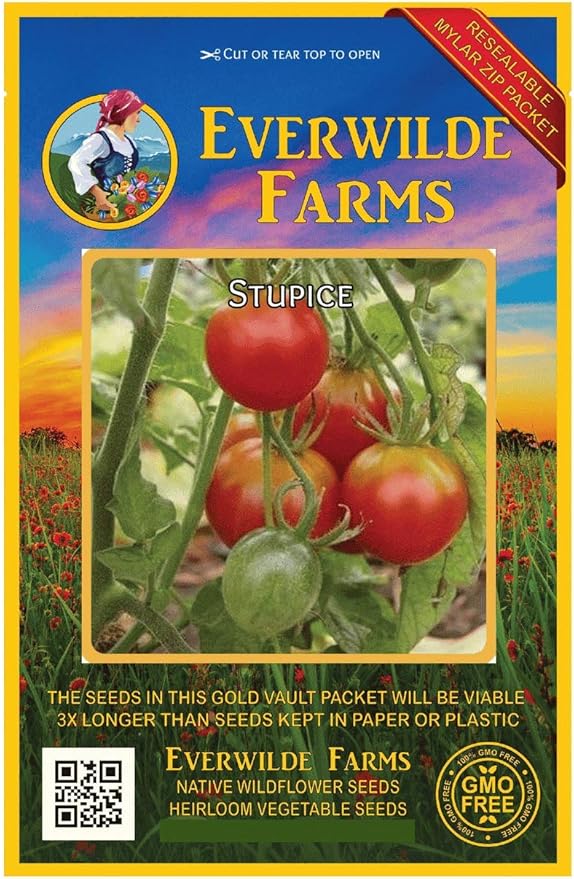
    Everwilde Farms – 50 Stupice Heirloom Tomato Seeds – Gold Vault Jumbo Seed Packet

    Stupice Tomato Review

    Is Stupice Tomato A Hybrid?

    Stupice tomatoes are an heirloom variety and they are open-pollinated. Hence, they are not hybrid tomatoes. This also means they have never been cross-bred or they have not been cross-bred for a very long time (usually decades or even centuries).

    Click here to learn about:

    Planting Stupice Tomato

    It’s fairly easy growing this tomato variety so far you follow the right procedure. Here are some guidelines you can follow to successfully plant stupice tomatoes.

    • Step 1

    Preferably, stupice tomatoes seeds should be commenced indoors. Plant seeds starting from 6 weeks before the last frost date. The temperature for starting seeds indoors should be around 75 to 80 degrees Fahrenheit.

    • Step 2

    Each cell or pot should have about 2 or 3 seeds sown. Then once the seedlings have developed a third set of leaves or when they have attained a height of 2 to 2.5 inches, go ahead and transplant them to individual pots.

    Transplant the individual pots of around 4 inches. Remember to thin to the strongest seedlings.

    Planting Stupice Tomato

    Furthermore, when transplanting seedlings to pots, we recommend you use a fresh potting mix. This is to prevent the introduction of any soil-borne disease.

    You should also water regularly, especially in hot weather. Matter of fact, pots may require daily watering in very hot weather.

    • Step 3

    Recommended is the application of fertilizer to the seedlings for 7 to 10 days. The fertilizer should be a liquid or water-soluble fertilizer. Then the fertilizer should be diluted to a quarter of the recommended measurement at the seedlings stage. This is to ensure your plant root system does not get burnt.

    • Step 4

    Then once the last frost in your region has elapsed, you can transplant your seedlings outdoors. Make sure the nighttime temperature is around 55 degrees Fahrenheit. Also, ensure you gradually acclimate to outdoor conditions.

    Plant spacing between rows should be around 24 to 36 inches.

    Check Out How To Water Arborvitae?

    Harvesting

    Stupice tomatoes should be ready for harvest in merely 40 to 45 days from transplanting.

    Also, you can harvest your juicy stupice tomato once you’ve seen the desired color of the tomato fruit. If you have green tomatoes, they can be ripened at a cool temperature when they are blemish-free. However, if they are very dark green tomatoes, they may not ripen totally.

    Recap On Stupice Tomato Review

    We have seen how stupice tomatoes are one lovable variety of tomatoes that is fairly easy to grow and can serve as a great addition to your garden.

    Here is some recap on some of the things we mentioned about this flavorful tomato variety:

    • They are high-yielding plants. Inclined to produce around 3 to 6 ounces of red juicy tomato fruit. Their fruits are also borne in clusters of five or more.
    • It gives a red and intense color and the flavor is richly tangy and sweet.
    • They mature pretty early. Their maturity from transplanting is as fast as 40 to 45 days.
    • Stupice tomatoes are indeterminate tomato variety meaning they tend to grow in a vining manner. Hence, they often require staking or caging.
    • Stupice tomatoes usually grow as tall as 5 to 7 feet.
    • This plant variety is cold tolerance.
    • Start seeds indoors preferably for better results.
    • Use a fresh potting mix when transplanting seedlings to pots.

    Read more information about What Does A Plum Tomato Look Like?

  • Plum Tomatoes vs Roma Tomatoes

    Plum Tomatoes vs Roma Tomatoes

    Tomatoes are great a fruit that comes in so many varieties. Plum tomatoes and Roma tomatoes are two common varieties of tomatoes you can find. But is there really a difference between plum tomatoes vs Roma tomatoes? Let’s get some facts on this.

    With so many different varieties of tomatoes available, having some insight into some of these tomato varieties will really go a long way. Getting to know their different features can even give you a better idea regarding how best to plant them, the best preparation methods for these tomato varieties, and so on.

    In this article, we will be focusing on the differences between plum tomatoes vs Roma tomatoes. So, continue reading to gain some knowledge regarding this.

    Roma vs Plum Tomato

    So, regarding plum tomatoes vs Roma tomatoes, different questions may come to our minds. Questions such as: are Roma tomatoes similar to plum tomatoes? Do they have any tangible differences?

    Well, the main difference between plum tomatoes vs Roma tomatoes is that Roma tomatoes are simply a type of plum tomato variety. Interesting right? Therefore, the plum tomato has different varieties and a Roma tomato is one of these varieties of plum tomato. This also means plum tomato has other varieties of tomatoes under which are different from Roma tomatoes. Roma tomatoes are just a popular type of plum tomato that falls under the plum tomato variety.

    Roma vs Plum Tomato

    Again, we can say Roma tomato is a type of plum tomato. However, not all plum tomatoes can be regarded as Roma tomatoes. Because Roma tomatoes are one of the most popular varieties of plum tomatoes, Roma and plum tomatoes are usually used interchangeably at grocery stores as well as the produce market.

    Now there are other types of plum tomatoes variety apart from the popular Roma tomatoes. So, some of them include Amish Paste, Big Mama, San Marzano, and Ropreco Paste. Therefore, comparing plum tomatoes and Roma tomatoes isn’t necessary because Roma is simply a type of plum variety.

    To further get a better understanding of plum tomatoes vs Roma tomatoes, let’s look into each of these tomato varieties.

    Find more information about What Does A Plum Tomato Look Like?

    Click here to Learn About:

    Some Info About Plum Tomato

    Plum tomatoes are a pretty popular type of tomatoes and a widely cultivated tomato variety in America as well as Europe. This plum tomato variety is used for specific purposes such as tomato paste or tomato sauce.

    Rather than having a round shape like every other tomato, the plum tomato has this unique oval to a cylindrical shape. The fruit size of plum tomato also differs depending on the variety.

    You can have big, medium, or large-sized plum tomatoes. However, small-sized plum tomatoes are the most commonly found in the market because of their easy usage. But you can still find large or medium-sized varieties in the market.

    Heirloom 8 Tomato Seeds and 2 Basil Herb Seeds | Non GMO

    81f7ynap8NS. AC SX569

    Also, the plum tomato has this very small variety that is similar to the size of a grape and it is often referred to as grape tomato.

    Other types of plum tomato apart from Roma include Amish Paste, Big Mama, San Marzano, and Ropreco Paste. Roma and San Marzano tomatoes are the most common types of plum tomato varieties.

    Check Out This List of Things You Can Compost

    How Is The Texture Of Plum Tomato?

    Plum tomato tends to be pretty soft and tender on the outside. Then the inner part of the plum tomato contains fewer seeds and fewer seed compartments (usually around 2 compartments). They also have less liquid; therefore their content tends to be more concentrated. All these features make them an excellent choice for paste.

    Again, when it comes to sauce, the concentrated content or flavor tends to improve the flavor and mouthfeel of the sauce. Because the tomato maintains and holds its shape very well, it can do well when canned to use in the future.

    Some Info About Roma Tomatoes

    Roma tomato also referred to as Italian plum tomato is a kind of plum tomato variety. The major growing parts of this tomato variety are the United States, Mexico, and Australia.

    Found in the market popularly. This tomato variety has a pear or egg shape and the plum tomato fruit can come in red and yellow colors.

    They are one plum variety that is very easy to cook with. This is because of their lower seed content, lower water content, and firm texture. These features allow this tomato to be easy to create lovely, tasty sauces and pastes.

    Just like every other tomato, Roma is canned and made into a sauce as a preservation method. This encourages the longer shelf life of tomatoes. The smaller seed size and fewer numbers of seeds also promote the canning process that offers to prolong the shelf life.

    Furthermore, some of the Roma tomatoes have been genetically enhanced to be resistant to some common diseases. These common diseases include verticillium and fusarium wilt.

    Read More About How To Get Rid Of Mealworms In The Garden?

    Are Roma Tomatoes Bigger Than Plum Tomatoes?

    The question isn’t really a straightforward answer. As we’ve mentioned, both Roma and plum tomatoes can reasonably be regarded as the same tomatoes. All Roma tomatoes are under the plum tomato variety. However, not all plum tomatoes tend to be Roma tomatoes.

    Therefore, plum tomato can come in different varieties and each of these tomato varieties has different sizes of tomatoes.

    What Is The Difference Between Plum Tomatoes And Whole Tomatoes?

    Plum tomatoes and whole tomatoes are quite similar. Plum tomatoes are basically whole tomatoes that are packed in the juice inside a can. These tomatoes have been peeled so they can remain skinless. However, all their seeds are still intact.

    What Is The Difference Between Plum Tomatoes And Whole Tomatoes

    Conclusion

    Tomatoes fruits no matter the varieties are pretty versatile and they are most loved in different recipes in so many homes. We have looked into plum tomatoes vs Roma tomatoes to know if there are any differences between these two

    We’ve discovered that Roma tomatoes are actually under the category of plum tomatoes. Hence, Roma tomatoes are a type of plum tomato variety.

    Roma tomatoes are one of the most popular types of plum tomato you can find. This makes these two names (Roma and plum) to be used interchangeably especially at the grocery store and produce market. But now we have a good idea about what Roma and plum tomatoes are.

  • How To Peel A Buttercup Squash

    How To Peel A Buttercup Squash

    Buttercup squash is a kind of kabocha winter squash that is an heirloom native to the Western Hemisphere. This type of squash is pretty tasty and versatile. However, cutting and preparing them may be quite intimidating. Hence, this brings us to the question: how do you peel a buttercup squash?

    But once you’ve perfected how to prepare and peel a buttercup squash, then it’s time to continue enjoying the variety of buttercup squash.

    So, if learning the easy way of preparing or peeling buttercup squash interests you, then let’s look right into this.

    A Little About Buttercup Squash

    Before we delve into how to peel a buttercup squash, let’s briefly look into some details about this squash.

    Buttercup squash is a type of winter squash that often appears dark green and it is a variety of Marialva Cucurbita maxima. Take note not to confuse the buttercup squash with its cousin butternut squash.

    This winter squash tends to weigh around 5 to 7 pounds each. It also has an average diameter of about 10 to 20 centimeters and a height of around 5 to 7 centimeters.

    A Little About Buttercup Squash

    They tend to be round in shape and they grow with a very distinctive protruding ring around the lower end that is opposite the stem end. It’s been suggested that this squash has an upside-down acorn shape with an undersized cup.

    Click here to learn about:

    How To Peel Buttercup Squash?

    As we mentioned, buttercup squash may seem daunting to prepare or peel. They tend to be dense and their outer part is very hard and thick and this majorly contributes to the difficulty in peeling them. This is why we will be tipping you on the easy and sure way how to peel or safely prepare buttercup squash.

    Peeling buttercup squash can be difficult and very tricky and this is not usually necessary even when you plan on cooking them. Peeling butternut cups is not compulsory, you can leave the skin on while you cook them.

    Another thing you can easily do is scoop out the flesh of this squash. Make use of a sharp and big heavy knife and gently split the buttercup squash into half lengthwise through the stem. Then with the help of a heavy spoon, scrape out the seeds and make sure you save the seeds to roast later. Then you can cook this squash according to the recipe you desire.

    However, if you still wish to peel and cut your buttercup squash, start by piercing the skin of the buttercup squash all over using a knife or fork. Then microwave the buttercup squash for about 2 to 4 minutes or longer depending on the size.

    Then allow the buttercup squash to cool down and you can begin peeling and cutting. After doing this, microwave again to soften and loosen the skin so that the skin can fall off more easily.

    Amazon Choice
    Squash Peeler & Seed Removal Tool
    $8.99

    All-in-One Squash Peeler and Seed removal tool

    We earn a commission if you make a purchase, at no additional cost to you.
    12/02/2025 09:02 pm GMT

    Is Eating The Skin Of A Buttercup Squash Ideal?

    Basically, all squash is an edible fruit. However, edible does not mean you want to eat them. Some squash offers thin skin that is tasty and tender. Other types of squash on the other hand deliver a very tough shell that even when you cook them, tends to give this stringy and chewy bite that we prefer to avoid.

    However, if you wish to eat the skin of your squash, you can, by all means, do so.

    The Taste Of Buttercup Squash

    The flavor of buttercup squash is sweet and nutty. The thin outer skin of this winter squash surrounds a sweet-flavored, slightly nutty orange-tasting flesh. This tends to be a fine-grained, creamy texture with a dense consistency.

    The inner flesh is orange and sweet and it’s been said that the more intense the inner colors are, the more vitamin A it contains.

    Read more about Plants That Need Calcium

    Cooking Applications Of Buttercup Squash

    Buttercup squash tends to be slightly dry but this can be alleviated by steaming or baking. It can serve as a possible substitute for butternut squash, sweet potato, or delicata squash.

    You can stuff buttercup squash and you can bake with it. You can as well microwave it and serve it in soups, casseroles, pumpkin pie, or simply as a side dish. Buttercup can as well be pureed to make a creamy soup.

    Furthermore, the seeds are very useful in your cooking, so always remember to save the seeds of buttercup squash. You can roast the seeds just like with pumpkin seeds for a tasty snack.

    Find more information about Can You Eat Kabocha Squash Skin?

    Storing Buttercup Squash

    This squash should be wrapped in plastic, refrigerated, and stored for several days. You can store cooked buttercup squash for 1 to 2 days when refrigerated. However, when you freeze this squash, it can be stored for 3 months approximately.

    You can as well store your buttercup squash at room temperature (50 to 55 degrees) in a cool and dry place and it will last up to 3 to 6 months.

    Health Benefits Of Buttercup Squash

    Here are some great health benefits buttercup squash offers:

    • Carotenoid: just like every other winter squash, buttercup squash is a wonderful source of carotenoid and this is a nutrient that enhances night vision and eye health. Vision accuracy tends to decrease with age. Therefore, the elderly need to obtain adequate dietary carotenoids. Carotenoid also offers carotenoid property which also helps reduce the risk of cancer.
    • Vitamin C: vitamin C is another great nutrient buttercup squash is loaded with. This plays a crucial role in immune function and the prevention of diseases.
    • Vitamin A: buttercup squash also contains a good amount of vitamin A. Buttercup squash has an orange inner flesh color and it is said that the more intense the inner flesh color is, the more vitamin A it contains.
    • Potassium: this winter squash is as well loaded with potassium nutrients. This element helps lower blood pressure.
    Health Benefits Of Buttercup Squash

    How Long Does it Take to Boil Buttercup Squash?

    You can boil buttercup squash on the stove or in an instant pot. The time it takes to cook will depend on the size and shape of the squash and your desired tenderness level. Here are some general guidelines for boiling buttercup squash:

    Stovetop:

    1. Cut the squash into 1-2 inch cubes.
    2. Place the cubes in a pot and add enough water to cover the squash.
    3. Bring the water to a boil and reduce the heat to a simmer.
    4. Cook the squash for 10-15 minutes or until it is tender. You can use a fork to poke the squash to test for doneness. If the fork easily pierces the flesh, the squash is done.
    5. Drain the water from the pot and serve the squash.

    If you prefer your squash to be softer, you may need to cook it for longer. On the other hand, if you like it firmer, you should cook it for a shorter period. 

    Instant Pot:

    1. Cut the squash into 1-2 inch cubes.
    2. Place the squash in the Instant Pot and add 1 cup of water.
    3. Close the lid of the Instant Pot and set the valve to the sealing position.
    4. Press the “Manual” or “Pressure Cook” button and set the cooking time to 5 minutes.
    5. When the cooking time is up, allow the pressure to release naturally for 5 minutes, then use the quick-release method to remove any remaining pressure.
    6. Carefully open the lid and test the squash for doneness. If the squash is not tender, you can cook it for an additional 1-2 minutes.
    7. Drain any excess water from the Instant Pot and serve the squash.

    How Long Do You Cook Buttercup Squash in The Oven?

    If you want to cook butternut squash in the oven, follow these steps:

    1. Preheat the oven to 375°F (190°C). 
    2. Cut the squash in half, scoop out the seeds, and place the halves cut-side down on a baking sheet lined with parchment paper. 
    3. Bake the squash for 30-40 minutes or until it is tender and easily pierced with a fork. If the squash is still firm, continue cooking and check for doneness every 5-10 minutes.

    What to Do With Leftover Buttercup Squash?

    You can use leftover squash in many delicious ways. Here are a few ideas:

    Puree

    You can puree the squash to use it as a base for soup. Add broth, spices, and other vegetables to create a creamy and flavorful soup.

    Mash

    You can use mashed squash as a topping for baked goods like bread, muffins, and scones. 

    Dice

    If you dice your leftover squash, you can add it to stir-fries or pasta dishes for a pop of color and flavor!

    Leftover squash can also make a great addition to salads and grain bowls when roasted. If you can’t use it immediately, you can freeze it in small portions. It will keep up to 5 days in the fridge and about 6 months in a freezer when properly sealed. 

    How To Can Buttercup Squash

    Canning buttercup squash is quite a process. There are many different recipes you can follow. Here is a basic one:

    The ingredients you’ll need are:

    • Fresh buttercup squash
    • Water
    • Salt (optional)
    • Canning jars with lids and rings
    • A large pot or canning kettle
    • A jar lifter or tongs
    • A canning funnel (optional)

    Follow these instructions:

    1. Wash the squash thoroughly and cut it into small pieces. Remove the seeds and any tough or fibrous parts.
    2. Fill a large pot or canning kettle with water and bring it to a boil. Place the jars in the pot and sterilize them for 10 minutes. Remove the jars from the pot and set them aside to cool.
    3. Bring water to a boil in a separate pot and add the squash pieces. Boil the squash for 5 minutes or until it is tender.
    4. Drain the squash and pack it into the sterilized jars, leaving about 1 inch of headspace at the top. If you are using salt, add 1/2 teaspoon per quart jar or 1/4 teaspoon per pint jar.
    5. Use a canning funnel (if available) to pour hot water over the squash in the jars, leaving 1 inch of headspace. Use a wooden or plastic utensil to remove any air bubbles.
    6. Wipe the rims of the jars with a clean cloth and place the lids and rings on top. Tighten the rings until they are finger-tight.
    7. Place the jars back in the pot or canning kettle and ensure they are covered by at least 1 inch of water. Bring the water to a boil and process the jars for 45 minutes (for quarts) or 35 minutes (for pints).
    8. Use a jar lifter or tongs to carefully remove the jars from the pot and place them on a towel to cool. As the jars cool, you should hear a popping sound. This indicates that the lids have been sealed properly.

    If you want to double-check that the jars have sealed, press down on the center of the lids. If the lids do not move, they are sealed. If the lids move or pop up, they are not sealed. Canned buttercup squash will keep in a cool, dark place for up to a year.

    How To Peel A Buttercup Squash: Conclusion

    Learning how to peel buttercup squash has been discussed in this guide. We have also looked into some other related things you need to know about this great-tasting winter squash.

    FAQ’s

    What is the easiest way to peel a buttercup squash?

    I would suggest doing it the same way you’d peel a carrot, with a vegetable peeler. Cut the squash in half (or quarters if it is small) so that you can get to the inside more easily. Scrape out the seeds and cut the squash into manageable pieces. Then use the peeler to take off the skin in one continuous piece. I think this is the best method to get the skin off, and it doesn’t take a lot of time or effort.

    What is the best way to store butternut squash?

    Squashes are high in moisture content and should be used as soon as possible after purchase. If you want to store it for a while, the best way to store it is to bake it. That way, it retains moisture and nutrients. I’ve made a lot of roasted butternut squash dishes over the years, and they’re great reheated.

    What happens if you refrigerate butternut squash?

    It’s a great idea to freeze the butternut squash. If it’s well cooked, it will stay nice and firm for a long time. But don’t freeze the cooking liquid as it will separate from the butternut squash. Just drain the squash and pat it dry with paper towels. Place in a freezer bag or plastic container and store in the freezer for up to 6 months.

    Can you eat the skin of a buttercup squash?

    If you roast the squash, the skin becomes soft and can be eaten. If you boil the squash, the skin gets tough and is not edible. Buttercup squash is a great vegetable, and it’s also great roasted.

    How long does buttercup squash keep?

    Most winter squash can be stored in a cool dark place for up to three months.

    How can you tell when a buttercup squash is ripe?

    When it’s ripe, a buttercup squash will be full and soft. If it isn’t quite ready, the rind may be firm, but the inside will still be a bit hard. You can also tell by looking at the stem; if it’s green, it’s not quite ripe.

    What is the best way to cook a buttercup squash?

    Cut off the top of the squash and scoop out the seeds. If desired, peel the skin. Cut into halves or quarters and roast as directed in the recipe.

  • Yellow Beans vs Green Beans

    Yellow Beans vs Green Beans

    Beans are a common staple we love to make use of in our various meals. Now there are different varieties of beans so yellow beans and green beans are part of them. In this post, we will be looking into yellow beans vs green beans.

    Both yellow beans and green beans are great-tasting beans. But what we would like to know is if there are any differences between them.

    So, let’s dive into the major differences between yellow beans ad green beans. We will hence be discussing yellow beans vs green beans, what they are known as, their applications, and so on. So. Continue reading to gain some insight on these.

    But before we delve into these two great beans, let’s touch or briefly look into each of these beans and see what they are all about.

    About Green Beans

    Generally, the variety of the long and tender beans is basically referred to as green beans. These green beans refer to every type of beans variety. Therefore, green beans include wax or yellow beans, haricots verts, stringless beans, long beans, and so on.

    This green bean derived its green color from the pigment chlorophyll. Green beans can also be regarded as snap beans or string beans. So, in case you come across this bean variety labeled string or snap beans, they are the same vegetables with just different names.

    About Green Beans

    This great-tasting bean can be consumed raw or you can simply cook it.

    This bean is a great source of vitamins such as vitamin A, C, and K. It is also packed with fiber and folic acid. Green beans also offer many other health benefits that will further be discussed in this post.

    You can find green beans all through the year in the grocery store. However, the warmer months are the peak season for this green vegetable.

    About Yellow Beans

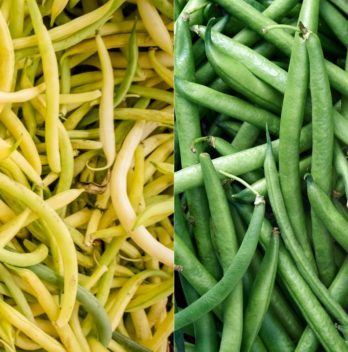
    Yellow bean is also a type of green bean variety and it is also referred to as wax beans. This yellow bean may appear physically different from the usual green beans, but trust me, their taste is remarkably similar.

    These two beans are almost identical to each other in all aspects except their color. Hence, we can refer to it as yellow-green beans.

    The color of yellow beans is pale cornflower. It is stringless and the flesh appears translucent yellow and this clings tightly to its little lime green legumes inside their shells.

    As we mentioned, yellow beans are also a green bean variety. The yellow beans have just been bred to lack the pigment chlorophyll that can make this vegetable appear green.

    About Yellow Beans

    Yellow beans are as well great to be consumed raw or you can simply cook them. You can also steam them, roast them, or simply boil them. You can also incorporate them raw into salads with cooked tuna or salmon. Or you can simply serve them with creamy herb dip.

    The tastes of these yellow wax beans are crisp especially when harvested young. It also feels succulent and tender firm, with that mellow grassy sweet and nutty flavor.

    Why Are Yellow Beans Referred To As Wax Beans?

    The name yellow wax beans are given to dozens of wax bush bean varieties. They individually have various shades of yellow in their appearance and variance in waxiness and this depends on the cultivar.

    These yellow beans or wax beans are almost identical to green beans in all areas except their color.

    Green Beans vs Yellow Beans

    Now let’s look into yellow beans vs green beans to know how they differ from each other:

      • Color: the most obvious difference is in their color. Green beans come in green color. Then yellow or wax beans come in yellow color. This color is mainly due to the presence and absence of the pigment chlorophyll.

      • Loose of Color When Cooked: green beans tend to lose some of their visible colors when cooked. Yellow beans or wax beans on the other hand will still maintain their color even after blanching them in boiling water or salted water.

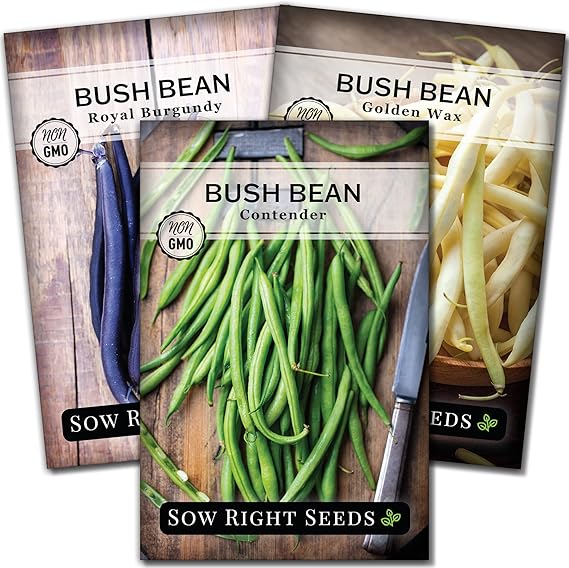
    Sow Right Seeds – Tri Color Bush Bean Seed Collection for Planting – Non-GMO Heirloom Seeds

    816MAD6fC S. AC SX569

    Are There Wax In Yellow Beans?

    It is traditionally known that yellow beans are referred to as wax beans. The term ‘wax’ has become a common term that is used to refer to any yellow beans as waxy whether they are waxy or not.

    A true bean that is waxy actually possesses that waxy texture and feel.

    What Causes Green Bean To Turn Yellow?

    When you leave your green beans for a while and you notice them turning yellow, it may just be the pods turning yellow and your beans are fine. Some of these green bean varieties may fade to yellow as their pods age or mature.

    Health Benefits Of Green And Yellow Beans

    Both yellow beans and green beans are similar hence they tend to have similar health benefits. Here are some of them:

      • These beans are loaded with Vitamin A, C, and K.

      • These nutritious beans help reduce the risk of diabetes, heart diseases, and obesity.

      • It can also reduce the risk of early mortality rate.

      • Another great benefit you enjoy from consuming this great-tasting vegetable is a healthy completion.

      • You also enjoy increased energy and overall lower weight.

      • Green beans are rich in iron and this is very beneficial to women of child-bearing age. It enhances fertility. Also, pregnant women benefit from consuming green beans as it contains folic acid which helps fight against neural tube defects in pregnancy.

      • Green bean is rich in vitamin K and this assist in enhancing the bone’s health.

      • Because green beans contain a high quantity of chlorophyll, this may help obstruct the carcinogenic effect of heterocyclic amines that are derived when meats are grilled at high temperatures.

    FAQ’s

    Do yellow and green beans taste the same?

    Yellow and green beans look different, but they taste pretty much the same. There is no difference in flavor between the two, though there are differences in texture. Green beans are slightly more tender than yellow beans.

    Yellow beans are bright and shiny, whereas green beans are dull and green.

    Both plants produce very good sized pods. I usually cut the pods in half and cook them right away.

    Are yellow beans good for you?

    A recent article from the Washington Post claims that yellow beans are healthy and can be used to make a quick meal. The article claims that they have high levels of protein, fiber, iron, calcium, folate, and zinc, but I’m not so sure. I tried this recipe myself, and it was pretty tasty. But I don’t think it would be my first choice to make if I wanted to eat healthily.

    How do you eat yellow beans?

    This is a question we ask ourselves every year when we return to the farm. I eat yellow beans year round, but in the summer they are at their best, and I eat them in many ways: with butter, in salads, on pasta, on pizza, in soups, and of course, in burritos. I like to add yellow beans to our favorite recipes.

    They are so versatile and easy to use, and they lend themselves to a wide variety of flavors.

    What types of green beans are there?

    Green beans are available in several varieties such as French beans, string beans, sugar snap beans and so on. These beans can be easily grown in a home garden or even in a pot. Beans are also available in dried form. They come in various sizes, shapes, colors and flavors. Green beans have been used as a source of protein for many generations and they have been known to have a lot of health benefits.

    Can yellow beans be eaten raw?

    I think it’s important to know that there is a difference between “cooked” and “raw”. If you want to eat them raw, then you need to soak them in water overnight.

    How do you cook dried yellow beans?

    I usually boil them until they are soft, and mash them with a potato masher. I use them in soups, stews, etc.

    How do you cook green beans?

    Green beans are such a favorite of mine. I love them fresh, steamed or sautéed.

    Green beans are very easy to prepare. You can either boil them in water until tender, or steam them. For the latter, you can simply toss them into a steamer basket and cover the top with a lid.

    Conclusion

    Regarding yellow beans vs green beans, we have seen that there aren’t so many differences between these two great-tasting beans. The major difference we can visibly see is their colors.

    In fact, green beans are also the same as yellow beans. The only difference is that green beans contain the pigment chlorophyll that is responsible for the green color. While yellow beans on the other hand have been bred to lack the chlorophyll pigment that makes them green.

  • Drip Irrigation For Tomatoes In Containers

    Drip Irrigation For Tomatoes In Containers

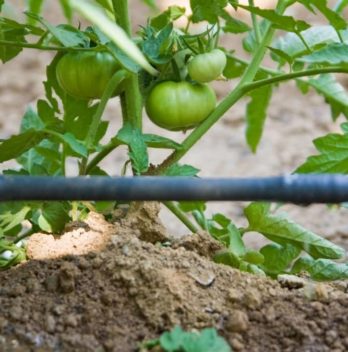
    Tomatoes being a juicy water-filled fruit indicate they will require proper watering. You can plant tomatoes in your outdoor garden, raised garden bed, or even containers. If you’re planting tomatoes in containers, one ideal way of supplying water to your container’s tomatoes is through drip irrigation.

    Watering your tomato plant is a crucial step to take to achieve that thriving and healthy crop. If your tomato plant doesn’t receive adequate watering at the appropriate times, it can lead to plant stress that puts your plant at risk.

    Growing tomato in a container is very easy and you can always enjoy a fruitful harvest. But you need to take extra measures to enjoy great results especially when it comes to watering these plants.

    Therefore, let’s dive into one great way of supplying water to your tomato plants which is drip irrigation for tomatoes in containers.

    The Need For Watering In Tomato Plants Containers

    drip irrigation tomatoes

    These juicy tomato fruits are composed of about 95% water. Hence, water is one major factor that contributes to their growth and development.

    Planting tomatoes in your traditional outdoor garden may seem a bit easier for tomatoes to obtain water. For instance, your tomatoes can receive water from rain and other factors. It will even be easier for traditional outdoor tomatoes to reach down their roots to search for water.

    However, when it comes to planting tomatoes in containers, extra effort to supply this juicy plant with water will be needed.

    Therefore, installing that automated drip irrigation for your container’s tomatoes can make things easier when it comes to the plant’s watering needs.

    Drip Irrigation Tomatoes

    Now, let’s look into the tomato drip irrigation system. Installing drip irrigation for your tomatoes in containers is a great way of providing moisture to the plant. It is also an effective way of supplying fertilizer to your crops.

    However, when it comes to making use of the drip irrigation for your container’s tomatoes, you need to ensure the installation is very efficient. You need to get the installation, maintenance, and operation right.

    A correct and effective drip irrigation system should distribute water evenly to your tomato plants. This is usually done with the right timing or scheduling of watering sessions.

    Drip Irrigation For Tomato Plants: Things To Consider For Proper Watering

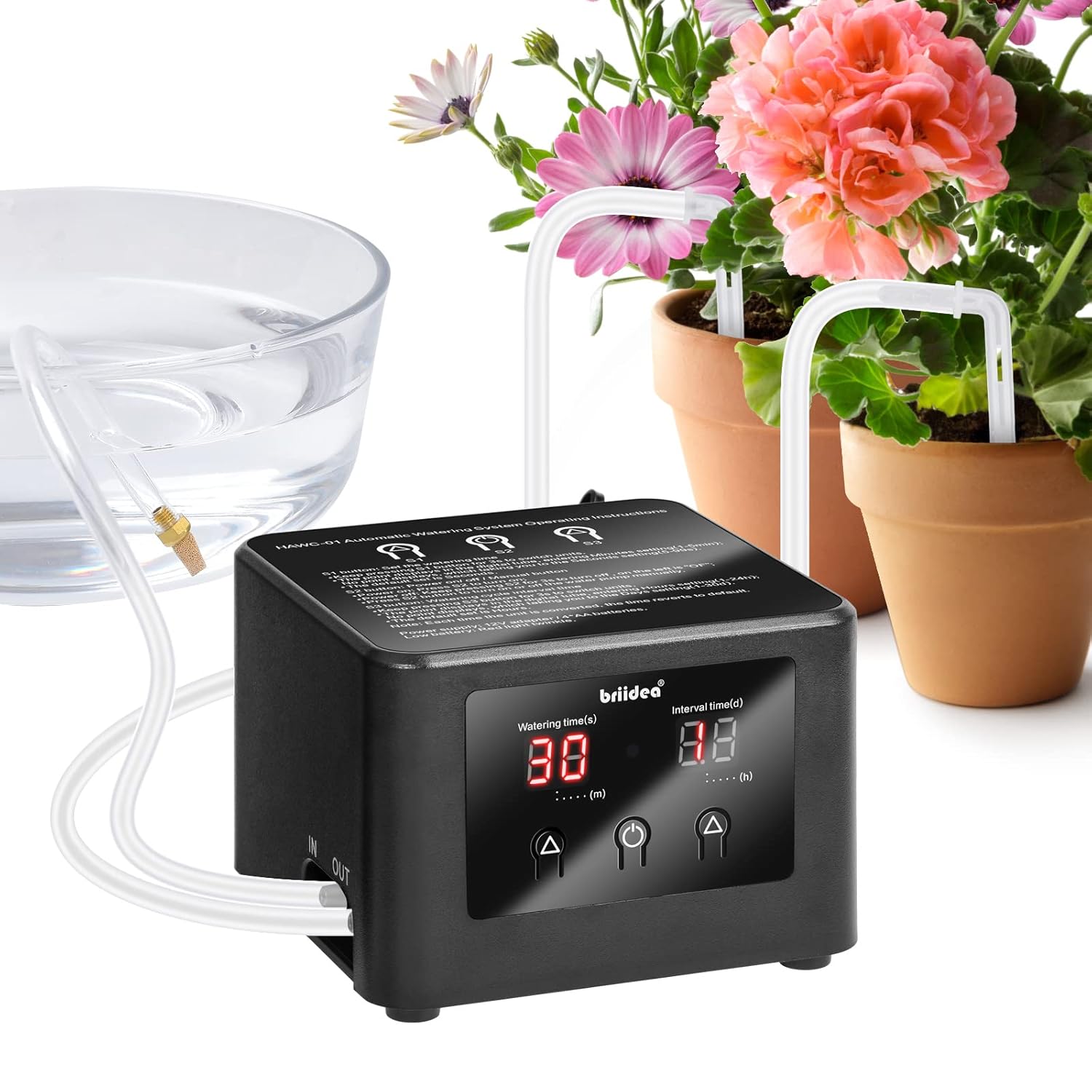
    You can set the timer for the watering schedule of the drip irrigation for tomatoes plants in your containers.

    The watering needs of your tomato plant will greatly depend on things like environmental weather. The hotness of the environment, how big the tomato plant is, and how windy should be some things to consider when setting the timer for your drip irrigation. Soil type is another thing to consider because different types of soil have their characteristics of absorbing, retaining, or draining water.

    ·         Environmental temperatures

    Temperature is one major factor to consider when planning the watering schedule for your drip irrigation tomatoes in your containers. Around the middle of summer, you may need to water your tomato plants at least once or even twice daily.

    When the temperature is moderate, you can water twice or thrice weekly. During rainy seasons, if your tomato container is outdoors, you can reduce the watering needs to once weekly. Or simply water when needed.

    ·         Soil type

    Tomato plants prefer loose soil such as sandy soil with a mixture of clay texture and the addition of organic matter. However, tomatoes can still thrive in sandy clay soil.

    So, regarding the soil type, clay soil tends to hold more water while sandy soil is loose and well-draining. Therefore, you should water less in clay soil and water more in sandy soil.

    ·         Plant size

    The size or how big your tomato plant is will also determine how much to run your drip irrigation for. Run the drip irrigation system into your tomato plant for plants less than 18 inches tall for 30 minutes every 3 days. Once the tomato plant begins to grow bigger, then you should increase the watering schedule.

    Extra watering tips

    Ensure the drip emitters are set directly to the soil direction to avoid wetting the leaves of the plant. This is to prevent fungal diseases usually caused by constant wet tomato leaves.

    Additionally, ensure water gets deep into the container. If you water too little, it may just be the upper soil layers that receive moisture. Water needs to get deep into the root of the tomato plant.

    One trick to ensuring water gets to the base of your root is to water until you see drains out of the container base.

    tomato drip irrigation system

    What Happens When Tomatoes Don’t Get Adequate Water?

    In all this, note that tomatoes are sensitive to both lack of moisture as well as excess moisture of the soil. When you overwater the tomato plants, it may lead to the drowning of the plant. Then under-watering could cause blossom end rot (the bottom of the plant changes to black).

    When a tomato plant is deprived of water especially during the hot season, it can lead to plant stress thereby putting the plant at risk.

    Also, you may notice an adverse effect such as tomato splitting on the vine from water inconsistency. This usually happens when there hasn’t been a proper water supply to the tomato plants for a long time. Then you probably water the tomato plant or heavy rain falls on the plant.

    When this happens, the tomatoes tend to absorb excess water because it has been thirsty for a while. Then this causes the tomato fruit to split on the vine.

    Automatic Watering System

    71VsmRKKBUL. SL1500

    FAQ’s

    How much water do tomatoes need drip?

    Watering is essential for good tomato growth. Water requirements for a tomato plant are affected by the size of the plant and the amount of sun it gets. The smaller, bushier varieties need more water than the tall varieties. You can also tell by how fast the soil is drying out. If the soil dries out too quickly, the plant will be stressed and not grow as well as it would if it got more water.

    Water should be applied at least once a day in early spring and daily thereafter until fruit is ripe. Water that is applied at the rate of an inch per week is sufficient to assure adequate growth.

    What is the best watering system for tomatoes?

    Tomato plants are sensitive to wet soil, so it’s important to water regularly. There are a variety of methods to water tomatoes. You can use either drip irrigation or overhead sprinklers.
    The best tomato watering system should be one that will keep the soil moist without drowning the plants. Watering systems are used to provide a consistent water supply to your plants.
    Drip irrigation is a popular method because it uses less water than overhead sprinklers. It’s also good for small gardeners who want to conserve water. The most important thing when using a drip system is to make sure you have enough emitters to cover the area that needs to be watered. You can buy a kit that comes with everything you need. If you choose to use an overhead system, it’s best to use an automatic timer that will turn the system on and off automatically.

    Should I water tomatoes every day?

    You should only need to water your tomatoes every other day. If you water them more than every other day, they’ll likely have root rot. The reason for this is because you are essentially “over watering” your plants. Over watering causes the soil to become too wet. Soil that is too wet is difficult to drain, so the plant has a hard time getting rid of excess water.

    What are the signs of over watering tomato plants?

    The first sign is the leaves. Over watering will cause the leaves to wilt and fall off. The second sign is that the stems will start to rot and the plants will become leggy. This is an indication that the plant is not getting enough water. If you see these signs in your tomato plants, stop watering. Let the soil dry out for a day or two and then water again.

    How can you tell if your tomatoes need water?

    You can tell if your tomatoes need water by watching for wilting leaves, browning stems and the development of blossom end rot. If you are growing in a greenhouse, you can also look at the soil moisture content to see if it is too wet or dry.

    Additional Say

    It really makes things easy using drip irrigation for your tomatoes in your containers. All you need do is to schedule the watering plan and factor in some things such as temperatures, size of the plant, soil type, humidity, wind, and so on.

    Make sure you don’t overwater or underwater your tomato plant. The water consistency must also be accurate. Then ensure the water circulates through the entire soil and make sure water gets to the root of the tomato plant.

    Additionally, ensure your containers have good drainage holes at the base to allow excess water to pass through.

  • Why Do Green Peppers Turn Red?

    Why Do Green Peppers Turn Red?

    Why exactly do green peppers turn red is the question we will be answering today. Peppers tend to start as green pepper before turning red on the plant vine.

    Peppers are essential cuisines of tropical Asia as well as equatorial America. The pepper plant has been widely grown in South America and Central America and they are now been grown all over the world.

    The difference between green peppers and red peppers is purely time. It is the timeframe these fruits have been left to mature on the vine.

    Let’s look into more things to note on why green peppers do turn red.

    Why Do Green Peppers Turn Red?

    do green peppers turn red

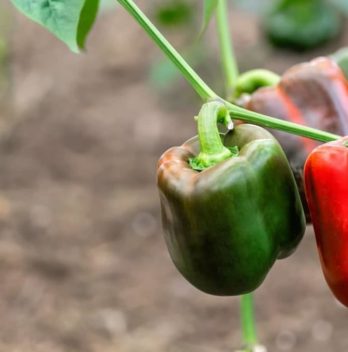
    So, will green peppers turn red? Why exactly do green peppers turn red? Usually, the colors of peppers or bell peppers are inclined to change from green to yellow, to orange, and then red. These changes depend on how long they are allowed to mature on the vine.

    Therefore, green peppers tend to change or turn to red when they are left on the vine. When peppers turn into different colors and finally turn red, this means they have reached their full maturity. Hence, green peppers are the immature fruits of red peppers.

    Ideally, almost all peppers will wind up turning red in the long run if they were left on the plant for long.

    Green Pepper Turning Red: Which Pepper Is Sweeter?

    Green pepper tends to taste slightly bitter while red pepper tastes much better. This is because as the maturity of the pepper progresses, the fruit is liable to become sweeter. Therefore, red pepper which is the last stage of pepper maturity tends to be sweeter than green pepper.

    This is one major reason why green peppers are less expensive than red pepper when you shop for them in the grocery store. Red peppers will take more time to reach maturity. But green pepper on the other hand can be derived in less time compared to red peppers.

    Helpful Tips On Ripening Or Turning Green Pepper To Red

    You may need to harvest your unripe green peppers early probably due to frost or other reasons. So, this may leave you with the unripe green pepper. If you wish to ripen these unripe green peppers to red, here are some tricks on how you can go about this:

    ·         Ripening green pepper using the paper bag method

    Once you have your green peppers, get a brown paper bag. Get the appropriate size of paper bag depending on the amount or how large the pepper is. Then put a ripe banana, apple, or tomatoes with the green pepper.

    Putting any of these ripe fruits with green pepper will hasten the ripening process. The green pepper should turn red and ripen in about a week or more.

    Grocery/Lunch Bag, Kraft Paper, 8 lbs. Capacity

    911WC0ICB2L. AC SL1500

    ·         Ripening green pepper using windowsill method

    This method is pretty simple and easy and it’s perfect for just a few unripe green peppers. Peppers can get ripen faster in warmer temperatures indoors but will ripen slowly in cooler temperatures.

    So, leave the unripe green pepper on a sunny windowsill where the room is warm for a couple of days. This will help them turn ripe. When they are done ripening, they should be stored in the refrigerator if you aren’t using them right away. Or you can simply make use of the ripened peppers as soon as possible.

    However, once you notice they are beginning to go soft, it’s best you discard them.

    ·         Ripening green pepper using the branch method

    Another way you can ripen green peppers is to hang the peppers upside down while the pepper is still attached to the branch. Do this indoors so they can ripen.

    But generally, green unripe peppers tend to ripen or turn red on their own accord. Therefore, merely keeping them in a room temperature can make them ripen. They should turn red and ripen in around a week or two weeks or more.

    However, some may turn bad if left unattended for too long. So, ensure you always check them from time to time so most of it doesn’t go bad.

    Ripening Green Pepper On The Vine

    There may come a time when you really need to hasten up the ripening process of your peppers on the vine. Well, there are also things you can do to encourage or hasten green pepper to ripen or turn red on the vine. Here are 3 ways to go about this:

    1. Enhance the natural process of pepper ripening

    Pepper plants strictly follow the natural period it takes to mature. Therefore, there may be little or less thing you can do to change the maturation timing. However, you can always help to ensure the timing is not delayed or nothing hinders the maturation process.

    Hence, when we talk about enhancing the natural timing process for the pepper plant, we are majorly referring to what you can do to prevent delays in the maturation process.

    Some of these enhancements include choosing the appropriate plating site. Select a spot where your pepper plant can receive a good supply of sunlight. Ensure other plants don’t obstruct or cast shadows on other plants. However, if the sun is way too much for the pepper plant, provide a bit of shade probably with some cloth to give your plant some relief.

    1. Adequate nutrition supply

    You need to also supply proper nutrition to your pepper plant. Fertilize your soil bed before planting. Use fertilizer containing nitrogen, magnesium, potassium, and phosphorous.

    1. Trimming

    When you trim your pepper plant properly, it ensures the plant concentrates its resources on yielding bigger fruit faster.

    Prune the bottom of the pepper plant and maintain a branch of at least 6 inches off the ground. Doing this helps focus more nutrients on the fruit-producing activity of the plant. This also helps deter potential pathogens and unwanted insects from infesting your plant.

    will green peppers turn red

    FAQ’s

    Can you eat a green pepper that turns red?

    You can eat a green bell pepper that turns red. This is because the color of the pepper is caused by oxidation, which is caused by the chemical reaction between water and oxygen. The pepper starts out as a bright, fresh green color, but as it is exposed to air for long periods of time, its cells become oxidized. As a result, the pepper turns a dark red or brownish-red color.

    You can eat red bell peppers that turn black, but only after you cut off the part that turned black. The red part of the pepper will remain safe to eat.

    You can eat a green pepper that turns red. The longer you leave it in the sun, the more red it will get. They are not poisonous, and they taste great! If you are concerned about food poisoning, you might want to be cautious about eating the seeds. I

    Which color bell pepper is the healthiest?

    This is a very good question. We can’t say for sure which pepper is “healthier” since all peppers are quite healthy, but we can say that the color of the pepper has nothing to do with its healthiness. If you’re looking for the healthiest pepper for your diet, you have to look at what you like and what you can eat.

    Why are ripe peppers better?

    Ripe peppers are great to eat, and you will see why when you try them. They are very sweet, tender, juicy and have a wonderful taste that is hard to describe. Ripe peppers are also excellent for making sauces and salsas. When you get peppers that are not ripe, you will find that they are hard, bitter, and the flavor is more of a vinegar-like taste than the sweetness you expect from peppers.

    What’s the deal with green peppers turning red?

    If you’ve been growing peppers in your garden, you may have noticed that some are green and others are red. This happens when the pepper plant has reached maturity. The green peppers are called immature green peppers, and they are not yet fully mature. The red peppers are called mature red peppers, and they have reached their full potential for color.

    How do you know if bell peppers are ripe?

    The best way to tell if they are ripe is to smell them. If the peppers have a sweet aroma, they are ready. You should also be able to hear them crack when you press down on them.

    How long does it take for bell peppers to ripen?

    It depends on the type of pepper, and how ripe they are when you buy them. But generally, bell peppers will ripen in a couple days. And you can speed up the process by putting them in a paper bag with a banana or apple.

    Do bell peppers change color as they grow?

    No, peppers don’t change color as they grow. Bell peppers are just green when immature and then turn red when mature. The same is true for all other peppers. If you want to have peppers of different colors, you’ll need to start them from seeds.

    Concluding Remarks

    So, we have seen why green peppers do turn red even after harvesting. Green pepper is the immature stage of a pepper. Therefore, it is simply a natural process for green pepper to turn red because red is their final stage of maturity.

  • Growing Romaine Lettuce In Container

    Growing Romaine Lettuce In Container

    Growing romaine lettuce or any other lettuce in a container is a common practice for small space gardeners. This is usually done when gardeners do not have adequate space to grow this plant in a garden.

    Growing this plant in a container gives the plant an early start and allows for easy monitoring. The plant may easily be taken outside for sunlight and brought indoors during light freezes.

    This is a guide on the major considerations to note when growing romaine lettuce in a container as opposed to a garden. The peculiarities involved in growing this plant in a container are also discussed.

    There are a few things you must note when growing this plant in a container such as weeding, soil nutrient, water, and sunlight exposure. All of these are covered here. Now let’s get into what growing romaine lettuce in a container entails.

    What Growing Romaine Lettuce In A Container Entails

    Generally speaking, growing romaine lettuce in a container requires the right type of pot and planting medium. The following must be noted about growing this plant in a container:

    • Container Size: Romaine lettuce ordinarily requires sufficient room for roots to grow. Therefore, it is best if you use containers or pots ranging from 6 to 12 inches in width and length. Such containers should where possible, have adequate drainage holes.

    • Best Soil: the plant requires a consistent supply of water, but does not do well when water clogs the soil. The clay soil is therefore the best soil to plant as it provides a permeable surface. This soil has the ability to easily evaporate excess water and as such, prevent soggy roots.

    • Fertilizer Application: before sowing the plant, add some fertilizers to the soil to boost the soil nutrient. This will in a large way affect the growth potentials of the plant.

    • Planting: this may be done directly on the soil prepared, or there may be a transplant.

    What Growing Romaine Lettuce In A Container Entails

    Tips On How To Grow Romaine Lettuce In A container

    The following should be observed by you when planting romaine lettuce:

    ·         Container Settings

    Carefully set a 2-inch diameter seedling pot in a tray, to catch draining moisture. Alternatively, you may decide to set a 6 to10 inch diameter container on a drip tray if you intend to grow the plant to maturity.

    Ensure to fill the containers with a soilless potting mixture. You do not really need to add fertilizer to seedling pots if you are going to be sowing transplants. Where you intend to grow to maturity, mix ½ tablespoon of 10-10-10 fertilizer into the soil of a 6-to-10-inch container.

    Check Out What Is The Botanical Name Of Carrot?

    ·         Water

    Continuously water the soil to the point where the excess moisture begins to drip from the bottom of the pots. Allow this draining process to go on for about 30 minutes, thereafter empty the water from trays.

    ·         Seed Sowing

    Sow your romaine seeds about ¼ inch deep into the prepared soil. For a 6-to-10-inch container, plant two seeds per container.

    For larger containers, plant three seeds per pot. Since every seed will not likely germinate, you may decide to over sow and then remove the excess after germination.

    Organic Lettuce Seeds for Planting – 8 Leafy Greens Heirloom Non GMO

    ·         Maintain A Mist Soil

    The soil surface should be mist with water from a spray bottle. You may decide to cover the top of the container with a plastic bag so as to retain moisture, humidity, and warmth during the germination period.

    Click Here to Learn About How Does The Early Girl Tomato Taste

    ·         Supply With Warm Environment

    Set the container in a relatively warm spot between 65 and 70 degrees Fahrenheit to aid germination.

    Germination usually takes romaine lettuce less than seven days from sowing. When you notice that the soil has begun to dry again, remove the plastic bag and mist the soil again.

    When you notice that the plant has started to germinate, remove the plastic bag covering the container. Also, provide the romaine with full sunlight all day long and sufficient water.

    ·         Thinning

    When the plant begins to produce leaves, thin each pot to the strongest seedling. This is to ensure that you get the best possible result.

    ·         Harvesting

    From germination, baby romaine lettuce usually takes about 55-65 days to grow. Romaine lettuce however takes between 65-80 days to grow.

    When To Plant Romaine Lettuce

    The best possible time to grow romaine lettuce is usually when the temperature is between 50 and 70 degrees Fahrenheit. Although some varieties of this plant have high heat tolerance, a majority of varieties hardly tolerate heat.

    This means that when it gets too hot, the plant will not survive. For the best result to be attained, it is best to start growing romaine lettuce two weeks before the last frost date.

    You can also begin to grow romaine lettuce in the fall as well. However, you must ensure that this is done about eight weeks before the first frost gets to your area.

    Read more about Drip Rings Hydroponics

    Why You Should Be Growing Romaine Lettuce

    There are quite a lot of reasons why you should be growing romaine lettuce. One of the foremost reasons for doing so is that it is a great source of nutritious vegetables for the body. No doubt, vegetables are of utmost necessity for proper body growth.

    Romaine lettuce is favored by other species for various reasons. One of them is that the plant usually grows as tall as 8 to 10 inches above the soil, unlike other species. This makes it cleaner and reduces the extent it picks dirt.

    Also, the romaine lettuce is slower to bolt and turn bitter when heated than any other lettuce. So although romaine lettuce prefers the cooler temperature, it is still able to do well despite the heat.

    Why You Should Be Growing Romaine Lettuce

    Harvesting Romaine Lettuce Gown In Container

    To harvest romaine lettuce grown in a container is relatively easy. All you need to do is to cut the outside leaves of loose lettuce when the leaves are still tender. After cutting, the leaves will very likely grow back.

    It is always best to cut lettuce when the leaves are still tender. This is to ensure you get more yield as the plant grows very quickly and to avoid bolting.

    FAQ’s

    How big a container do you need for romaine lettuce?

    It’s not just the amount of space, but the amount of water and nutrients that it needs to grow. I know that it needs about 1 gallon per bunch (3 bunches per 10 inches) and that it requires a lot of water, but I don’t know what that is relative to the size of the container.

    A 2 gallon bag will work well for lettuce. You could even get away with a 1 gallon bag, but it will be more difficult to keep the soil moist without some kind of sponges or something in there. Lettuce will also grow better in a larger container, so if you have room for a bigger one, go for it! If you are using a plastic container, the bag will not hold water. You need to add enough to the bag so that the soil gets wetted. If you use a plastic container, you will need to keep it in a tub, because it won’t hold water.

    We love to grow our own romaine lettuce, and we grow it in an 18-inch container. We just put the seeds into the bottom of the pot and water them up until they sprout. Then we transplant the seedlings into a larger pot, and we’re ready to go.

    It depends on a few factors, including the amount of sunlight your plants will get.

    How deep do containers need to be for lettuce?

    Lettuce needs about 2-3″ of soil to be healthy. If you’re growing in a greenhouse, you can use whatever kind of containers you like.

    How do you harvest potted romaine lettuce?

    It’s very simple. Remove the outer leaves from the head, trim the root end and cut the base of the head into quarters, then separate the leaves and cut them into small pieces. Rinse and dry thoroughly. The outer leaves are generally tougher than the inner ones, but they’re also the most bitter. The leaves on the bottom are the least bitter and they’re also quite small.

    Can you start romaine lettuce indoors?

    Yes, it is possible to grow romaine lettuce indoors. You can plant romaine lettuce seeds directly in soil or seed starting mix and expect some success. Romaine lettuce is a cool-weather crop that can be planted in the spring or fall. It does best when planted in soil temperatures of 65°F to 70°F (18°C to 21°C).

     It will grow slowly but will produce well.

    Conclusion on Growing Romaine Lettuce In A Container

    Romaine lettuce as we have seen above is one of the species of lettuce that can do well in containers. They however require some special care when grown in containers and this has been discussed above.

    When selecting the lettuce seed to plant, do well to choose the romaine lettuce as you are guaranteed a wonderful experience.