Author: Eunice

  • DIY Grow Light Controller

    DIY Grow Light Controller

    Having control over your indoor garden space is the beauty of indoor gardening. Part of this control can be experienced with a DIY grow light controller. Utilizing a grow light controller is a safe and reliable way of operating your indoor garden.

    You will require a grow light controller especially if you’re not always in your home to operate your grow light. As such, you can set your grow light to operate at specific times or hours using a grow light controller.

    In this post, we will be discussing DIY grow light controller as well as recommending some grow light controllers to purchase. So, continue reading to find out about this.

    What Are Grow Lights?

    Grow light is a lamp or light powered by electricity and it’s used in supplying plants the light they need to grow. Grow light is usually meant to imitate the work done by the sunlight on indoor hydroponic plants.

    Most grow light will supply a full spectrum for a plant’s growth. They emit a different color spectrum that helps stimulate the development of plants.

    There are various types of grow light such as fluorescent light, light-emitting diodes (LED), high-intensity discharge lights, and so on. All these grow lights have various characteristics and they function differently but they all provide light for your plants’ growing needs.

    What Are Grow Lights

    So, supplying your indoor plants with optimal light is one crucial factor in their growth. However, you need to know the duration to which your grow lights will be on for.

    Grow lights are not meant to be on for 24 hours. Different plants require different light duration that must be followed for their optimum growth.

    Also, the various plant stages of your plants will require different light requirements. With the grow light controller, you can set your light to a specific time which will run even in your absence.

    Grow Light Controller

    So, why do we need a lightning controller for our indoor gardening? Making use of a grow light controller gives you a safe way of operating your indoor garden.

    Take for instance the high intensity grow light (HID) that offers good light intensity which allows you to grow your plants efficiently. However, the HID consumes much power especially when you first switch them on. This means they are high voltage requiring them to be ignited.

    Now, an HID grow light requires a special ballast to power them or operate. This ballast produces a high inductive electrical power that powers on the lamp. Usually, the lamp fitting is attached to the electronic ballast and the ballast will be connected to a power source. Now, with the HID requiring a lot of load to power on and this may cause some malfunctioning issues as they run.

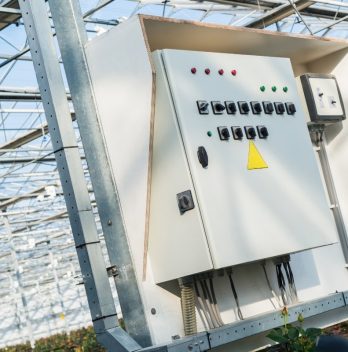
    So, this is where the lightning controller comes in. Depending on the controllers’ capacity, it will help you run 2 and even more grow lights of specific capacity smoothly. The lightning controller will bring safety and simplicity to your indoor garden.

    DIY Light Controller

    To build or set up your DIY grow light controller, simply follow the process here.

    Some Recommended Grow Light Controller Box

    If you don’t want to go through the stress of a DIY grow light controller, you can simply purchase ready-made ones. So, below are some recommended grow light controllers for your indoor garden:

    1.    Titan Controls HGC702843 Professional Series Helios 18 – 12 Light 240 Volt Controller

    Here, we have the Helios Titan controls for controlling your grow lights. It can run up to 12 high-intensity discharge (HID) grow lights at 240 volts. Therefore, you can run all your 12 lights on a single timer. Isn’t that great?

    With this Helios Titan grow light controller, you can even run two different timing programs using the dual trigger cord sets. The front panel is removable and it permits you easy access to wire the controller into your power system. It is also made of durable materials that you will enjoy for a long time.

    Titan Controls Helios 18-12 Light 240 Volt Controller

    w/Dual Trigger Cords (4/Cs), Brown/A

    We earn a commission if you make a purchase, at no additional cost to you.

    All in all, this Helios Titan control is a safe way to operate high-intensity grow light in your indoor garden.

    2.    Top Grow 8 Lighting Relay Ballast Maximum 8000W Grow Light Controller for Hydroponics

    Next, we have the Top Grow 8 light controller. This grow controller is a reliable controller that will permit you to run up to 8 grow lights. Each outlet allows you to run 1000 watts of 8 different grow lights resulting in 8000 watts total or maximum light wattage.

    The 8 outputs permit you to operate 8 different grow lights at 120/240 volts together. The light controller is also pretty durable and it will be perfect for your plants’ growing system.

    It features a trigger cord that allows you to plug into a standard 24 hours timer to vary the lighting programs.

    8 Lighting Relay Ballast Maximum 8000W Grow Light Controller
    $57.99

    Hydroponics Light controller for Indoor Double Ended Grow Lights and Grow Tents

    We earn a commission if you make a purchase, at no additional cost to you.
    12/02/2025 12:04 am GMT

    3.    Titan Controls 8-Light Controller, 240V – Spartan Series

    Here is another Titan grow controller which is suitable for running up to 8 grow lights. It allows you to operate grow light of up to 8000 watts in your indoor garden. This means you can run 8 different 1000 watt grow lights.

    The grow light controller is made of durable material. This controller is also contained in a rust and dust-free compartment as well as moisture-proof compartment.

    The Titan grow light controls also features dual cord sets that permit you to operate two separate lightning programs.

    Titan Controls – Spartan Series 8 Light Controller – 240 Volt, Tan
    We earn a commission if you make a purchase, at no additional cost to you.

    FAQ’s

    How do you make a light controller?

    What do you need? This is what I use: 1 x Raspberry Pi 3 Model B 4 x 100 watt power supplies (I got mine from Amazon) 4 x high quality heat sinks (I got mine from Amazon) 4 x 2, 1A power adapters (I got them from Amazon) 4 x 6V 2A power supplies (I got mine from Amazon) 4 x MOSFETs (I got mine from eBay) 8 x LED lights (I got mine from Amazon) The process is fairly simple. You take the LED lights and the Raspberry Pi and put them in a box. Then you connect it to your AC power supply and run it for 10 minutes to charge the battery and the battery will last long enough to grow plants. The only thing I would suggest is that you put the lights on a heat sink or a radiator to prevent the LEDs from burning up.

    How many volts does a grow light need?

    Voltage determines how much power the light bulb can provide to your plants Voltage determines the color temperature of the light bulb (e.g. warm white vs. cool white) Voltage determines how fast your plants grow (i.e.how fast they mature from seed to harvest) A higher voltage will provide more energy and produce more light. If you use a high-powered LED, it should be able to provide a sufficient amount of light for most plants. However, if you are using a low-powered LED, you may want to increase the voltage by adding an extra transformer or inverter to boost the output. You can find voltage conversion kits on Amazon or eBay. The kit usually includes a power supply with a voltage range from 12 to 60 VDC and a transformer or inverter to change the voltage to 120 VAC.

    How do you use a grow light timer?

    You can use any of the timers that are sold by GrowTek.com.  This timer allows you to choose when your lights will turn on and off. It can be used in conjunction with any grow light you buy from Growtek.com.

    What do light controllers do?

    They administer the light that you pants receive over the day. Light is the most important factor for a plant’s growth. Plants need light to grow, but also require it to produce fruits, flowers, seeds and so on. Plants also need the right amount of light. Too little light can cause plants to grow poorly or not at all. Too much light can harm plants.
    The amount of light you use depends on several things. The first thing you need to consider is the kind of plant you are growing. Some plants are sensitive to sunlight, while others tolerate it better. There are also different types of light bulbs. You may have noticed that some lights produce more light than others. This is because some bulbs have a higher wattage. If you plan to grow an indoor plant, you should use a fluorescent light. It is safe for plants and does not produce too much heat. You should also consider the position of your light. You will need to ensure that the light is positioned in a way that it reaches the plant. If you have a single plant, you should position the light so it is aimed at the leaves.

    Final Say On DIY Grow Light Controller

    Different plants require different light timing schedules for their growing needs. Therefore, it’s important you provide them the right light duration. So, you can do this by simply plugging your various grow lights into a standard timer or controller.

    There are many benefits to using a grow light controller for your plants’ growing system. You get to control more than one grow light giving them separate light timing schedules. Thus, the lightning controller offers you control, simplicity, and safety to your indoor garden. So, you can go for a DIY grow light controller or simply purchase a ready-made brand.

  • How Far Apart To Plant Pole Beans

    How Far Apart To Plant Pole Beans

    Getting to know how far apart to plant your pole beans is one step to achieving maximum bean yields.  Pole beans grow tall on climbing vines and it’s crucial you give them the appropriate spacing for the ease of gardening.

    Growing beans plants in your garden will offer you great benefits such as a large quantity of yield. You also enjoy their amazing flavor and pleasant health benefits.

    Proper spacing of pole beans gives you the ease of harvesting during the end of their bountiful harvest time. So, let’s find out how far apart to plant our pole beans.

    Planting Pole Beans

    Pole bean is a type of green beans crop. Generally, there are two types of green beans growing styles you can plant and they are pole and bush. Pole beans grow about 5 to 6 feet or even more. Therefore, pole beans require trellis or staking. On the other hand, bush beans will only grow about one foot or two feet.

    These two green beans are all climbers and both require slightly different care. But in this article, we will be focusing more on pole beans. Let’s go further to know when is the best time to grow pole beans.

    When To Plant Pole Beans

    Pole beans should be planted after the danger of frost has elapsed. Thus, they can be planted around spring or early summer.

    Pole Bean Planting Instructions

    It’s pretty easy planting pole beans and you will enjoy a great harvest if you plant them the right way. Below are the steps to planting them:

    Step 1- Sow your seeds

    Beans generally are tender legumes. They don’t thrive well when transplanted because of their fragile roots. Therefore, germinating their seeds indoors may not be advisable.

    So, the best way to plant your pole beans is to sow them directly into your soil. Make sure you push the seeds into the soil to about one or one and a half inches deep.

    Step 2- Pole Beans Spacing

    How far apart you should plant your pole beans seeds should be about 4 to 8 inches to about 3 or 4 seeds. For rows, also plant about 3 to 4 seeds and space them 2 to 3 feet apart.

    Pole Beans Spacing

    Step 3- Temperature

    Generally, green seeds are warm-weather crops and will do well in air temperature around 65 to 80 degrees Fahrenheit. Temperature is one crucial factor to consider when planting pole beans. The soil temperature in your garden should be around 50 to 60 degrees Fahrenheit. Also, the surrounding air should be around this temperature range. This will promote quick germination and prevent root rot.

    Step 4- Trellis or teepee support

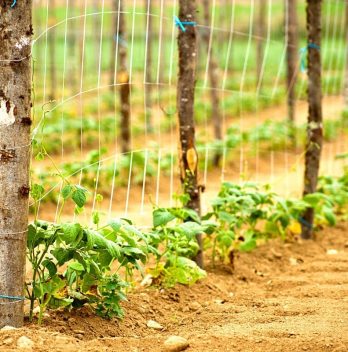
    As your pole beans grow tall or vertically, they will require support. Thus, your pole beans will need trellis or teepee for support. If you want to make use of a teepee, obtain about 3 long pole branches and they should be approximately 6 to 7 feet tall. Tie these 3 long poles together at the top and spread out the base of the support to form a circle.

    Once your poles begin to grow tall and vines grow up, tie them up to the pole. This way, you are able to train your pole beans to continue twirling around the pole throughout their growing season.

    More Tips To Growing Pole Beans

    • Use Excellent Draining Soil: The soil you will be using to grow your pole beans should be well-draining. Well-draining soil will help prevent root rot and powdery mildew. They should also be filled with lots of organic amendments so you can enjoy bountiful yield at the end of the harvest.

    • Sunlight: Supply your pole beans with a full direct sun of about 6 to 8 hours per day. The temperature should be around 60 degrees Fahrenheit preferably. However, avoid too high temperatures as this can predispose your pole beans flower to start dropping. Therefore, whenever there is high heat, we recommend using row covers to shield your beans plant.

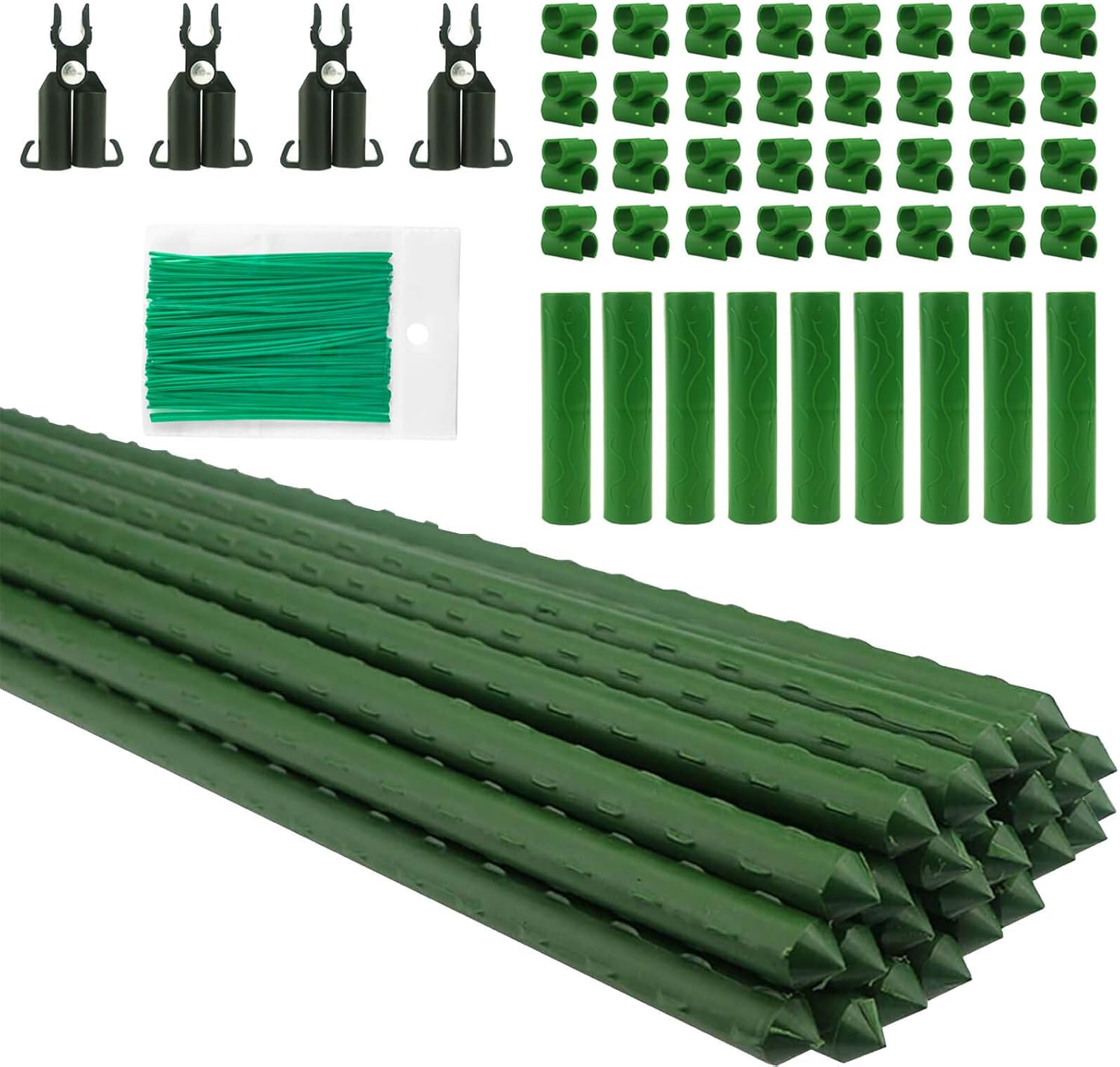
    Orgrimmar 26 PCS 48″ Garden Support Stakes Plastic Coated Deformable Climbing Plant Trellis

    71rlQAsHWDL. AC SL1500
    • Water Appropriately: Your pole beans need to be watered the right way and avoid overwatering. Watering should be applied directly to the soil to maintain good moisture and avoid drying out of the soil. Water 2 inches deep every week.

    • Mulching: We recommend mulching your soil to your bean plant. This will maintain warm soil, prevent drying out of the soil and also minimize weed. So, your plant can flourish and produce great yields.

    • Soil pH: The appropriate soil pH for pole beans is slightly acidic and the pH should be around 6.0.

    • Nutrient Application: Your pole beans will require a bit of fertilizer. You should add your fertilizer before planting your pole beans.

    • Pest & Disease Control: You can prevent diseases such as mildew by maintaining adequate air circulation between vines. Whenever you spot big insects, you can simply pick them off by hand. Then aphids can be removed by water or using neem oil.

    Harvesting Pole Beans

    Bean plants tend to produce bountiful yields and you can obtain a yield of several pounds of beans from just a single bean plant. For pole beans most varieties, you should expect your first harvest around 60 to 70 days.

    You can start to harvest your pole beans once you notice the pods are full and swollen. Ideally, you should pick your beans every 3 to 5 days as this will help prevent you from harvesting older beans. Older beans tend to be woody and bitter.

    Harvesting Pole Beans

    We encourage you to harvest your pole beans consistently as this will encourage new flowers. This will also enhance your vines to live longer.

    How far apart are bean poles?

    When planting bean seeds, it is best to space the rows about 1/2 the length of a bean seed. For example, if the row spacing is 6 inches and the seeds are about 1/4 inch long, then the space between the rows should be 3 inches. Seeds should be planted about twice as deep as they are wide.

    How tall should pole bean trellis?

    A six feet trellis should be fine.

    What should not be planted near pole beans?

    Pole beans are fairly easy to grow and are a great crop to have for a small garden.
    Pole beans are a great nitrogen fixing crop. They will help to fix some of the nitrogen in the soil and convert it to nitrates that can be used by the crops you plant next. Pole beans are often planted as a cover crop after harvest and they can be pulled or cut at ground level. If you have a large area, you could consider planting a couple of different varieties.

    However, onions, garlic and chives should not be planted near pole beans.

    Will pole beans climb string?

    They’ll climb, but not much. If you plant them right next to the supports, then they won’t grow taller than 2 feet.If you use trellis supports, you could probably get them to grow a little taller than that.

    Can you grow pole beans on a fence?

    If you have a fence (wood or metal) and the pole beans are only planted within the fence then they should be fine. They should not grow to high. If the fence is too low it might be hard for them to climb up.

    Why are my pole beans not climbing?

    Some varieties will climb if they’re in containers. You may need to stake them. Or transplant into larger containers so they’ll have room to grow. If they aren’t climbing, it’s probably because they’ve been transplanted and the roots haven’t established yet. I’d keep them for another week or two, then take a few out and look at the roots.

    It might be a matter of the bean seeds being in the ground too long.
    If there’s no soil movement, you need to get the soil moving. If you have any good tools for that (e.g. spade), then start digging, turn over the soil, till it down, etc.

    Conclusion On How Far Apart To Plant Pole Beans

    Growing pole beans will be an awesome addition to your garden. How far apart you should plant your pole beans should be around 4 to 8 inches for 3 to 4 seeds. While growing in rows, you should plant about 3 to 4 seeds and space them 2 to 3 feet apart. Remember to always support your climbing beans with stakes or trellis.

  • What Is An Action Spectrum

    What Is An Action Spectrum

    If you are wondering what an action spectrum is, we’ve got you covered here. Getting to know about the action spectrum in various plants will give you an idea of how plants make use of different lights for their development.

    The lights we see consist of various wavelengths and light has a comprehensive relationship with plants. Plants will either absorb or reflect the different colors of the light spectrum. This absorption or reflection affects the process of photosynthesis that will determine how your plants process their food.

    Now, let’s have a discussion about the role of the light absorption spectrum, light action spectrum, and how they are connected to photosynthesis. We will also talk about various plant pigments, their functions and, many more. So, let’s begin.

    Absorption And Action Spectrum

    Both absorption spectrum and action spectrum play a significant role in the plant process of photosynthesis. Let’s go further by looking at what these two entails and discuss more details on them.

    What Is An Action Spectrum?

    Firstly, let’s define what the action spectrum is. An action spectrum is an illustration (usually showed in a graph) that reveals the rate of photosynthesis at various light wavelengths. Thus, it illustrates the wavelength that propels photosynthesis.

    Action spectrum was first discovered and titled by T.W. Engelmann when he was researching on algae Cladophora. The action spectrum gives an insight into the nature of the photoreceptor involved. It also helps us understand the differences between the absorption spectrum of a known pigment. Action spectrum will illustrate the usefulness or effectiveness of light in photosynthesis.

    Maximum photosynthesis usually takes place in the red and blue light spectrum. Next, let’s take a look at what the action spectrum of photosynthesis is.

    Photosynthesis Action Spectrum

    The action spectrum of photosynthesis in any given plant will indicate high light absorption for red or violet and orange or red color spectrum. It will also show maximum light absorption in the blue region. However, it will indicate a low absorption rate for the green or yellow color spectrum.

    The colors blue and violet on the light spectrum have the shortest wavelength and the highest energy. On the other hand, red has the longest wavelength and has the least amount of energy.

    Absorption Spectrum

    The absorption spectrum will indicate all the colors of light absorbed by a given plant. It describes the electromagnetic radiation range of plant absorption. It relies on the cellular and molecular structure of a plant. So, it varies depending on the plant species.

    Absorption And Action Spectrum

    Pigments

    The pigment is a common name used for a molecule that takes in or absorbs light with color. Also, we can term pigment as any chemical compound that assimilates visible radiation between 380 nm (which is violet) and 760 nm (which is red).

    These pigments assimilate light rays from the visible part of the electromagnetic spectrum known as photosynthetically active radiation (PAR).

    Now, any type of colored substance generated by a plant is known as plant pigment. There are different pigments contained in plants and they result in the different colors we see. These plant pigments give rise to leaves’ color, flowers, as well as fruits. Now the most crucial function this pigment offers is control over the photosynthesis process with plants’ growth and development.

    Plant pigments will only absorb the wavelength of light ranging from 700 nm to 400 nm. Now, this is the ideal PAR range for plants.

    Below are the 3 major plant pigments that determine plant color:

    Chlorophyll

    This pigment is one of the most important in plants because it is directly involved in the plants’ photosynthesis. Their absorbing wavelength spectrum is 429 nm and 659 nm. They are also responsible for the violet-blue and orange-red colors.

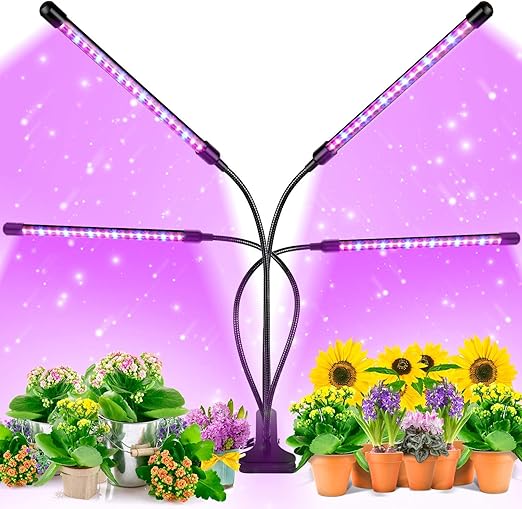
    EZORKAS 9 Dimmable Levels Grow Light with 3 Modes Timing Function for Indoor Plants

    71Bi1KCH88L. AC SX522

    Carotenoid

    They are accessory pigments. Involved indirectly in photosynthesis. Even though plants can’t photosynthesize with carotenoids, this pigment can still transfer the light energy they get down to chlorophyll.

    Carotenoid pigments are photo-receptive agents that prevent harmful reactions. They are also responsible for the orange, bright yellow, and red colors in various plants, vegetables, and fruits.

    Anthocyanins

    This pigment plays a crucial role in the reproduction of plants. It as well helps by attracting pollinators and seed disperses. They are, however, not directly involved in the photosynthesis process. But just like carotenoids, they also help shield plants from harmful rays.

    Absorption Spectrum Of Chlorophyll

    Chlorophyll is a type of pigment and in nature, we have 6 types of chlorophyll. However, in plants, there are 2 major types of chlorophyll which are chlorophyll A and chlorophyll B. The region of the spectrum that plant chlorophyll absorbs differs for both chlorophylls A and B.

    Chlorophyll A and B have different roles they play in photosynthesis. Chlorophyll A is the main pigment that is involved in photosynthesis. On the other hand, chlorophyll B is a supplementary pigment that receives light energy which it will pass to chlorophyll a.

    Absorption Spectrum Of Chlorophyll

    The color spectrum that chlorophyll A absorbs is violet and orange. On the other hand, the color spectrum that chlorophyll B absorbs is blue and yellow. Both chlorophyll a and b hardly absorb the green spectrum. The green light is reflected rather than being absorbed. So, this results in the green color of most plants.

    FAQ’s

    What does action spectrum of photosynthesis indicate?

    Photosynthesis is the process that provides the energy necessary for growth and development of plants and algae. The primary role of photosynthesis is to fix atmospheric CO~2~ into organic molecules, such as sugar or starch. Carbon is stored in plant tissues during the day and it is released at night to fuel respiration. Photosynthesis uses solar energy (in the form of photons) to create chemical energy from water and carbon dioxide.

    Photosynthetic organisms absorb light energy from the environment in order to convert it into chemical energy. In plants, this is realized by the light-harvesting complex (LHC) II and the reaction center (RC). The RC is the part of LHCII that contains the primary quinone electron acceptor Q~A~.

    The action spectrum is the distribution of photons that excite a biological reaction or process. The spectrum of the light that reaches the Earth’s surface is called the solar spectrum, and its shape is modified by absorption and scattering in the atmosphere and the Earth’s surface .

    What action spectrum indicates is the rate of photosynthesis.

    How does the light spectrum affect plant growth?

    Plants need a certain amount of energy in order to grow and thrive. This energy is provided by the sun. The energy that plants receive from the sun varies depending on how the light spectrum is. This means that plants grown under different light spectrums will have different growth rates. Sunlight is composed of different wavelengths of light. The spectrum of sunlight can be broken down into three main categories: red, green and blue. These wavelengths are all present in sunlight but are more or less prominent depending on the time of day and the season. In general, the more intense the wavelength, the greater the energy of the light. The spectrum of sunlight has an effect on the growth rate of plants in a variety of ways. For example, plants grown under a red spectrum of sunlight grow faster than those grown under a blue spectrum. Red light causes the plant’s photosynthetic pigments to absorb more of the light, which leads to increased plant growth. The opposite is true for blue light. Blue light inhibits the photosynthetic pigments of plants, which decreases plant growth.

    Additional Say On What Is An Action Spectrum

    We hope by now you have been enlightened on what an action spectrum is and you can see the role they play in a plant’s photosynthetic process and developments.

    Remember, the absorption spectrum of chlorophyll that determines photosynthesis lies in the blue and red regions. Also, light wavelengths within the range of 400 nm to 700 nm are utilized by plants for photosynthesis and this is the ideal PAR range.

  • Too Much Potassium In Plants

    Too Much Potassium In Plants

    Supplying your plants the appropriate level of potassium is beneficial to their growth. A bit of extra potassium isn’t too bad; however, too much potassium in plants can be pretty detrimental to them.

    This is why you need to know the amount of potassium needed by plants. You also need to know how to reduce potassium in soil whenever there’s an issue of excess addition in order to save your plants.

    So, let’s dive in and talk about problems caused by too much potassium, how to solve excess potassium in the plants’ soil, the benefits of potassium in the soil, and more.

    Potassium Soil

    A soil that has a healthy amount of potassium will experience plant flourishing. It is an important nutrient component required for the optimal growth of plants. Potassium is a macronutrient and it is the third value in the NPK (Nitrogen, Phosphorous, and Potassium) ratio.

    Potassium helps with photosynthesis and will enhance the rigidity of plants and also helps with disease resistance. It will also help with the drought or stress that your plant may experience.

    Potassium should be supplied in the correct amount and a little extra amount may be fine. But when it gets too much, it will lead to issues that will cause nutrient deficiency.

    Generally, the right quantity of potassium level should range from 40 to 80 ppm.

    Too Much Potassium In Plants Soil

    When potassium in plants becomes too much, it interrupts the absorption of vital nutrients such as magnesium, calcium, nitrogen, and so on. This in turn will lead to a deficiency in nutrients which will be a risk to your plants’ development.

    The first signs you will notice when there is excess potassium present in the soil is:

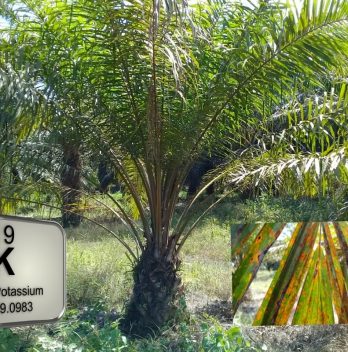
    • The leave veins may begin to show a red color patch.
    • The older growth of the lower stem will start to experience yellowing of foliage and the rest of the leaves remain light green.

    To detect or confirm excess potassium in your plant soil, simply have your soil tested. This is the only accurate way of confirming excess potassium in plants. Garden testing kits can be used to test excess potassium in soil and they can be purchased at your local garden or nursery center.

    Luster Leaf 1601 Rapitest® Soil Test Kit

    51Ftsdj9ZCL. SY445

    How To Lower Potassium In Soil

    The following things can be done to relieve the presence of excess potassium in plant soil:

    • Dilute With Water Addition: Loosen the soil with a shovel and add water to dilute and remove excess potassium in the soil. After doing this, let the soil dry totally and repeat the flushing process two or three times more.
    • Use Low Potassium Fertilizer Contents: When you are purchasing your fertilizer, the products you’re buying have the main macronutrients listed out. These main macronutrients include nitrogen (N), phosphorus (P), and potassium (K). So, to decrease potassium in plant soil, go for products that contain a low amount or zero amount of potassium (K). Note that in this case, your plant will do well without potassium.
    • Plant Cover Crops: Cover crops of legumes can also help as they will increase nitrogen fixation. This will only boost the nitrogen level without increasing potassium or phosphorus level.
    • Use Organic Manure: The ratio of NPK in organic fertilizers is usually low. Chicken manure for example has an NPK of 4:3:3. The nutrients in manure also decompose slowly which can reduce potassium build-up.
    • Remove Rocks or Stones: Rocks contain minerals such as mica and feldspar rich in potassium. Therefore, separate and remove as many stones or rocks as possible to prevent them from releasing their minerals into the soil.
    • Mix Crushed Eggshells With Soil: If you are making use of a small area, mix and dig in mussel shells or broken eggshells into the soil. This can assist in balancing nutrients in the soil. Wood ash or soft phosphate can also be added to the soil to improve calcium rather than potassium.
    Potassium Soil

    Preventive Measure

    Constant monitoring or testing your soil can help detect early if there is any excess nutrient in the soil. If your soil tests enough or high potassium level, you should refrain from adding more fertilizers that may contain potassium.

    Another thing you can do if you already have enough potassium levels in your soil is to always choose nutrient products low in potassium.

    Benefits Of Potassium In Plants

    The macronutrient potassium (in the right quantity) is essential to plants in many ways and growers rely on potassium for healthy crop production. Below are the benefits of potassium in plants:

    • In plants, the movement of nutrients, water, and carbohydrates is connected with potassium.
    • Potassium will help enhance the size and quality of vegetables and fruits. Thus, it is essential for edible foods.
    • It is used as a regular fertilizer scheme in lawns, gardens, and orchards. It also enhances the blooming of roses and other flowering plants and enhances strong stems and developed flowers.
    • The plant cell that controls water is regulated by potassium. Potassium will as well aid some enzymes in a plant cell.
    • Deficiency in potassium will cause plants to be unable to convert nutrients into nutrients required by roots, leaves, and fruits.
    • Potassium will also assist plants in water usage and it will help with drought or stress experienced by your plants. Thus, saving your plants from diseases and heat stress.
    • Enzymes activation in plants requires potassium and it helps with the production of starch, protein, as well as ATP. ATP production helps regulate the rate of photosynthesis.
    Benefits Of Potassium In Plants

    FAQ’s

    What are the effects of too much potassium in plants?

    Potassium is a mineral, one of the most common minerals in the Earth’s crust. It is an essential part of plant life, and all living things need it to grow. Plants absorb it through their roots and use it to make plant cells function properly. Some plants take up potassium in quantities far greater than other plants, but they can’t store it in their cells like other plants. So what happens when these plants take up too much potassium?

    So what happens when these plants take up too much potassium? They grow more slowly, or not at all.

    What are the symptoms of potassium in plants?

    Potassium is a mineral that is necessary for plant growth, according to the University of Maryland Extension. Potassium helps control the size of the plant, maintain healthy and strong roots, increase resistance against stress, and create energy reserves. Keep Learning The level of potassium in the soil is the first thing that needs to be considered when planning to grow plants.

    Plants that are deficient in potassium will have leaf yellowing, wilting or other signs of illness. Potassium is also a component of chlorophyll, which is what makes plants green.

    How do you fix too much potassium in soil?

    The most common way to correct this is to apply a slow release fertilizer that will be available for a longer period of time. In the case of potassium, I use something like Potashite which is a slow release fertilizer that releases potassium at a rate of about 0.5 lbs per 1000 sq. ft. over a 3 year period. Another option is to add wood ash to your soil.

    Wood ash contains potassium, magnesium, calcium and phosphorous. I would recommend adding a small amount at first until you see how much it grows, then add more if you need it. The amount that you need will depend on the size of the plant.

    Conclusion On Too Much Potassium In Plants

    There is no disputing the importance of potassium in the development of plants generally. However, you need to be aware of the right amount to supply your plant soil. Too much potassium in plant’s soil can be pretty detrimental to their growth.

    Ensure you always test your soil with the right testing tools especially when you want to apply your NPK fertilizer. When you notice you have a high level of potassium, you should make use of fertilizer with a low or zero potassium ratio.

  • Growing Spinach Indoors Hydroponics

    Growing Spinach Indoors Hydroponics

    Let’s talk about growing spinach indoors with hydroponics. The spinach veg is an excellent food loaded with many nutritional benefits. Therefore, it will be a great addition to your garden having these fresh leafy greens and they will grow so well in hydroponics.

    The spinach growing season is usually restricted to spring and fall. But with growing spinach hydroponically, you get to enjoy your spinach all year round.

    We are all about easy indoor gardening and we have outlined all you need to know about growing spinach indoors hydroponics.

    Spinach Hydroponics

    Growing spinach in hydroponics is very rewarding. You get to enjoy plucking your fresh leafy greens from your indoor garden rather than buying from the grocery stores.

    Here is a guide on how you can go about growing spinach in your hydroponics, so read on to learn more.

    Tips To Growing Spinach Indoors Hydroponics

    Let’s look at how you can germinate hydroponics spinach from seeds. So, the first thing is to germinate your seeds using rapid rooter plugs. Before germinating, always soak the seed plugs in water. Also, ensure you only put a couple of seeds into the plugs to get a successful result.

    You can sow about 4 or 5 seeds in each rapid rooter plug. To enjoy a continuous year-round harvest, you can continue to sow new seeds every couple of weeks.

    Spinach Hydroponics

    Unlike other leafy greens such as lettuce, basil, etc, it can take up to 3 weeks longer for your spinach seeds to germinate. The ideal temperature for your spinach seed to grow optimally is around 45 to 75 degrees Fahrenheit. Also, give them a light duration of about 12 to 14 hours per day.

    Avoid using a heating mat or pad because spinach is a cool-weather crop and raising their temperature can cause poor germination.

    You will need to pinch off the heads of several plants once the seedlings begin to sprout above the starter plugs. Ensure you pinch and not pull so you don’t disturb the root system. Only the healthiest or strongest seedlings should be left to continue their growing process.

    Once you notice the root emerging out of the starter cube, you can now transfer your spinach seedlings into your hydroponic system. Then you should begin your spinach growth on a one-quarter diluted solution before you increase the strength of your solution slowly.

    Hydroponic System For Growing Spinach

    We have various types of hydroponics systems and many of them can work for growing indoor hydroponics spinach.

    The best types of hydroponics to grow with spinach include nutrient film technique (NFT), raft, and deep water culture (DWC).

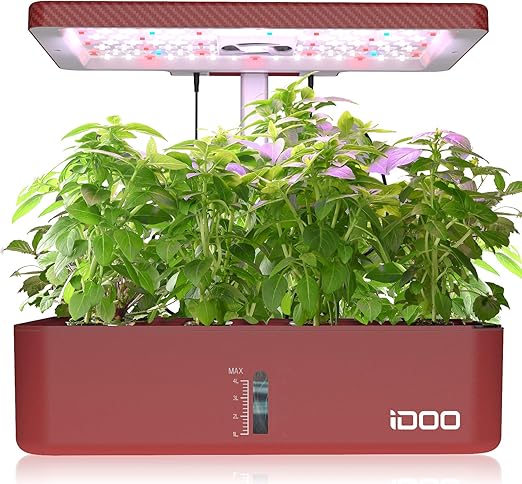
    iDOO Indoor Herb Garden Kit, 12 Pods Hydroponics Growing System with LED Grow Light

    817 zhu+feL. AC SX522

    Spinach plants usually have shallow roots, therefore, your hydroponic systems do not need to be so deep. Nevertheless, one of the easiest ways to get started with growing spinach hydroponically is by using the deep water culture system (DWC).

    Light Duration For Hydroponic Spinach

    Spinach is a low to moderate light duration requiring plant and they don’t need too much intense light. You can supply your hydroponic spinach plant with about 10 to 14 hours of light a day.

    There are many different grow light options you can go for when it comes to growing spinach indoors with hydroponics. One great choice is the fluorescent grow light. This is because of its minimal heat emission, moderate power consumption, and affordability.

    Nutrient and PH Requirement For Spinach Hydroponic

    Clearly, we want our spinach to always grow bountifully in its vegetative stage. To achieve this, you need to provide your spinach plant with NPK nutrients with a high nitrogen ratio. This same nutrient scheme will encourage only the vegetative phase and it can be used up until the harvest period.

    Therefore, nutrients high in nitrogen, as well as phosphorous, will enhance the growth of your spinach. The appropriate pH range for spinach is around 5.5 to 6.5.

    Temperature Requirements For Spinach

    Spinach does not require too high a temperature as they are cool weather crops. The appropriate temperature range for spinach is around 45 to 65 degrees Fahrenheit.

    Temperature Requirements For Spinach

    Ensure your hydroponic spinach temperature does not 70 degrees. If it gets to 70 degrees, it may lead to plant bolting. Bolting is when your plant starts entering into the flowering stage which usually leads to bitter-tasting spinach.

    Hydroponic Spinach Spacing Requirement

    Because spinach is a shallow-rooted plant, it does not need a deep grow bed. So, you can give your spinach plant about 4 to 5 inches of space apart.

    Harvest Time Duration For Spinach Hydroponics

    Spinach plants should attain their full maturity around 35 to 40 days. Just like the lettuce cut and come again, you can simply harvest a small portion of your spinach. You can as well harvest the whole plant.

    Benefits Of Growing Hydroponics Spinach

    When you grow spinach hydroponically, you enjoy lots of benefits, and below are some of these benefits:

    1. Loaded With Great Nutrients: The leafy spinach is an incredibly healthy food that can be added to your food recipes. It is loaded with iron, vitamins, and folate. It is also great nutrition for blood health and bones.
    2. Easy To Garden With: Growing spinach in hydroponics is one easy plant to garden with. Your plants will be less prone to soil-borne disease and have no stress of weeding.
    3. All-year-round Supply: Unlike when you grow spinach in an outdoor traditional garden, you may be restricted to growing spinach only during spring. But with growing spinach indoors hydroponics, you enjoy all year round freshly spinach supply.
    4. Rapid Growth: Growing spinach with hydroponics encourages faster growth and a healthy abundant yield.

    FAQ’s

    Can spinach be grown hydroponically?

    Yes. You will find that there are many different methods to choose from and you can even mix and match them to suit your needs. As long as there is adequate oxygen, water, nutrients and light, your plants will thrive.

    It is very easy to grow spinach in a hydroponic system. Most people use the soilless mix (hydroton) with rockwool or vermiculite for growing. The plants need a lot of light and need to be fertilized regularly. You should know the amount of water you are giving the plant by the size of the container. For example, a large pot will require more water than a smaller one. You can also check the potting soil for moisture content. If it is dry, you can add water.

    Can you grow spinach without fancy equipment?

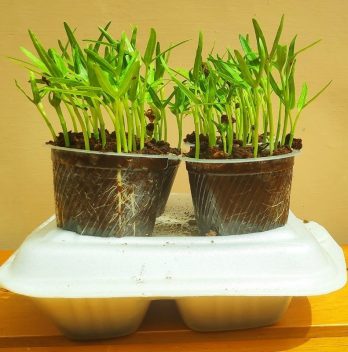
    Yes, you can. The first time I tried it, I used a plastic pot with holes drilled in it, a plastic cup for water and a piece of cloth as a growing medium. It worked pretty well. Here’s what I did: I had a 10-inch pot with holes drilled in it, so I put two pots side by side, about 2 inches apart. I put the pot that was to grow spinach in the second one.

    I put the pot with the plastic cup on top of the spinach pot, and put the plastic cup right over the holes in the spinach pot. Then, I put a small plastic cup with water in it next to the spinach pot. The plastic cup was a bit bigger than the pot, so I could put a few seeds in it and put the pot right over them. I put a little bit of soil in the bottom of the plastic pot, so that the roots wouldn’t get dried out. Then, I put some seeds in the plastic cup, and put the pot right over the seeds. When the seeds germinate, they’ll grow up through the holes in the bottom of the spinach pot and into the water. You can use any kind of seed, but I found that spinach seeds germinated the fastest.

    In a couple days, the plants will be big enough to transplant into their permanent pots. I put the little seedlings in a bigger pot, and then planted them outside in my garden.

    Do all lettuces need the same amount of light in a hydroponic system?

    The amount of light needed for spinach varies quite a bit depending on the variety of spinach that’s being grown.

    This means that if you want to have the very best crop you should look into the best types of grow lights for the type of lettuce that you are growing.

    Final Say

    As we can see, there are awesome benefits to growing spinach indoors with hydroponics. Simply follow our tips on how to successfully grow your spinach in the comfort of your home and enjoy fresh green spinach.

    Remember; keep your spinach seed moist when germinating. Transplant them into your hydroponics when the roots have sprouted out of the germinating cubes. Start with moderate nutrients and gradually raise the nutrient strength as they develop. Also, supply spinach with low light intensity and a short duration of about 12 hours daily.

  • Three Way Meter PH/Light/Moisture

    Three Way Meter PH/Light/Moisture

    If you’re looking for a garden tool to measure the soil moisture content of your soil, light, and help control pH levels in the soil, then you’re talking about the three-way meter pH/light/moisture. It is a three different soil tester in one device, isn’t that awesome?

    You may come across this gardening tool being called various names such as 3-in-1 soil tester, 3-way soil meter, soil analyzer, multi-purpose soil meter, and so on. Whichever name you see, they are all the same.

    The three-way soil meter for plants allows you to easily monitor the conditions of your plants. Therefore, you get to give your plants the best care by using this gardening tool. In this article, we will be discussing more info on the three-way PH/light/moisture meter, how to use it, and more. So, let’s begin.

    More Info On The 3 Way Soil Meter

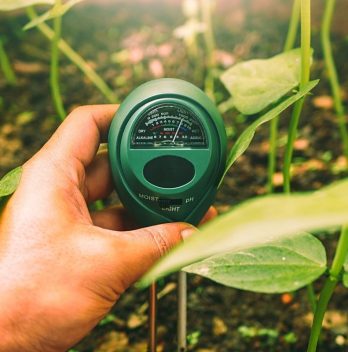
    The three-way meter PH/light/moisture is a piece of long metal equipment that is usually pushed into the soil. It is used to test measure moisture levels, soil pH, and light intensity.

    • Firstly, the three-way meter will help you monitor the pH range in the soil as they become acidic or alkaline. This way, you get to adjust the pH levels to the appropriate range that is required by the particular plant you are growing.
    • Secondly, the meter will help you test if your plants are receiving optimal sunlight for proper growth.
    • Then lastly, the meter will test for moisture level to let you know if your plants require more watering or less watering.
    More Info On The 3 Way Soil Meter

    Generally, this 3 in 1 meter is a great way of keeping in touch with the conditions of your growing plants. So, you get to offer your plants the appropriate care they need to grow strong and healthy.

    Let’s dive in further by looking at the 3 things this meter measures and their importance.

    • Importance Of Soil PH In Plants

    One crucial factor that can’t be ignored when growing different plants is the soil pH. The availability of various nutrients and how they are been absorbed by plants largely depend on soil pH.

    If the pH of your soil is out of range, your plants will not grow well and produce a good yield. They will end up looking stressed and if this is not resolved on time, your garden stands a chance of being futile.

    This is why you need to always monitor your soil pH and you can do this using the three-in-one soil pH meter.

    • Importance Of Sunlight

    Sunlight is a key factor in the growth of your plant as it is an important source of energy for all plants. Light gives off energy that is absorbed by plants which feed the process of photosynthesis. This process of photosynthesis where plants make their food is needed for the survival of your plant.

    The rays of sunlight give off different color spectrum needed by your plant in its various stages of growth.  The vegetative, flowering, and fruiting stages, all require a specific spectrum to flourish. It’s crucial you give your plants the required light.

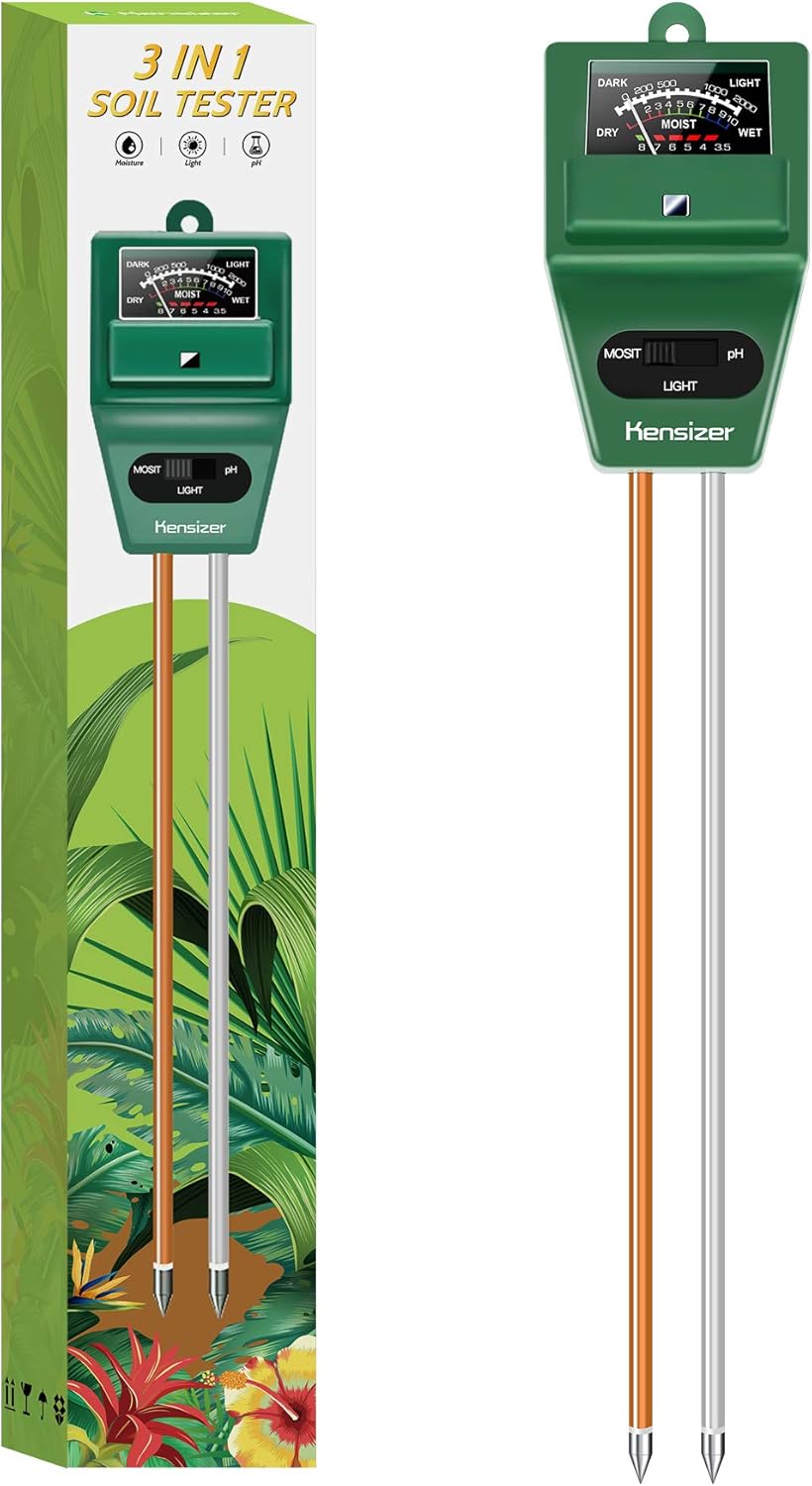
    Kensizer Soil Tester, 3-in-1 Soil Moisture/Light/pH Meter

    712vmaXJmyL. AC SL1500

    So, with the three in one soil pH meter, you can as well test for light and always give your plant the right intensity for its growth.

    • Importance Of Moisture

    The third important measurement the three in one pH meter detects is moisture level.

    When you underwater your plant, it can cause wilting, brown tips of leaves, dryness of leaves, as well as leaf curling. This shows your soil is dry and requires moisture. Overwatering on the other hand can cause brown tips of leaves, yellowing of leaves, root rot, and wilting.

    Overwatering and under watering are both detrimental to your plants and the three-way meter pH/light/moisture can help you prevent this.

    How To Use Three-Way Meter PH/Light/Moisture

    Step 1- Soil PH Testing

    To test for soil pH, dip the pointed forks into the soil. The first reading you see should be the pH and it’s measured on a scale of 1 to 14. Reading from the first value 1 which means most acidic. So, the value 14 reading most alkaline and the number 7 means neutral.

    Most plants prefer a slightly acidic medium and will preferably grow between the 6 and 7.5 pH range. You can adjust the soil pH to suit your various plants by adding limestone to increase the pH and add sulfur to lower the pH range.

    Step 2- Moisture Testing

    For moisture readings, inset the pointed fork into the soil to be tested and press the button on the meter. Go ahead and see the moisture readings. The moisture content level can be read in a 10 percent increment and it will move from no moisture to total saturation.

    Usually, the majority of the soil will prefer mid-range moisture value. So, you can always detect if you are over watering or under watering. If you find yourself overwatering, you can simply add sand to your soil to improve drainage.

    Step 3- Light Testing

    To detect light, simply push the button on your 3 way meter till it falls on light testing. The light testing can calculate the intensity of light in foot candles from the range 0 to 2,000.

    The light intensity for different plants varies. Some plants prefer full sun, while some others prefer partial sun or shade. Therefore, be aware of the type of plant variety you have and their light requirements.

    However, the light requirement for average indoor lightning is about 100-foot candles.

    Note: After every use, ensure you wipe clean the forks of the tester using distilled water and a clean cloth. Always do this between every use. This is to ensure all your readings are not contaminated or affected and to get the correct readings.

    Importance Of Sunlight

    FAQ’s

    What is a three Way PH/Light/Moisture meter?

    This 3-in-1 meter is designed to measure the relative humidity (RH) and the soil/plant water potential in one unit. It is also able to measure pH.

    It usually has an LCD screen and a touch screen and is a very compact unit that’s easy to use, and a very handy tool to have in your garden.

    They work on the same principle as an analog thermometer (a little bit more expensive). You insert a probe into the soil, and the meter will indicate the current temperature of the soil, which is the same as the air temperature, minus the water vapor content in the air, plus the humidity in the air. If there is no water in the soil, then the meter will indicate that the soil is at the dew point. If there is water in the soil, then the meter will indicate the temperature of the water.

    What is the difference between a soil probe and a moisture meter?

    A soil probe measures the relative humidity of the air around the roots of plants. It has a tip that goes into the soil, and it measures the relative humidity of the soil. A moisture meter on the other hand, measures the water potential of the soil. It does this by measuring the pressure inside a sealed chamber which is connected to the soil.

    It is not as precise as the soil probe, but it is much faster. The soil probe will tell you how moist the soil is, and it will tell you how dry the soil is. The moisture meter will tell you how dry the soil is. Both are important, and knowing both can help you get the most out of your plants. A soil probe is the best way to measure the relative humidity of the air around your plants. It will tell you if there are any problems with the air around your plants. A moisture meter is great for measuring the water potential of the soil, and it will tell you how wet or dry the soil is. It is very useful to know what the water potential of the soil is, because it tells you how much water the plant needs.

    Is it costly?

    It is a very expensive tool, which isn’t surprising as many people even have trouble figuring out how to use all of its features. In part, you’re paying for the easiness with which it is to set up.

    Most people use it as a tool to determine when it is that they should add fertilizer to their lawn, vegetables and flowers.

    Conclusion On Three Way Meter PH/Light/Moisture

    We can see the three-way pH/light/moisture meter is a great way of closely monitoring the conditions of your garden. It can be used for both outdoor and indoor gardening. Therefore, this is a great tool to have in your garden.

  • How Often Should I Flood My Ebb And Flow

    How Often Should I Flood My Ebb And Flow

    Ebb and flow also known as flood and drain have some watering schedule rules to follow.  How often you should flood your ebb and flow system will depend on different factors. So, this is why we will be enlightening you on this.

    The important thing is to flood your plants before your grow media dries out. So, you flood your plant for a particular time and drain them after the flooding time has elapsed.

    Therefore, the watering schedule of your ebb and flow system will require adequate monitoring so your plants do not drown or dry out. So, let’s dive in to know how often you should flood your ebb and flow system.

    Ebb And Flow System

    Ebb and flow or flood and drain system is a type of hydroponic system that makes use of the intermittent supply of nutrient water solution which flows over the roots of the plants.

    The nutrient solution flows also across the inert grow medium used in the ebb and flow. This grow medium ensures to retain some water for the use of plants for some time until the system is flooded again.

    The idea behind this versatile hydroponic system involves the movement of water across the grow tray from time to time. This water is rich in nutrients required for plants growth. The system has a pump that pumps the nutrient-filled solution from the reservoir below.

    Gravity is used to return the nutrient-filled water back into the reservoir where it flows back up to be reused.

    As the nutrient solution is being pumped, it moves up reaching the grow tray or container. This nutrient solution now drenches the root of the plants until they reach the water limit.

    Usually, the ebb and flow makes use of a timer that controls the water flow which goes on or off. This way, the flooding schedule is monitored. As the timer goes on, it pumps nutrient-filled water above the plants and when the timer goes off, the pump is stopped.

    However, you still need to know how long the timer should be set to know how often you should flood your ebb and flow. So let’s look into this.

    How Often Should I Flood My Ebb And Flow?

    When we talk about how often you should flood your ebb and flow, what we mean is how many times should the nutrient water flow through the plants. This will depend on the factors we are going to be looking at and this will help you deduce how to plan your hydroponics system watering schedule.

    Then once you’ve observed your plants’ response to the watering schedule you give them, you can be sure of a perfect flood and draining cycles.

    When to Flood My Ebb And Flow

    Ebb & Flow Hydroponics Tips – Factors To Consider

    1.    Size Of Plant

    The size of your plant is one determinant of how often you should flood your ebb and flow hydroponic system. The bigger the plant size, the more frequency is required to flood your system. This is because bigger plants have more stomata they use to transpire or give off water into the atmosphere.

    Therefore, smaller plants will require less flooding. You should also increase the flooding frequency as your plants grow and get bigger.

    2.    Grow Media

    There are various growing mediums that can be used in flood and drain hydroponic systems. We have Rockwool, coconut coir, vermiculite, expandable clay pebbles, and so on. But you should know that each of these grow media differs in terms of water intake and water retention.

    Grow media such as Rockwool can absorb and retain adequate moisture, thus requires minimal flood and drain cycles. However, grow media such as expandable clay pebbles requires more time to be flooded because of their slow water absorbing capacity.

    3.    Temperature

    The heat produced by sunlight or the type of grow light you have can hasten up evaporation. Domestic heating systems and some other factors may bring about a hot environment and can predispose your system to water loss. This will tell you how much to flood your ebb and flow hydroponic system.

    Also, as the season changes for outdoor ebb and flow, you will need to adjust the flooding times to suit seasonal variations.

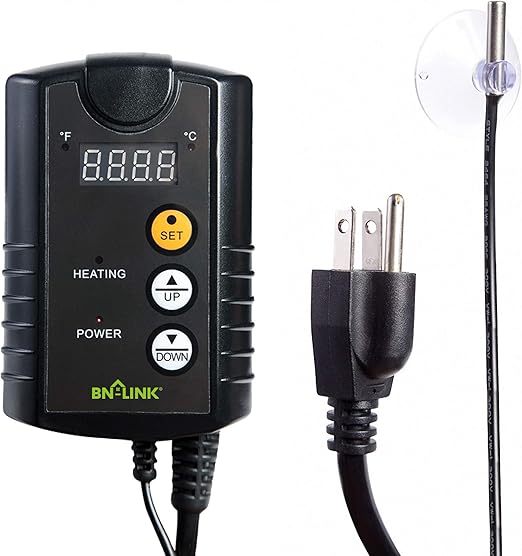
    BN-LINK Digital Heat Mat Thermostat Controller for Seed Germination

    71n290lSosL. AC SX522

    4.    Hydroponic System Size

    The size of your hydroponic system is another factor to consider when deciding your system’s flood and drain cycles. A bigger and deeper system requires lesser flood and drain cycles. On the other hand, the shallow and smaller system requires more flood and drain cycles.

    5.    Type Of Plants

    Some plants are water-loving thus requires more watering schedule while some are less water requiring. This is why you need to learn about the type of plant you will be growing. Get to know how much watering they prefer.

    6.    Light

    Light plays a role in the transpiration rate of your plants. Just as we mentioned earlier, the type of grow light used in your flood and drain hydroponic garden will contribute to the watering schedule. Therefore, in order to evaluate the flood and drain timing, consider the grow light distance to plants, power of grow light, and light duration.

    A stronger light, longer light duration, as well as a closer light distance will require more flooding cycles. This will help cover up for the lost water through the stomata in the leaves.

    7.    Humidity

    Humid environments contain saturated moisture thus, your flood and drain cycles should be minimal. On the other hand, dry environments increase transpiration in plants more. Thus, you should flood and drain your system more often.

    Ebb & Flow Hydroponics Tips - Humidity

    FAQ’s

    How often should you flood and drain?

    If you plan on using 100 gallons, you will need to fill the tank and let it sit for at least 24 hours. I would recommend doing this once a week. You will need to refill the tank with fresh water at least every other day. If you live in a humid area, you may want to add a dehumidifier to help dry out your plants. For the most part, you don’t want to keep water sitting in the system for extended periods of time. This can cause nutrient depletion and algae growth.

    What plants can be grown in a Ebb and Flow system?

    With the Ebb and Flow system, you can grow a variety of plants from herbs to fruit and veggies.
    It is a great option for growing small fruits and veggies like lettuce, strawberries, and peppers. You can even grow tomatoes, kale and cucumbers in an Ebb and Flow.
    Ebb and Flow is a technique where the growing medium is moved around the plants in a controlled fashion, alternating between dry and wet. In this way the roots are kept moist and healthy and can grow to their full potential. The flow and ebb system is a very efficient way to water your garden without the use of soil.

    What is the best medium for flood and drain?

    The best medium for flood and drain is usually a sand-based mixture, such as: Cemented sand Diatomite Clay-based media. You can use clay pebbles as well:

    How fast does hydroponic water flow?

    The flow is controlled by your pump. You could have a 1GPM (gallon per minute) pump, and you can use a 0.5GPM (half gallon per minute) pump, too. If you’re going to use an air stone, it’s important that you don’t put too much pressure on the air stone. If you do, the stone will crack and you’ll have to replace it. If you put more than 1 psi (pounds per square inch) on the stone, it will crack. So use a reasonable amount of air pressure to get the most out of your pump. I wouldn’t use an air stone at all unless you are using a very high-powered pump like a 1HP (horsepower) or 2HP pump.

    How do you control water flow in hydroponics?

    There are several ways to control the amount of water that flows through your system. The easiest way is to use a pressure regulator, and set the flow rate accordingly. You can also attach a pump to the output of your main supply line, and turn it on or off. This is less convenient, but more reliable.

    Conclusion On How Often Should I Food My Ebb And Flow

    Deciding on the appropriate watering cycles for your flood and drain hydroponic system is an important point to know. The goal is to prevent your plants and grow media from drying out completely or drowning.

    You should follow our tips above to help you decide how often you should flood your ebb and flow hydroponics system.