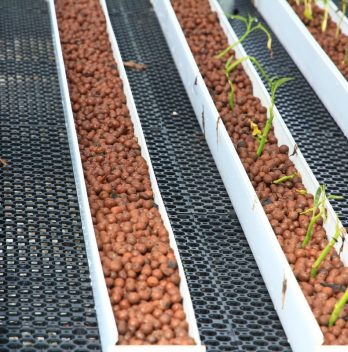
You need to know not all hydroponic growing media are suitable for aquaponics. So, one of the most appropriate growing media for your aquaponics is growstones. We will be discussing more growstones for aquaponics so read on to find out.
Growstones are great bio-filters for growing fish and veggies in your aquaponics garden. They have excellent physical integrity and you will enjoy a smooth, clean and healthy aquaponics system.
What Are Growstones?
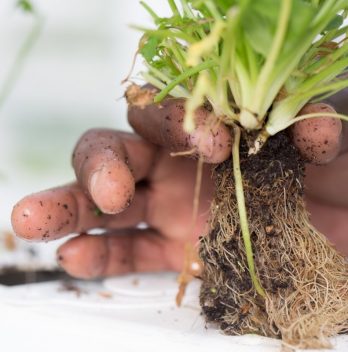
Growstones are growing media used in supporting soil-free plants in hydroponics or aquaponics. Growstones also known as hydro stones are the best growing media for your aquaponics system.
They are basically made from glass and they come in various sizes. Growstones are lightweight and porous.
They are good replacements for other grow media such as perlite, and if you know perlites, you should know it’s a mined mineral. Perlite is very easy to break and turn into a fine powder which is why growstones is a more reliable alternative for your aquaponics.
Growstones are a highly sustainable renewable resource and they can also replace clay pebbles. They can be used in aquaponics as well as all types of hydroponics.
What Growstones Has To Offer Your Aquaponics System
The benefits growstones offers your aquaponics gardens are as follows:
Growstones are reusable.
They will supply your aquaponics plants with good aeration. Even if you overwater your aquaponics plants, you don’t need to worry about root rot because of its top-notch aeration abilities. So be rest assured of a healthier root system with growstones.
Using fewer growstones than when you use perlite or other grow medium for your aquaponics will even give you better results.
Growstones have an excellent surface area which gives room for bacteria that helps convert ammonia from fish waste to nitrates to be used by the plants.
Growstones have excellent moisture retention. They can wick water up to 3 to 4 inches above the growing medium.
They will not break down or decompose into water or your system and they will maintain their physical integrity at all times. Thus, the fish reservoir tank will always remain clean throughout.
Growstones will give a neutral pH if presoaked for a couple of days before use.
Even though they are made from glass, growstones will not injure or cut you when you handle them. Also, even if growstones break, they won’t harm you.
Recommended Growstones For Aquaponics
Here are some growstones we recommend for your aquaponics system:
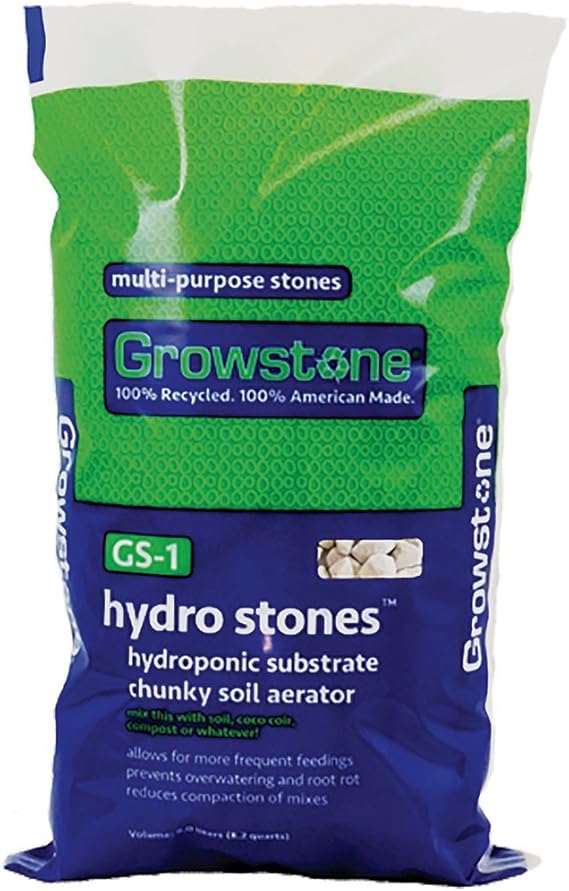
The Growstone 950HY33CF is a Gs-1 hydro stone made from recycled glass. It is a great choice for the aquaponics system, hydroponics system, as well as traditional soil mix.
It has all the properties that a growstones will offer such as optimum aeration, good drainage, and it’s a clean grow medium. This growstone will also decrease over-watering that can predispose your plant to root rot thus offering your plants a healthy and clean environment.
They are great for your aquaponics plants root as they will improve nutrient absorption that will improve healthy plant growth.
It also has a great surface area that encourages nitrifying bacteria that converts the fish waste to plant nutrients.
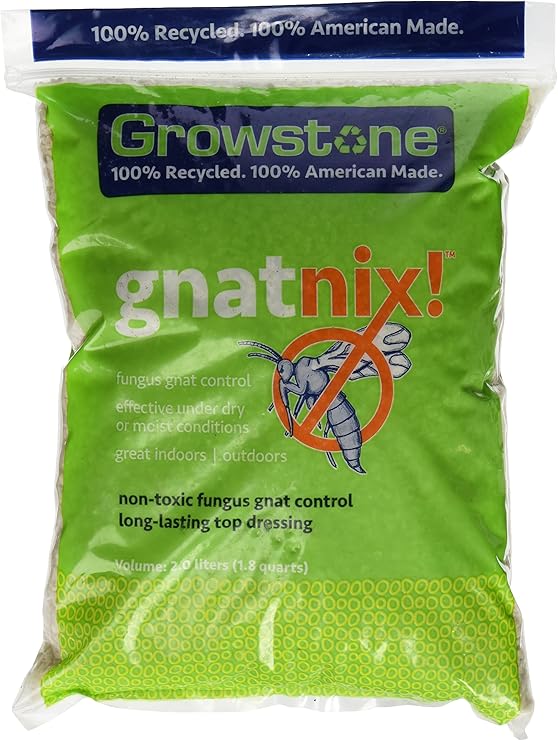
Growstone Gnat Nix control is another recommended medium you can use for your aquaponics or hydroponics system.
We particularly appreciate this growstone gnat nix control because it will offer an additional gnat control for your aquaponics garden. We do know that gnats are a common pest most soilless growers’ encounter. It will also help reduce over or under watering that can cause root rot. Therefore, your plants can grow healthily.
They are great for moisture absorption, drainage, and oxygenation. All these excellent qualities will improve your aquaponics plant development and result in greater yields.
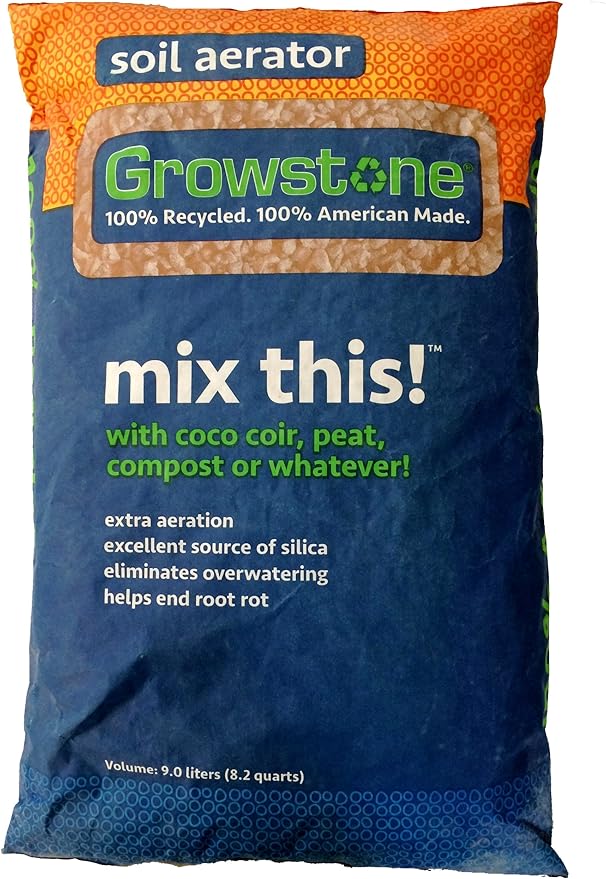
This growstone mix has been carefully mixed to suit both your hydroponics and aquaponics. It will also suit your fish as they have a good surface area that aids bacteria in converting ammonia to nitrates for plant use.
It can replace clay pebbles or perlite and it’s 100 percent made from recycled glass. Promotion of moisture absorption, good drainage, and aeration. They will also improve nutrient absorption which will help in your aquaponics plant growth.
It will also improve aeration and drainage in traditional soil, coco coir, peat, or compost.
Growstones are made of quartz that is treated to be hard and scratch-resistant. Growstones are used in conjunction with plants, which grow into the stone to anchor it in the ground. Growstones can be used in many different applications including growing succulents, herbs, cacti and more!
Growstones are made from quartz and are treated with a special adhesive that makes them extremely durable.
What are they good for?
The benefits of using growstones are numerous.
They are an easy way to have a garden or pot without the hassle of having to constantly water and maintain your plant’s soil. This means that you can enjoy your garden throughout the year and not have to worry about watering. You don’t have to continuously fertilize and weed your plant’s soil either, since growstones keep your plant’s roots planted into the ground. Growstones also provide a more stable environment for plants since they are much easier to move than pots. They also do not need to be watered as often because the soil is already moistened when the plant is placed in them
What sizes do they come in?
Growstones come in many different sizes so you can choose which one will work best for you.
These sizes range from the smallest size, which is about 1 inch by 2 inches, to the largest size, which is about 6 inches by 12 inches. The smaller sizes of growstones are great for planting small seeds or seedlings while the larger ones are ideal for large plants.
What’s a quality grow stone product?
Growstones are from Aqua-Tropical Technologies are designed to help you in your quest for high-quality plants that grow and thrive in an aquaponics system.
Growstones are a series of three, pre-cut plant containers that are specifically designed for use in an aquaponics system. They are made of a high quality plastic and they feature a built-in reservoir for water circulation and aeration.
What are the advantages of these kinds of stones?
Growstones have several advantages over other stones: They can be used for growing both fish and plants They are made from recycled glass They are durable They are easy to clean They come in various sizes They are dishwasher safe They are biodegradable Growstones are made from 100% recycled glass, and the material is durable and very strong. The pieces are also dishwasher safe, which is a huge advantage if you are cleaning your system often.
Conclusion On Growstones For Aquaponics
Growstones are perfect for the aquaponics system because they will offer you a problem-free aquaponics growing medium.
With that said, we do hope you have learned some things about growstones for aquaponics. If you have any questions don’t hesitate to ask us as we will give you a quick reply.
When you notice your plants start showing discolored leaves or poor growth, these might be symptoms of a nutrient lockout.
A nutrient lockout can be put as plants’ inability to absorb or take in nutrients. These nutrients are available, but your plants can’t just take in these nutrients; thus, the occurrence of a nutrient lockout.
Nutrient lockouts occur frequently among hydroponic growers. Most of the time, newbies are frightened when this occurs because they might think they did something wrong. The vital thing you should know is that both skilled and newbie growers experience a nutrient lockout. Also, making the right move to solving the problem is important to save your garden.
Nutrient Lockout Symptoms
Identifying nutrient lockout symptoms is very important. If you mistakenly diagnose nutrient lockout as something else, you may do the exact opposite of what’s needed, making matters worse for your plants’ health.
Below are the symptoms you will observe when it comes to diagnosing nutrient lockout:
Discoloration of leaves
A few leaf burns.
Plants stunted growth.
Deformity of plant structure.
These symptoms are quite confusing because they are similar to plant undernutrition. Some growers may not be conversant with these issues, and they may think their plants need more nutrients, so they add more nutrients.
This worsens the situation because the plants’ environment is exposed to more salts or nutrients. This, in turn, affects the system’s pH, causing more nutrient lockout.
Therefore, ensure you know the correct diagnoses to avoid nutrient overfeeding.
Inappropriate pH Range: inappropriate pH range in soil or water can cause a nutrient lockout. pH levels should be maintained and kept between 5.5 and 6.5. It should also be measured routinely. Various types of minerals contained in nutrients can only be absorbed by your plant at exact pH ranges. When your pH levels do not meet some particular ranges, an adjustment will be needed quickly.
Build-up of Excess Minerals: when excess minerals in your reservoir build-up, it will cause a nutrient lockout. Always replace your nutrient solution every week or two weeks and keep your reservoir clean. Also, you can use clean water to rinse off excess nutrients from your plants’ roots.
Adding too many Nutrients: adding excess nutrients to your garden can also cause your plants not to be able to absorb nutrients. Nutrients contain salts and too much of it increases the pH of your garden causing the nutrient lockout. Ensure you follow instructions and apply the right amount of nutrients to your plant solution.
Inappropriate Mixing of Hydroponics Nutrients: when you don’t mix your hydroponics nutrients properly, it can cause the inability of the roots of your plants to absorb nutrients. Always read and follow instructions from your nutrient pack or bottle to mix appropriately.
Solutions Nutrient Lockout
After recognizing and confirming nutrient lockout symptoms in your hydroponics or soil, the next step is to solve the problem. Here’s how to fix nutrient lockout:
Flushing
To save your garden, the first thing to do is nutrient flushing. We recommend you clean your soil or growing medium by saturating it with fresh water for 24 hours or so. Also, go ahead and empty your reservoir and rinse it well.
You can also use a special bleaching agent to flush out excess nutrients that have built up in your garden.
After successfully flushing your garden, allow the soil to dry. If you are making use of hydroponics, make sure you feed your plants with the correct amount of nutrients afterward.
How To Reduce Risk Of Nute Lockout
Just as it is important to identify and fix nutrient lockout, it is also crucial to reduce the risk of re-occurrence or running into one.
You can avoid the risk of a nutrient lockout by judiciously checking the pH level of your system. Also, when you want to change your nutrient solution, do so carefully by checking the pH level of your growing medium.
If you notice any changes in pH, flush your system when necessary. You should also ensure you don’t do flushing close to your crop harvesting time.
Digital Soil pH Meter, Industrial Grade Soil pH Tester
Calibration-Free LCD Display, High Accuracy Soil pH Pen, Soil pH Monitor for Garden, Lawn, Plant …
We earn a commission if you make a purchase, at no additional cost to you.
FAQ’s
Can overwatering cause nutrient lockout?
The amount of nitrogen that a plant can take up depends on the amount of water that it receives. If there is too little water, the plant will not be able to take up enough nitrogen and therefore become stressed. However, if there is too much water, plants are subjected to osmotic stress (the ability of the plant to hold water is impaired). This can lead to nutrient lockout, where the plant has no access to nutrients in the soil and cannot take them up.
When the roots are flooded with water, the excess water causes the cells in the root to swell, which reduces the cell’s ability to absorb water and nutrients. Overwatering also damages the root system by reducing the ability of the roots to absorb water and nutrients. In the long term, overwatering can lead to nutrient deficiency.
Can you reverse nutrient lockout?
I would not be so quick to add a new fertilizer. The reason for this is that some fertilizers will lock up nitrogen in the soil and others will do the same with phosphorous. The best way to test is to wait until your soil is at least somewhat aerated, then take a sample and test it. You should be able to tell if there is a problem by testing the soil. If you notice that the soil is acidic, then you may need to add lime. If the soil is alkaline, then you may need to add something that will raise the pH. What I would suggest is to test the soil first, then you can add the new fertilizer.
What does nitrogen toxicity look like?
The first thing that comes to mind when I think of nitrogen toxicity is how it affects plant growth. Nitrogen toxicity often results in stunted growth, which is a condition where the plant grows at a slower rate than normal and is often characterized by a smaller, bushier plant. In addition, nitrogen toxicity often leads to yellowing and chlorosis of the leaves and/or stems, and discoloration or wilting of the leaves. Nitrogen toxicity in plants can result from exposure to nitrogenous fertilizers, excessive nitrogen in the soil, or high nitrogen levels in the soil.
How do you fix overfed plants?
This is a common problem in gardeners’ lives, but it’s a simple fix. The first thing to do is to decide what type of plant you’re dealing with. If the plant is a perennial or shrub, it should be pruned to encourage new growth and to maintain the desired shape.
The next step is to figure out how much fertilizer you’ve applied. If your soil test results show that the plant requires more nutrients than the soil can provide, your best option is to add composted manure, fish emulsion or kelp meal to the soil around the base of the plant. If you prefer not to use manures, then consider applying a liquid fertilizer. Be sure to follow the manufacturer’s instructions for application. For instance, many fertilizers have specific rates for different plants, and you’ll want to use those rates when you apply fertilizer.
Bottom Line
The bottom line, nutrient lockout symptoms are common, especially in hydroponics. Regularly taking precautions in advance can avoid or reduce the risk of a nutrient lockout.
Monitoring pH levels, using the correct amount of nutrients, and routinely flushing when necessary are all excellent practices for keeping your garden safe.
Super oxygenated water in plants enhances nutrients absorption as well as root growth, especially in hydroponics. It will also assist the vegetative phase and flowering phase of your plant. This is why the importance of dissolved oxygen in plants cannot be overemphasized.
In this guide, we will be discussing super oxygenated water for plants and more. So read on to gain some knowledge.
Is Super Oxygenated Water Good for Plants?
Oxygen is definitely good for plants. You might be wondering how plants need oxygen because they take in carbon dioxide in exchange for releasing oxygen. Even though this is true, plants do need oxygen just as you and I need oxygen to breathe.
Super oxygenated water in plants equals dissolved oxygen. Dissolved oxygen is the driving force of all types of plant systems in general. Be it traditional plants or hydroponic plants, oxygen plays a significant role in your plant’s health.
Importance of Super Oxygenated Water for Plants
Nutrients Absorption: super oxygenation of water in plants improves the absorption or uptake of nutrients from your plants’ roots. Let’s take organic phosphate as an example. The presence of oxygen in your plants’ roots will oxidize organic phosphate into absorbable inorganic phosphate which can be easily absorbed and use by plants.
Sufficient Growth: super oxygenated water in your plant will increase your plant’s growth and development of roots resulting in better yield.
Aerobic Respiration: oxygen is needed by the plant root system for aerobic respiration. This aerobic respiration is an essential activity that supplies the energy needed for plant root development.
Prevent Root Rot: you need to make sure the root of your plants have access to adequate oxygen so they don’t start to rot.
How to Oxygenate Water for Plants
Water is an important factor especially when it comes to hydroponics. Oxygenated water is also a significant element in your hydroponics or aquaponics system for healthy growth.
How to Increase Dissolved Oxygen in Water for Hydroponics Plants
Oxygenating water for plants in hydroponics is essential. The roots of your plants will need to have a nice environment so they can breathe easily.
As we know the roots are embedded in the grow beds which are made up of growing media. This is why the media needs to have the ability to access adequate oxygenation for the plant roots.
So, below are some ways you can oxygenate your hydroponics plants:
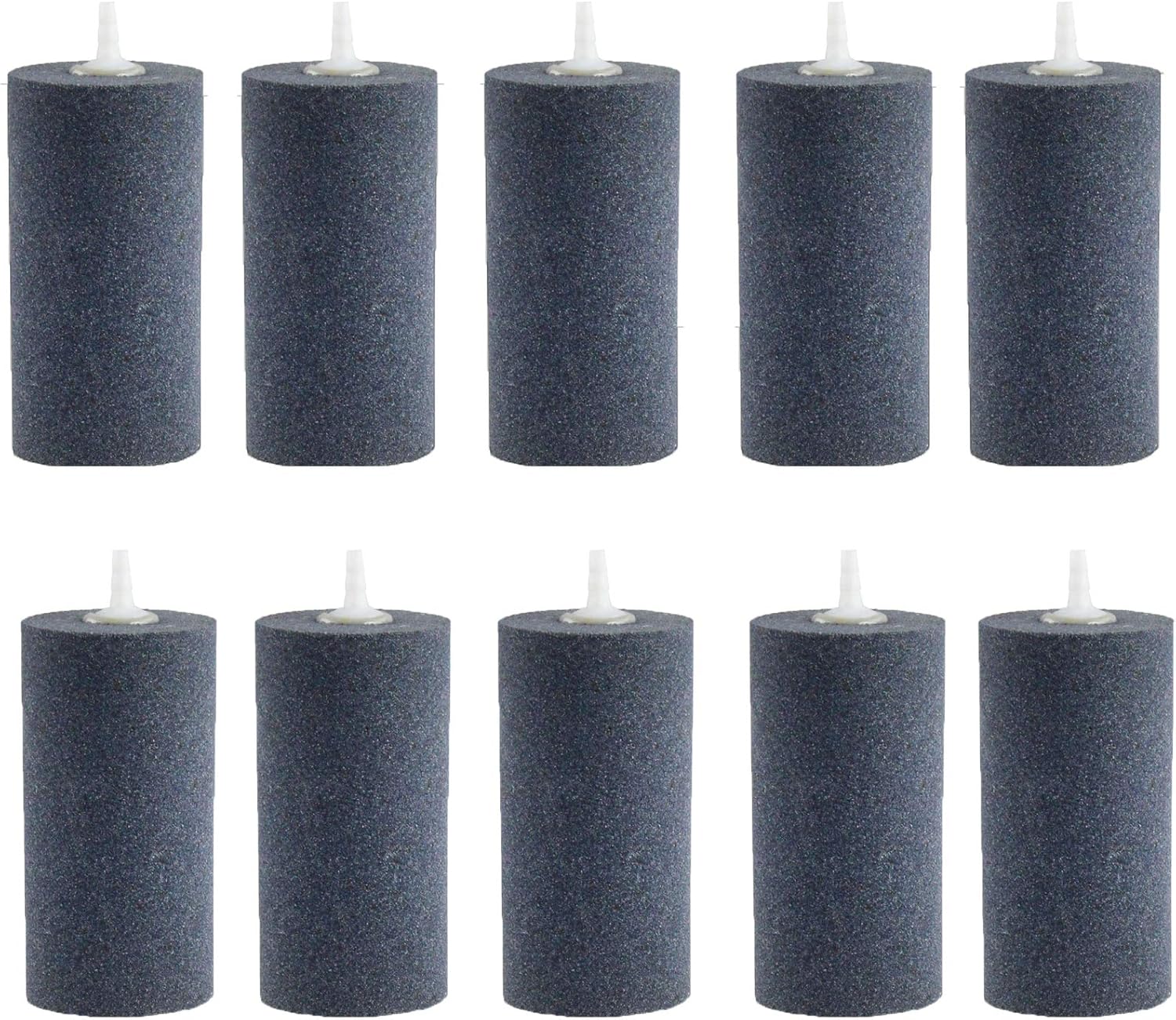
Airstone: one common method of supplying super oxygenated water to your hydroponic plants is by making use of an air stone. The pump in the hydroponics is attached to the air stone and the air is pushed through the stone. There are various sizes and shapes of air stone which makes them easy to fit excellently well into your hydroponic system. Even though some air stone produces large bubbles, we recommend purchasing the ones that produce smaller bubbles for the efficiency of supplying adequate oxygen to your root system.
Air Diffusers: another way is by using an air diffuser. Air diffusers distribute air into water by their bendable tubes. They are made up of bendable tubes having holes inside them which they use in distributing oxygen. Air diffusers release air or oxygen evenly into the tubes with their evenly distributed holes.
Siphon: the common ebb and flow (or flood and drain) in the hydroponics system makes use of siphon. Siphon is a method that spontaneously drains water from a hydroponic grow bed. As water is siphoned from the grow bed, it unveils or opens the plant root hair system to air. This process supplies oxygen to the root of the plant.
When it comes to aquaponics, it is essential for both your fish and plants to have adequate oxygen.
This is because oxygen plays a crucial role to fish development. With adequate oxygen, your fish will be very efficient in providing your plants with good nutrients and it will also increase the production of more fish for your plants’ development. Deprived of oxygen both in your fish and plants may cause them to die.
Factors that Affects Oxygen Concentration in Plants
The main factors that affect the oxygen concentration in plants are temperatures. Temperatures are a critical determinant of oxygen in plants.
During hot weather such as summer, the temperature increases and it causes a decrease in oxygen availability.
At night when the temperature is cool, there is the presence of algae in your water tank. Even though we always try to minimize the presence of algae, a little bit is important to produce oxygen in your water tank.
FAQ’s
How do you make oxygenated water for plants?
The process of making oxygenated water is known as hydroponics. It requires a special type of soil, called aeroponic media, and a special lamp that provides the light needed by the plants to grow. The oxygenated water is added to the soil in a small reservoir above the roots of the plants. In order to make this kind of system, you need some special equipment. such as an air stone.
What does aerating water do for plants?
Aerating your pond water is a great way to get the air in the water. It also helps keep the oxygen levels higher. You can use an aerator with or without electricity. You can buy them at almost any garden store. They will run on either electricity or battery power. It depends on what you like better.
What is highly oxygenated water?
Highly oxygenated water is water that has been exposed to pure oxygen. This process removes the carbon dioxide from the water and replaces it with oxygen. The amount of oxygen in the water is controlled by the concentration of dissolved oxygen (DO) in the water. The higher the concentration of DO in the water, the more oxygen the water will contain.
How do you increase oxygen in soil?
The most obvious way to increase oxygen is to add compost, but it may also be possible to improve your soil by adding extra organic matter, or by adding nitrogen fertiliser. So basically, adding compost would probably be the most effective way to increase oxygen.
How do you give plants oxygen?
Plants breathe by using the carbon dioxide we exhale and the water vapor we perspire. Plants take oxygen from the air and use it to make sugars and water. They can’t make oxygen out of nothing so they have to take it from the air. There are many different ways plants do this. For example, some plants use water to absorb the oxygen and then release it back into the air through their leaves, while others use the process known as diffusion. Diffusion is when a gas (oxygen) passes from a low concentration to a high concentration. Diffusion is a very slow process so it would not be practical to use it to remove all the oxygen from the air, but it is good at removing smaller amounts. This is what plants use to breathe.
Do all plants release oxygen?
There are two ways to answer this question. The first is to describe the process of photosynthesis and how it works in a general way. The second is to look at specific plants and see what happens when they are exposed to different levels of light. The general description In photosynthesis, light energy is captured by chlorophyll molecules in green plants and algae. These chlorophyll molecules then bind with carbon dioxide, water, and other substances to form glucose. The process releases oxygen as a waste product. The waste oxygen is expelled into the air. Some plants will actually release more oxygen when exposed to light.
Conclusion
Super oxygenated water is pretty important for the growth of your plants and the development of your plants’ roots.
Therefore, always ensure you provide sufficient oxygen for your plants so you can enjoy bountiful yield.
Just because hydroponic is a soil-free system does not mean we would not have anything to support our plants. This is why we have the hydroponic growing medium that replaces soil or dirt. So, if you’re searching for the cheapest hydroponic growing medium, then look through our guide.
We have outlined the cheapest hydroponic growing medium with the right information and some great tip to make your search easy. So, read on to know your best pick.
What Is A Hydroponic Growing Medium?
A hydroponic growing medium is a soil-free component that helps to hold sturdy or support the plant root system in the hydroponics. However, it does not provide nutrients. It is a permeable material therefore it can absorb and hold moisture, nutrients, and oxygen for the root system which is needed to grow healthily.
A hydroponic grow medium can also be a non-permeable material. You just have to increase the watering schedule so your plant root does not dry out.
Types And Characteristics Of Hydroponic Growing Medium
Before we dive into the cheapest hydroponic growing medium, let’s have an idea about the types and characteristics of some grow medium.
There are various hydroponic mediums available for your hydroponic use. Any type works great. They simply depend on the type of plant you wish to grow, the type of hydroponic system been used, and your preference.
There are so many growing mediums are accessible to suit your needs, budget, and preference. We have listed a few of the most common types of hydroponic growing medium used.
1. Rockwool
Rockwool is one soil-free hydroponic growing medium that has been in existence for a long period. It’s been longed used for plant starters and cloning. It is an inert media made from melting rock and other processes. Rockwool is meant to be pre-soaked and it has been shaped into cubes, slabs, or blocks.
Rockwool is now been used in place of starter plugs which helps in rapidly encouraging the sprouting of seeds in your farm.
2. Coco Coir
Coco coir is a famous and best-loved growing medium among hydroponic farmers. They come from the husk of coconuts and are great for hydroponic plant support and moist retention.
The soilless coco coir is loved because of its awesome characteristic protection of seed and makes them start strong. It will protect your seeds from buildup salt and too much sunlight that can harm your seeds. At the same time being a good medium free of fungi or pathogens.
3. Oasis cube
Oasis cubes is another great grow media comparable to Rockwool and they are made for both seeds and cuttings. It is an inert growing media that require no pre-soaking and has a neutral pH.
4. Expandable Clay Pebbles or Pellets
The expandable clay pebbles or pellets also called hydroton pellets is a pH neutral grow media. They are great supports for your plants which will also fit in net pots and they are reusable. Although they are not so cheap, they are cost-effective and great for your hydroponic plants.
5. Perlite
Perlite is another great media used for hydroponics. Apart from being a growing media, it is commonly used as soil additives by traditional soil growers. It is made from heating volcanic glass.
Perlite is not as good as standalone media. It is usually mixed with other grow media such as vermiculite, coco coir, as well as soil, and it’s usually mixed 50/50. Perlite is less expensive and it’s reusable.
6. Vermiculite
Vermiculite can be compared to perlites and it is made from heating mineral rocks till it expands into pebbles. It is mostly used in a mixture with other grow media.
4 Recommended Cheapest Hydroponic Growing Medium
We have listed some recommended cheapest growing medium you can go for:
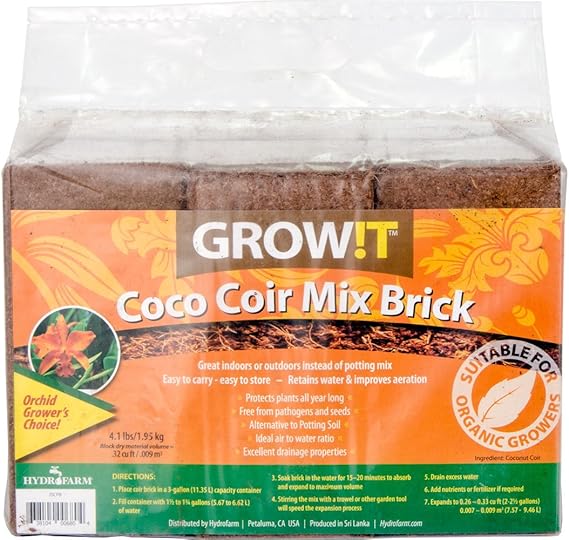
Grow!t coco coir mix is an awesome organic growing medium for your seeds and seedlings to germinate and start strong. It is one of the cheapest good quality coco coir and it’s easy to store and it expands very well. It is also biodegradable and renewable.
Another advantage we admire is that it offers protection against pathogens and fungi, therefore, giving your plant healthy growth. It also protects against the build-up salt.
Grow!t coco coir mix is a soil-free medium that holds water adequately and there’s no risk of plant drowning. It conveys nutrients throughout your plant root thereby improving plant development. It also has good aeration.
Pros
Great water retention, nutrient circulation, and aeration.
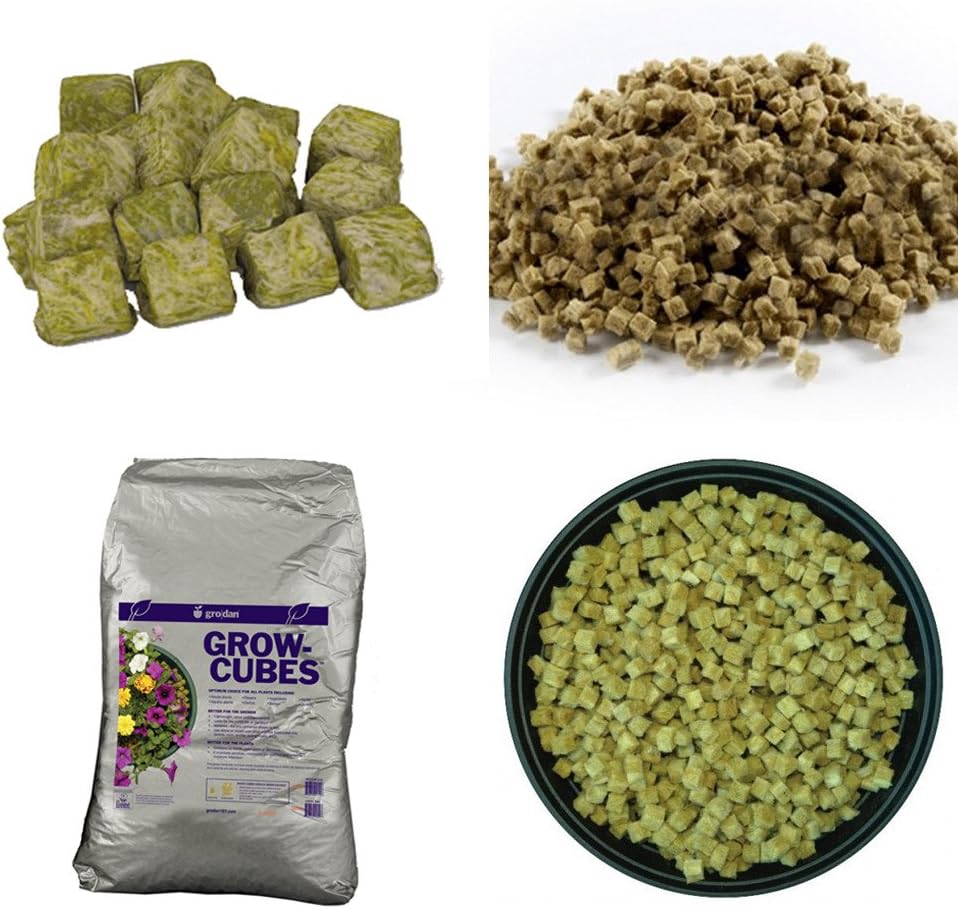
The Grodan mini cube is a type of Rockwool and it is an inexpensive hydroponic growing medium. It comes in a cotton-like candy fiber and has been compacted into various shapes such as blocks, cubes, or slabs.
Grodan mini cube will serve as a great anchor for your hydroponic plants in their various developmental stages. This type of growing media will retain moisture and deliver nutrients to your plant root. It is great in providing good air circulation (oxygen) for the growth of your plant.
We admire the fact that it comes with a pair of lovely gloves for your comfort and protection when handling your medium.
If you wish, the cuttings or seedlings you started in Grodan mini cube can be transplanted to dirt or your soilless growing medium. Grodon will work fine if all other growing conditions are met.
The downside is that they need to be presoaked and the pH range will need to be monitored.
All in all, this is a good option you can consider when choosing the cheap hydroponic growing medium if all other conditions are met.
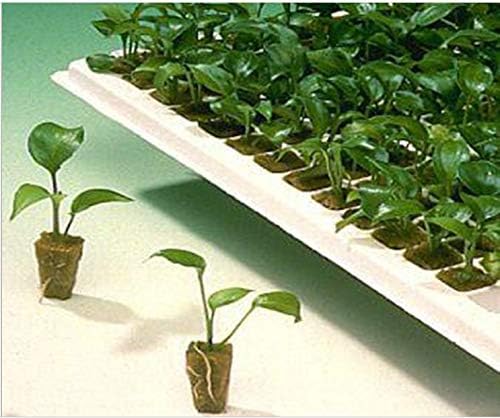
1.5 inches Rockwool is another cheap and available option for your hydroponic growing medium. It can be used for seed starters, root cuttings, and so on.
This medium provides a good anchor for your plant even for starter plants. It has great air circulation and excellent drainage properties. It also conveys nutrients to your plant root for adequate and rapid growth.
You can either use it for your garden hobby or commercial growing purpose. The size is excellent to fit into a standard flat grow tray.
Even though it requires presoaks before use, overall this is a good option you can consider when choosing the cheapest hydroponic growing medium.
Pros
Affordable.
Great for seed starters and cuttings.
Provides anchor for plants.
Great air circulations, drainage, and delivers nutrients.
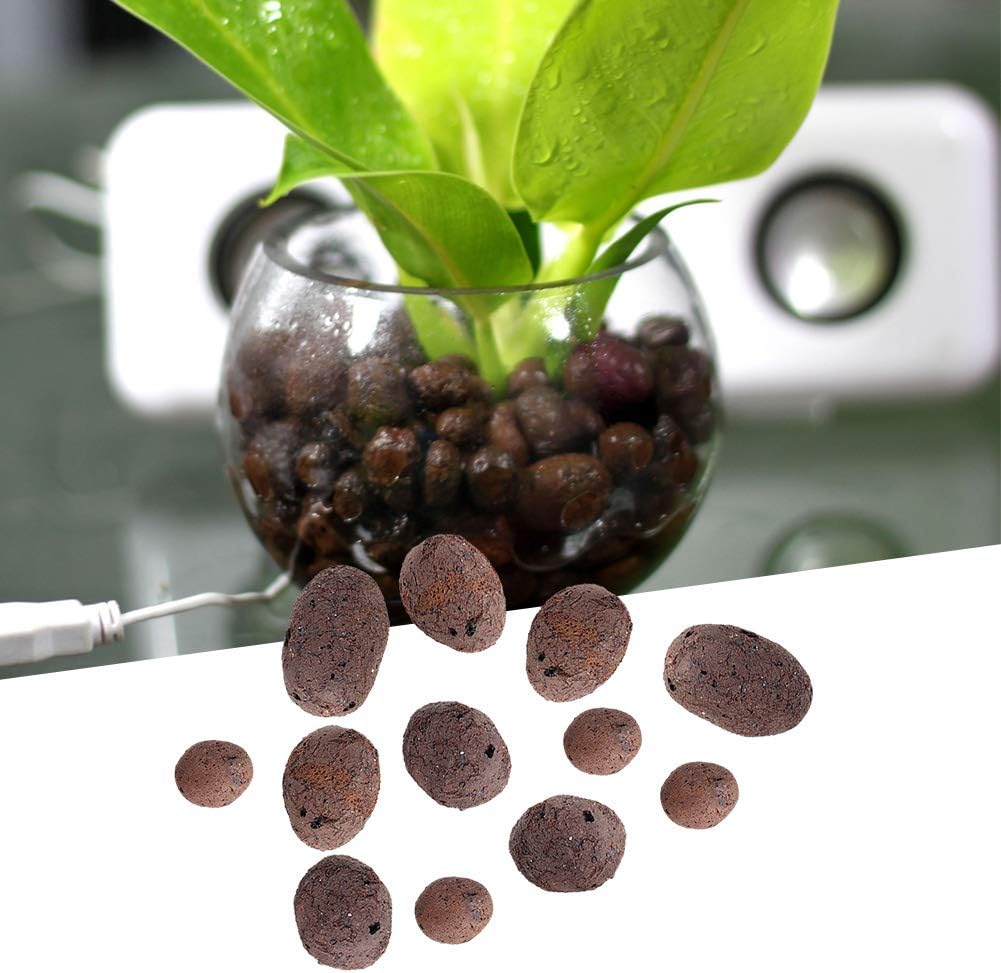
Clay pebble is another cheap soil-free hydroponic growing medium as well as aquaponics. It is safe and reliable and does not emit any toxic substances. They are also free from pests and diseases.
This growing medium is great support for your plant root and has excellent retention of moisture. It is as well a good transport media for nutrients. Another positive thing is that they are capable of storing nutrient and releasing it to the plant root slowly.
They might not be the best of the best, but you can work your way around it.
Points To Consider When Choosing The Cheapest Growing Medium
You need to put into consideration some points when choosing the cheapest hydroponic growing medium. We have outlined these points and they will help you make the right decision.
Water Holding Capacity: one important point to know when choosing your growing medium is its water retention. Because nutrients are dissolved in water, the medium needs to be able to hold water and transport nutrient solution for the usefulness of your plant growth.
Good Anchor: because there is an absence of soil that gives support: the growing medium should be able to provide an adequate anchor to hold your plant sturdy.
Aeration: the growing medium must have good air circulation which is required for your plants’ growth.
Affordability and Availability: you should also consider if the growing medium is affordable and available in your region.
You should also note that apart from choosing the right growing medium, all other growing conditions need to be met for you to have a smooth and running hydroponic garden.
FAQ’s
What growing medium is best for hydroponics?
One favorite growing medium is perlite. It’s lightweight, easy to mix into any solution and has a great absorption rate. The only thing is that it doesn’t seem to hold moisture very well. You can buy pre-mixed bags at your local gardening store. There are some good reasons to use coco coir. It’s cheap, light weight, easy to mix with water and will absorb up to 5 times its weight in water. The only thing is that it is not very absorbent so you will need to add more fertilizer to it than if you were using a more absorbent medium like peat moss or vermiculite. .
Can rocks be used in hydroponics?
I would suggest using them as an addition. If you are not familiar with hydroponics, it is a method of growing plants using nutrient solutions. It works by having the roots in a solution and the plant uses the water to transport nutrients into the root system. There are two basic types of hydroponic systems: a hanging basket system and a tray system. In a tray system, the roots are grown in a tray of nutrient solution and they are submerged in the solution. The roots grow down into the solution and the solution is constantly being replaced. This is a slow growing method because the roots are growing into the nutrient solution rather than pushing through it. In a hanging basket system, the roots grow out of the nutrient solution.
Is perlite a good hydroponic medium?
Perlite is a hydrophilic, air-filled, spherical, glassy volcanic rock. It does have some beneficial qualities, but like any other growing medium it has some drawbacks too. One big drawback is that it is very light, almost weightless, so you have to hold it up for your plants or they won’t grow well. Another major drawback is that it is a poor nutrient medium. It is a very poor nutrient medium. It does contain some nutrients, but the nutrients are so low in quantity that it is basically worthless as a nutrient source. Additionally, it is a very light material and will expand when wet.
Do you need soil for hydroponics?
No, you don´t. What is the best soil for growing plants? Hydroponic systems can be a little tricky to set up, but once it’s set up and running, it’s an easy way to grow a variety of crops. If you’re planning on growing hydroponically, then you’ll need a container that will hold water and your plant roots. These containers are called “soil-less” or “water-less.” Water-less containers are designed to be used in a hydroponic system. The main purpose of this system is to grow plants using water, rather than soil. In hydroponic gardening, you need to keep your roots constantly moist, so water-less containers are perfect for this type of gardening. It can be easy to start seeds or seedlings in a hydroponic system. This method is also great for indoor gardens.
Conclusion
Hydroponic growing medium supplies your plants good moisture so your plants do not dry out. They also convey nutrients and can act as a buffer in case your pump or any other essential part fails.
All in all, before you settle finally for a particular medium, try and experiment with the various medium. This way, you can pin down the appropriate growing medium for your plant’s growing needs.
Various plants have different growing needs and they will thrive with different growing mediums. Also, make sure all other growing requirements are met.
We recommend you give your system a trial and error so you can perfect all the needs of your hydroponic system.
Are you wondering if you can transplant your hydroponic plants to the soil? The straight-up answer is yes! You can definitely transplant your hydroponic plants into the dirt and we will teach you how to go about it successfully. So, read on to learn.
Transplanting hydroponics into the dirt is not a straightforward process to venture into. You have to consider and follow some fundamental processes for a smooth transition so your plant does not go into shock. Following the right procedure, will allow you to achieve a better performing and healthy plant.
Transplanting Hydroponic Plants To Soil
Transplanting your hydroponic plants into the soil can be done from cuttings or seedlings. Small Rockwool starter plugs or rapid rooter plugs can as well be used in cuttings and seedlings and transplanting them into the soil.
Steps On Transplanting Hydroponic Plants To Soil
To transplant your hydroponic into the soil, you first transplant it into a potting container. When they have grown and mastered the changes between indoors and outdoors, you can now transplant them into your outdoor garden.
Before you begin handling your hydroponic plants you wish to transplant, ensure you have all your materials available and set especially for fragile seedlings. This way, you don’t leave your fragile plants to linger and you can start right away. Also, the tender plant root can venture and transit seamlessly into the dirt.
Another thing before you transplant is to allow the water level in your hydroponic garden to drop and stay low for a few days. Also, don’t put or feed your hydroponic plant with direct LED light but put it close to the light and allow it to search for light.
Do this for a week or two. This way, the plant starts to adjust and harden off preparing for the outdoor experience.
Materials required for transplanting your hydroponic plants into soil include:
Get the growing pot you want to use to transplant. Obtain a pot size that fits the size of your plant. If you are planting a big plant, you should obtain a big pot and the pot should be wide and deep. This way, there is adequate room for growth and there’s space for the root which is important for your plant transition. Give your transplanted plant about 4 to 6 inches of space deep to allow them to grow. If your plants are grown and sticks together, carefully separate by breaking them up. Be careful because the plant can be prone to shock.
Step 2
Add your growing medium into the pot. Use a growing medium that has a buffer. You can make use of a potting soil mix that contains compost manure and some perlite. Spread or dig up a hole in your soil and put the hydroponic plant into the growing container and fit it through. Surround it with additional soil and adjust the plant until it’s fixed and sturdy.
The next important step is to water immediately. Always keep the soil moist because hydroponic plants are used to regular water.
Step 4
The next step is the feed them with sunlight. Take note to give them only some duration of sunlight. Do not keep them outdoors for long. They need to adjust to sunlight intensity and go through the stage of hardening. This way, they can get accustomed to sunlight and last in outdoor temperatures.
Plant Shock
If you followed the right procedure, your plant should come out well. However, your transplanted plant may suffer from shock and it’s not a rare thing to occur. Not too worry. It’s most likely the hydroponic plant transplanted is going through some recovery process as it enters shock.
You may start to notice the leaves getting soft or falling off. All you need to do is to give it some time. As the plant drops most of its leaves, new leaves will emerge as the plant recovers from shock in a couple of weeks. Always maintain a moist soil and allow the root to adjust and let it look for nutrients from the soil. This way, your plant will start to come back.
When your plants have fully recovered and are now resilient, they can now be placed outdoors.
FAQ’s
Can you repot hydroponic plants to soil?
You can, but it’s not easy. You’d have to be able to find the roots and then remove them from the pot, then replant them into a new pot of soil, preferably with some compost mixed in as well.
It’s a good idea to start with a small plant, and then build up the amount of potting mix. You should use as much potting mix as you need for the size of the plant you are growing. It’s a good idea to make a couple of small pots to test out your plants first. You can put the plants in the soil, but it will take them some time to adjust.
How do you transplant hydroponic seedlings?
Before you start transplanting your hydroponic plants into soil you need to decide whether you want to transplant the whole plant or just the roots. If you are just starting out in hydroponics I recommend that you just transplant the roots. You can do this by using a large pot and filling it with a mixture of peat moss, perlite, and vermiculite. Once the pot is full of the mixture you can take the hydroponic plant and place it in the center of the pot. Then take your knife and cut a hole in the bottom of the pot about two inches in diameter. Next take your roots and place them into the hole. Now fill the rest of the pot with more of the peat moss mixture. After you have put in all of the roots fill the rest of the pot with soil and water the plant. The most important rule to remember is that you must keep the roots wet. If the roots are dry they will die and you will lose your whole hydroponic garden.
The best way to transplant seedlings is to use a flat. I have a 5 gallon container with a lid that has a hole in the bottom, and I put my seedlings in there and then cover them with plastic wrap. The plastic will keep the soil moist while they are growing. Then when they are big enough, I take out the plastic and put them in bigger pots.
Can you use any seeds for hydroponics?
Yes, you can. For seeds, I’d suggest starting out with the best quality seeds. You could buy them from a reputable grow shop, or you can try to get them for free. The main thing to look for is good germination rates.
What vegetables can be planted using a hydroponic system?
You can grow any vegetable in a hydroponic system, as long as you provide the correct nutrients and lighting for the specific plant.
What is the most profitable hydroponic crop to grow?
Lettuce is the crops that do best in hydroponics.
Transplanting Hydroponic Plants
Transplanting hydroponic plants into the soil is really a practical process carried out by most growers. It might be somewhat tough to achieve especially for beginners, however, it’s worth the try.
But if in the end, it does not work out, you have the choice of carrying on with your hydroponic system.
Let’s talk about what a Dutch bucket is. A Dutch bucket is the central part of a type of hydroponic system method. Dutch bucket is one of the easiest, less expensive, and effective types of hydroponic systems.
Dutch bucket hydroponics is also called bato bucket system and it’s an efficient system where various plants can be grown in buckets. We have outlined all you need to know about the Dutch bucket so read on to learn.
What Is A Dutch Bucket System
Dutch bucket uses the bucket as the central core as the growing part for its plants. It is versatile and you can grow various plants from small plants to a bunch of large plants. They are sometimes used in aquaponics even though aquaponics systems are a bit difficult to set up in aquaponics.
Dutch bucket offers you the opportunity to easily grow large climbing plants such as vine. Thus, vine plants like tomatoes have been the major popular plants used in Dutch buckets by many growers. Actually, the majority of commercial hydroponics tomatoes are cultivated through Dutch bucket.
Other examples of vining plants are peppers, cucumbers, squash, beans, hops, eggplants, and potatoes. Ensure you supply adequate support for these large climbing plants especially when they become heavy.
Dutch bucket or bato bucket takes advantage of space and water and effectively. Because they are well aerated, you enjoy plentiful yield all year round.
Dutch Bucket Mechanism Of Action
First, let’s take a look at some of the requirements and components of the Dutch bucket hydroponics system. They include:
One big bucket or reservoir for holding water as well as nutrients.
Growing media type such as perlite, vermiculite, and coco coir.
Drip emitters.
PVC pipe.
Fittings and connections.
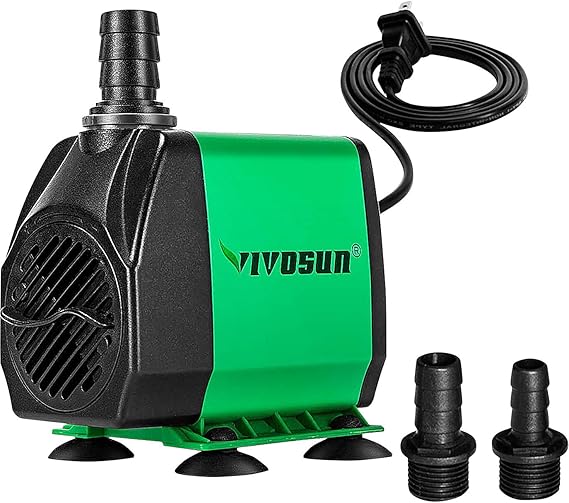
Submersible pump.
Clamps.
Now, let’s have an idea of how the Dutch bucket system works. The Dutch system makes use of the draining system technique and there are recirculation method and flow to waste method.
In a Dutch hydroponic system, the plants are grown in Dutch buckets which are lined up in a row. Keep in mind that it is crucial to use a grow media that can absorb and retain water, maintain outstanding air circulation around the roots, and give plants supports.
Drip emitters are attached along with the irrigation hose. Therefore, through the drip emitters, the plant’s roots are supplied and fed with adequate nutrients by directly pointing them to each plant’s roots.
With the big bucket or reservoir and a submerged pump that holds water and nutrients, nutrient solutions are pumped across the drip hose or irrigation path. Therefore, the pumped nutrients solution flows and drops over the plant roots through drip emitters.
In A Recirculation Method
The pipe at the base of the bucket leads to the drain. So, as nutrients are drops into the plants, the nutrient solution drops to the bottom level of the bucket and exits through the drain pipe. Therefore, the drain pipe passes the nutrient solution back into the nutrient reservoir.
The fact that the bucket does not fill up and it’s always drained back allows the root of the plants to always be exposed to adequate air. Excess nutrient solutions are returned to the reservoir. Therefore, the nutrient solutions used in feeding the plants are not lost.
This method is known as the recirculation irrigation method. In the recirculation method, you can leave the pump on to run all day, non-stop. It can run all day without monitoring.
Nutrients are not allowed to drain back into the reservoir. Therefore, they are drained out of the system without reuse. Though this option is wasteful, however, it does reduce the unbalancing of nutrients.
Below are the benefits you enjoy from making use of the Dutch system:
Dutch bucket is great for saving space for large crops and high vining crops.
An excellent option for vining crops, bushy, and fruity plants,
Very efficient in pest control because if an infestation occurs in one bucket, it can be easily replaced without affecting the other buckets or entire system.
It is very easy to set up making it a great hydroponic system for beginners.
Automated systems with a recirculation method allowing you to run the pump all day without the need for monitoring.
FAQ’s
What is a Dutch bucket used for?
Hydroponics is the use of a nutrient solution to grow plants without soil. The plants are grown in a container, usually with holes in it to allow for water to pass through and be absorbed by the roots. There are several different ways to do this, but the most common method is to use a system that consists of a bucket, which is used as the growing container, and a pump to move the nutrient solution around.
A nutrient solution is made up of a number of different substances. For example, there might be a fertilizer with nitrogen, phosphorus, potassium and micronutrients. There are also some chemicals that will help keep the water from becoming too acidic or too alkaline. In addition, there may be an anti-fungal agent to prevent disease in the soil. The purpose of the nutrient solution is to supply all the nutrients that the plant needs to grow. Hydroponic buckets can vary a lot in design. Some have holes in the sides, while others have a lid. Some may be round or square. They also vary in size and shape. The biggest problem with buckets is that they tend to be fairly heavy, so you need to be sure that it’s sturdy enough to support the weight of the plants inside. There are a few different ways to use hydroponic buckets. You can use them as growing containers for a single plant. You can use them as a growing container for multiple plants.
What is the point of aquaponics?
The term ‘Aquaponics’ was coined in 1996 by two engineers – Doug Tompkins and John Ikerd – who are now regarded as the founders of this revolutionary new technology. They believed that it could be an environmentally friendly method of producing high-quality food, whilst also providing a water recycling system. There are many different types of aquaponic systems, with varying levels of complexity and cost.
The basic concept is that fish waste is used to fertilise plants and vegetables, and this is then recycled back into the system. The nutrient-rich water that is created from this process provides a continuous source of freshwater for the fish and plants, as well as for other animals and people. In an aquaponic system, fish waste (called ‘sludge’) is removed from the tank, and this is then used to fertilise vegetables in the growing beds, which then filter out the nutrients and are returned to the fish tank. The water that is produced from the plant’s metabolism is then recycled through the growing beds, so that the plant and vegetable growth can continue without the need for any additional water. Aquaponics is a sustainable, self-contained, closed-loop system, which can be built in a small garden or on a large commercial scale. It is an innovative technology that has the potential to provide a valuable source of food for the world.
Conclusion
The Dutch bucket is an excellent type of hydroponic technique you can opt for. Thus, it is easy to set up and very efficient. It allows you to grow large and vining plants in a small amount of space and you enjoy abundant yield all year round.
Hydroponics comes with so many benefits. However, there are a few challenges to it. One of these challenges is root rot. If you are struggling with root rot in your hydroponics, not too worry. We will give you the information on how to fix root rot in your hydroponics.
Some growers experience root rot and think there’s no solution and dispose of these crops. That’s not always the case. It will interest you to know that most root rot can be fixed and we will teach you how to go about it. However, if the issue has existed for too long, your plants may perhaps be irremediable.
How To Fix Root Rot In Your Hydroponics
The first thing to fixing root rot in your hydroponics is to identify the problem. After identifying the problem, you can now take steps to solve it. Below are some ways you can detect root rot problems.
#1 Identifying Root Rot in Your Hydroponics
Signs should be checked from the leaves down to their roots. To tell if you have a root rot problem in your hydroponics, check for the following signs:
Leaves: leaves will begin turning yellow, wilting, or dry up.
Root: When you notice your leaves looking bad, that’s a sign your roots are suffering. Check your roots immediately. An unhealthy root looks tangled, slimy, and turns brown.
Smell: when you lift the lid of your tank to perceive the smell, the roots of your plant will smell funny.
#2 Fixing Root Rot Hydroponics
To stand a chance of saving your plant, early detection and taking early action is the key. Do the following quick steps to save your rotting root:
Go ahead and shut down your hydroponic system.
If your plants are in net pots, remove your plants from your hydroponic system.
Clean the root by running it underwater to eliminate the dead root and remains.
With clean scissors, cut away the infected root left.
Go ahead and drain the solution from your reservoir.
If you have a single plant hydroponic system, remove it and sterilize it. If your hydroponic system is multiple plants, isolate the infected ones, clean and sterilize them. Do not allow the root rot to affect the rest of your garden.
Now go ahead and put your system back on and running. Refill the nutrient solution.
However, if you are dealing with a large plant, cut or trim away the wilting leaves and part of the rooting root. This way, you will allow the plant to focus on rebuilding a new and healthy root system and leaves.
At the end of it all, ensure you maintain a nutrient level of about 70 degrees and adequately oxygenated. You should also keep the air pump on at all times for adequate air circulation.
Causes Of Brown Roots In Hydroponics
The major cause of root rot is poor air circulation in the water. Another reason is the lack of direct exposure of air to the root or combinations of both. It majorly occurs with a deep water culture system when the roots are exposed to water for a long time.
Although we know hydroponic farming deals majorly with water solutions, at times the roots can rot from oversaturation. This encourages and causes infiltration of pathogenic bacteria, microorganisms, and fungi to feast on the root causing root rot.
This infection can spread throughout your garden if you do not solve the problem. If you contain these infected plants early enough, you can save the rest of your uninfected hydroponic garden.
Prevention Of Root Rot In Hydroponic
You can always prevent root rot in hydroponics if you know and avoid the causes. Even before you experience root rot, it will be very helpful if you learn ahead how to quickly fix a root rot problem should in cause it happens to you. Follow the steps we outlined above to fix your rotten root.
Other steps you can take to prevent root rot are:
Maintain a clean and sterile condition of your hydroponics. Decontaminate your hydroponic system if need be and sterilize all parts of your system. Make sure there is no room for pathogenic bacteria from breeding.
Go for a suitable pump and air stone as this will enhance good air circulation.
Trim your roots religiously to encourage oxygen and nutrient to circulate easily. Don’t allow the root to overgrow and become large because they can hinder the access to important nutrients your plants need.
FAQ’s
Can hydroponic plants get root rot?
Yes, root rot can occur on plants grown in a hydroponic system. A number of factors can cause root rot, including nutrient deficiencies, poor aeration, and the presence of disease organisms. While it’s not always easy to diagnose, you may be able to use a soil test kit to determine whether a nutrient deficiency is present or if your plants are suffering from any type of fungal or bacterial infection. If you do suspect root rot, it’s important to get the plant out of the system as quickly as possible and begin treating it with a good fungicide. It’s important to make sure that the lights you use are either low-light fluorescent lamps or low-energy-consumption metal halide lamps. This will help to keep the plants from being stressed by excess light. You’ll also want to make sure that your plants have access to adequate ventilation, which is often difficult to accomplish in a hydroponic system. However, the main cause of root rot is over-watering. This causes the roots to wilt and eventually die.
What does hydroponic root rot look like?
Hydroponic root rot is a fungal disease that can affect your indoor hydroponic garden. It causes roots to become brittle and brown, and the plants will have a watery root area that is infected. The first symptom is the appearance of white fluffy roots. These roots are the hyphae of the fungus that is causing the damage. They are soft and spongy.
If you see white fluffy roots in your plants, you need to get rid of them immediately. If you do not remove them immediately, they will continue to grow and cause more harm. You can remove the roots with a sharp knife or by cutting them off at the base.
Can you over water in hydroponics?
Yes, it is possible to overwater plants in a hydroponic system.
Does high pH cause root rot?
The pH of a plant or soil is a measure of the amount of acid or base in that environment. The pH scale runs from 0 to 14 and is used to describe the strength of the acid or base in a solution. A pH of 7 is neutral; anything below 7 is acidic, while anything above 7 is alkaline. A plant’s normal pH range is between 2.5 and 1.5. A pH below 2.5 is considered too low for most plants and is often called acidic. QA PH below 3 is an indication of root rot.
Can root rot be reversed?
Yes. Root rot is caused by fungi, which are organisms that grow and reproduce in a similar manner to the bacteria that cause most other diseases. Fungi are not living organisms, but rather an organism’s spores. To prevent root rot, you need to prevent the fungal spores from germinating.
The most common root rot is caused by the fungus Phytophthora megakarya. P. megakarya is found in wet soil and has the ability to break down the cell walls of roots. When the cell walls of the root are damaged, the plant begins to decay. Other types of root rot are caused by species of Fusarium, Rhizoctonia, Pythium and Sclerotinia. There are many ways to control root rot. Preventing the fungi from germinating is one method. Another is controlling the moisture conditions around the roots. If the soil becomes too dry, the roots will not have enough water to feed them properly. Roots should also be kept moist at all times. You can also use fungicides to prevent the fungus from germinating.
Final Say
Cleanliness and good aeration are the right ways to preventing rotting of the root. Another way is to detect the symptoms on time to tackle them.
If you are experiencing root rot in your hydroponics, follow our outlined steps to fix your plants.
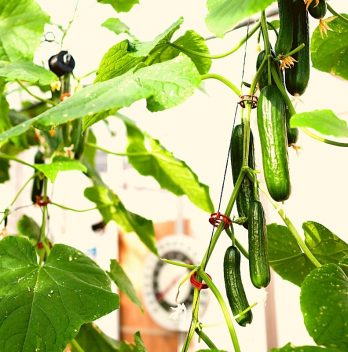
Let’s talk about the hydroponic cucumber nutrient formula. One common vine crop that is popular among farmers and gardeners is the cucumber plant. It is loved for the juicy and delicious fruits that it produces.
Hydroponic cucumbers can be grown successfully in a greenhouse setting. They are pretty easy to cultivate and they will yield fast and great results. Getting the hydroponic nutrient formula right for hydroponic cucumbers is crucial as this will provide sufficient nutrients for the plants to support all stages of their growth cycle.
Read on to learn about how to start cucumber hydroponics and the hydroponic cucumber nutrient formula requirements.
Select The Variety Of Your Choice
There are over 100 varieties of cucumbers to choose from. Some of these varieties can be easily found in supermarkets, while others are more uncommon and can only be found in specialty shops. These cucumbers can be used in various ways in the kitchen, such as pickling, slicing for salads, sandwiches, or just snacking.
Eight of the most common cucumbers are;
English cucumbers
Persian cucumbers
White cucumbers
Garden cucumbers
Kirby cucumbers
Lemon cucumbers
Armenian cucumbers
Gherkins
Some varieties are better suited for certain functions, so we that recommend you select the variety based on your preference or purpose. Choose if you want to cultivate cucumber for pickling or slicing. You should also select the variety based on your hydroponic setup. There are also resistant cucumber varieties which are an excellent choice. Note that these varieties can come in various shapes, sizes, and maturation lengths of time.
Other characteristics differentiate them. These may be useful to know if you plan to grow them:
Burpless: this type of cucumber variety tastes more delicious. It is also thin-skinned.
Spineless: this type does not have a spine or any prickly stubs. It also has smooth skin.
Bitter-free: most cucumbers are known to taste bitter when ignored and left for a long time on the vine. However, this type of cucumber variety is made to be bitter-free.
Gynoecious Cucumber: this type gives rise to female flowers. Some gynoecious cucumber varieties do not require pollination, while some do. Both however produce large numbers of flowers and will produce a lot of cucumber fruit over a relatively short period.
Hydroponic Cucumber Nutrient Formula
A balanced hydroponic cucumber nutrient formula has the right formula to support the growth of the plants at whatever stage it is at. To make a nutrient solution for cucumbers in a hydroponic medium, this is how you should do it;
Materials Needed
Plastic container, expanded clay, net pots, and hydroponic cucumber nutrient formula.
Starting Hydroponic Cucumber Seedlings
Started hydroponic cucumber in 3 ways, and they are:
Seed Germination: start with cucumber seed germination. The seeds will germinate quickly and you start to notice seedlings within 3 to 10 days.
Soil Transplant: you can as well transplant cucumber plants from soil to a hydroponics medium. You can purchase some cucumber plants from a garden store near you and transplant them into your hydroponics.
Cloning: start hydroponic cucumber with cloning as this is another great method. You can be assured of getting results of the same features or traits from the plants you used for cloning.
Type Of Hydroponic System To Choose
You need to decide which type of hydroponic will suit your cucumber. Variety is also important when choosing the type of hydroponic for your cucumber plant.
Indoor hydroponics will require space. But if you don’t have much space you can go for the bushy cucumber variety. You can go for the deepwater culture or ebb and flow system for indoor hydroponics.
We would however recommend you grow cucumber outdoors in the warmer months. This way, they can have adequate space and there will be space to produce more yield. You can make use of vertical hydroponics by training them to grow vertically. You can also opt for the drip, Dutch bucket, and bug ebb and flow systems. Use a trellis for support when your cucumber plants start to grow big.
Hydroponic Cucumber Nutrient Formula Requirements
Hydroponic cucumber nutrients have a specific formula. This is especially meant for their vegetative development. You can easily purchase these nutrient solutions online as they are readily available.
There are some nutrient solutions readily available to usher your cucumber plant into its flowering stage. Other nutrient solutions are also available to gear your cucumber plant throughout its flowering stage. Note for the flowering stage, you are required to change your nutrient scheme to lesser nitrogen. Also, add more potassium and phosphorous.
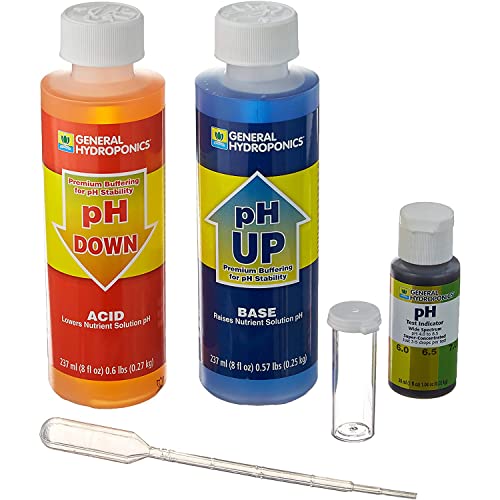
General Hydroponics pH Control Kit For A Balanced Nutrient Solution
We earn a commission if you make a purchase, at no additional cost to you.
03/10/2026 05:04 pm GMT
The one type of general nutrient scheme may be simple to use. But know that they may not provide your cucumber plants with the required nutrients tailored for the specific growth phase. Along with the right nutrient formula for your hydroponic cucumbers, other crucial environmental conditions should be maintained at an optimal range for efficient growth and production. These are;
pH – water pH for hydroponic cucumbers is key to efficient growth. The ideal pH range that the system should be kept at is between 5.5 – 6.0
Temperature – cucumber plants will thrive well in temperatures ranging from 70 to 80 degrees Fahrenheit. This temperature range will encourage and boost the growth of your cucumber plant.
So, your cucumber should be ready after 5 to 6 weeks after seed sowing.
Common Hydroponic Cucumber Problems
While growing cucumbers in hydroponics systems can be quite a breeze compared to growing them in the soil, it is however not without its share of troubles. But because these problems can be quite common and predictable, you can prepare yourself to fight them in case they do occur. Here are the 4 most common problems associated with growing cucumbers in hydroponics.
1. Powdery Mildew
Powdery mildew is a white fungus that can grow on the leaves, flowers, and fruits of the cucumber. This fungus thrives in areas that have a warm climate and provide high humidity. Environments like greenhouses are breeding grounds for powdery mildew, so if your hydroponics system is in a greenhouse your cucumbers are at high risk of getting infected. The risk will be higher in the summer and spring months.
Powdery mildew will not directly kill your cucumbers but it will steal some of the nutrients and water that the cucumber was supposed to use for growth and productivity. This will result in your cucumber plants growing slowly, becoming weak, or not even producing fruit.
The best way to treat powdery mildew is with the use of an organic fungicide that has sulfur as the main active ingredient.
Homemade remedies are another option to try. Mixtures that include potassium carbonate, soap, milk, and water work well. You could also add Neem oil to these mixtures for additional fungus-killing power.
2.Gummy Stem Blight
Gummy stem blight is another fungus that infects the stem and leaves of the cucumber plant and causes wet black lesions on the leaves and causes the stems to split and ooze a reddish brown sticky substance. If it is left untreated, the blight can travel up to the fruit and cause it to develop into black rot, resulting in the loss of a potentially good crop.
Commercial fungicides with great strength are used to treat gummy stem bight. They are applied during the prime gummy stem blight season, or when the leaves of the cucumber plant are starting to reach their full size.
3. Two Spotted Spider Mites
Two-spotted spider mites thrive in hot and dry environments. They can negatively affect the growth and productivity of cucumbers by interfering with photosynthesis.
The spider mites paper has tiny spots on the bottom of the leaves that cause them to swell, turn yellow, develop signs of necrosis, and reduced the growth of plant leaves.
If your cucumber plant is affected by these mites, the outer skin of the fruit will become rough and have a texture like that of sandpaper.
The spread of two-spotted spider mites is best controlled as soon as possible because they have very fast growth and multiplication rates, especially if the conditions are optimal for their breeding and growth.
Apply miticides or scrub the cucumber plant leaves with insecticide soap to get rid of them. You could also introduce predatory mite species that will kill the spider mites but not harm the cucumber plants.
4. Broad Mites
Broad mites feed and lay their eggs on the bottom of cucumber leaves. When infected, the shoots of the plant become distorted, the leaves begin to curl downward, and the fruits crack.
Broad mites thrive and reproduce in hot, humid conditions. They can however still reproduce and spread in cooler conditions, although at a slower rate. These mites can also spread via plant-to-plant contact, tools, and the gardener’s hands if they have come into contact with infected plants.
The application of miticides may help to a certain extent, but broad mites are resistant to most of these chemicals. The best way to deal with them is to remove all the infected plants in the garden. Also, make sure that you always clean and sanitize all the tools that you use in the garden after each use so that the spider mites do not spread.
How Long Does It Take To Grow Cucumbers Hydroponically?
After germination, cucumber plants grow very fast if the right environmental conditions are provided for them. It takes between four and six weeks from when the seed is sown to when the first cucumber is ready to pick. Cucumbers will continue to produce for three to four months after they start. To always have a cucumber crop, you can practice sequential planting
Can You Grow Cucumbers In Hydroponics?
Cucumbers are one of the most commonly grown plants in hydroponics due to the ease with which they can be grown. They can be grown as a hobby and they are also grown in hydroponics commercially.
They are best grown in greenhouses where conditions can be manipulated to suit the growth stage of the plant. Cucumbers grow best in warm temperatures of between 75 and 85 degrees F, and high light. Cooler temperatures and low light can limit the growth of cucumbers in hydroponics.
Final Note -Hydroponic Cucumber Nutrient Formula
With that said, we hope you’ve learned some things about growing cucumber hydroponically. Ensure you follow all our tips on hydroponic cucumber nutrient formula to get the best and most productive cucumber crop. Happy growing!
FAQ’s
What nutrients do hydroponic cucumbers need?
The term hydroponic cucumber refers to the fact that you do not have to provide any soil or manure for the plants to grow in. Instead, you supply the plant with a nutrient solution that they will absorb through their roots. Hydroponic cucumbers are grown in small plastic trays that are placed on top of a water source.
This is done because the water is recirculated, which prevents the growth of algae and other bacteria that could grow in soil-based cucumbers. The nutrient solution provides all the minerals and nutrients that the cucumber needs to grow. The nutrients that are used in hydroponic cucumber growing are called macro and micro nutrients. Macro nutrients are nutrients that are needed by the plant to grow. They include nitrogen, phosphorous, potassium, calcium, magnesium, boron, zinc, copper, manganese and iron. These nutrients are not as available in the soil as they are in the water. Micro nutrients are nutrients that are needed by the plant to grow but are not part of the macro nutrients. They include chlorine, copper, iron, manganese, molybdenum and zinc.
What is the best nutrient solution for hydroponics?
There are many nutrient solutions available to growers for hydroponics. However, most of these are not as efficient as they should be. There are many factors to consider when choosing a hydroponic nutrient solution, such as: Sugar content – The sugar content of the nutrient solution is very important, especially for those with high-intensity light. If the sugar content is too high, it can have an effect on photosynthesis and transpiration rates in plants. It can also have a negative effect on plant growth and development. Too low of a sugar content can result in low photosynthetic rates, plant stress, and even death. The best solution would have about 5-10% sugar. Mg/L – Magnesium is necessary for healthy cell division and chlorophyll production in plants. It is also beneficial for root hair growth. It is also essential to reduce the amount of calcium in the soil. Ca/L – Calcium is an essential mineral that is needed by plants for optimal health. Ca is the main component of cell walls, which helps with the strength and integrity of the plant. Calcium also helps promote strong cell walls, which will help the plant grow faster and thicker. K/L – Potassium is a vital element for plant growth and development. It is required for the formation of carbohydrates and proteins, as well as maintaining the cellular membrane. K is also essential to prevent plants from becoming salt-sensitive. Sulfate/L – Sulfate is an important nutrient for plants that is necessary for healthy cell division, chlorophyll production, and root hair growth. It is also essential for healthy plant growth and development. A good sulfate/L ratio is around The pH level of the nutrient solution is extremely important. A proper pH level is required for plants to properly absorb nutrients. Osmolarity – Osmolarity is a measure of the amount of dissolved solids in a solution. This number is used as a measure of the osmotic pressure of the solution. Osmolarity can be measured with an osmometer. It is important to keep the osmolarity of the nutrient solution at around 300-400 mOsm. This will help prevent the accumulation of excess salts and minerals in the soil or nutrient solution, which can be detrimental to plant growth. Dissolved Oxygen – Dissolved oxygen is one of the most important elements to consider when creating a nutrient solution for hydroponics. Too much oxygen can cause plant stress, and too little oxygen can cause plant death. A good dissolved oxygen level is around 7-10 mg/L.
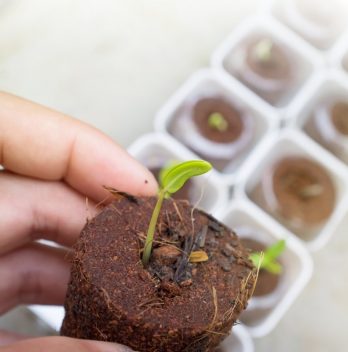
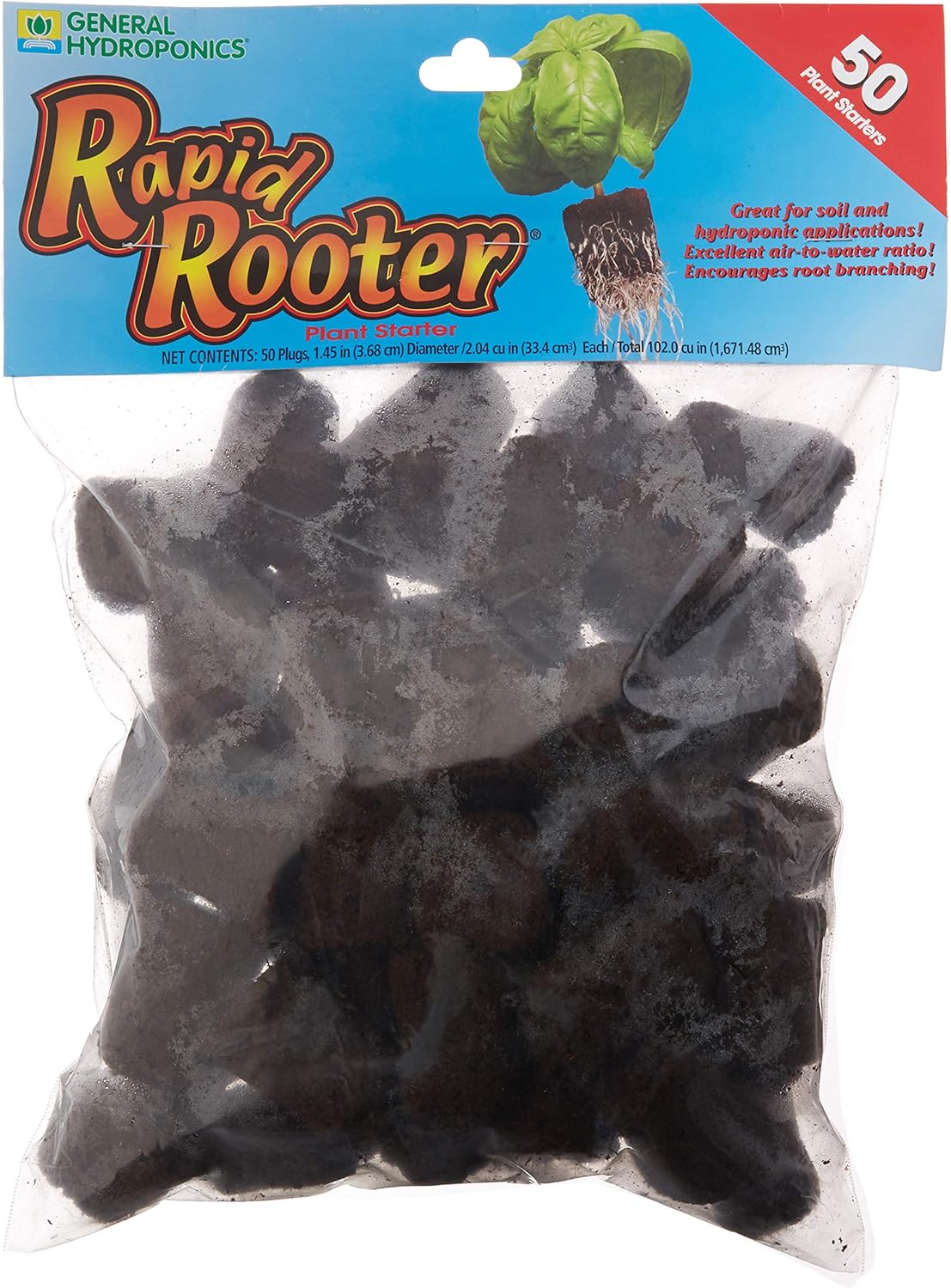
Let’s gain some knowledge about how to use rapid rooters. Rapid rooters are made up of organic materials and composted tree bark. It is a great medium for germinating seeds and cuttings, especially for your hydroponics.
Rapid rooter is one of the best grow plug to grow your seedlings and rooted cuttings. It will enhance the growth of your roots and it is easy to use, efficient, and clean.
How to Use Rapid Rooters for Your Hydroponic
Rapid rooters can both be transplanted in hydroponics and into dirt or soil making them versatile. So follow the steps below to know how to use rapid rooters for your hydroponic garden or soil:
Step 1- Soak your Rapid Rooter Plugs
Get distilled water and soak your rapid rooter plugs to rehydrate them. You can soak them for a few hours or up to 24 hours.
Before putting your rapid rooter inside its holes where the seeds are to be placed, you can tear a tiny part from the bottom. This way, the seeds are kept in a dark place. When you are done soaking, put the rapid rooter plugs in the grow tray.
Step 2 – Seed Planting
Next is to plant your seeds. Put a seed or more in the holes of each plug. To enhance the rate of successful germination for each of the rapid rooter plug, we recommend you plant more than a seed. These seeds need low light or darkness for seed germination.
Step 3 – Keep Moist and Cover Grow Tray
You will need to keep the rapid rooter moist by filling the grow tray with about a ¼ inch of water in the tray below. The rapid rooter plug can absorb moisture from the tray and stays hydrated.
The success of the germination rate will increase if you apply some heat. To keep a warm temperature, you can make use of a seedling heat mat below the tray.
Cover the tray with a dome so it can remain in a warm and damp condition. Over-watering them too much is a bad idea.
Transplanting Your Seedlings from Rapid Rooters Plugs
After a couple of weeks, the seedlings sprout, therefore, they can now be placed under light to boost their growth. When the roots start shooting out of the bottom of the rapid rooter plug, that’s a sign to sign it’s ready to be transplanted into your hydroponics or dirt.
Transplanting to Your Hydroponics
You can transplant your seedlings into any hydroponic grow medium, you can also transplant into dirt or soil. After transplanting them into your hydroponic system, supply just a little dose of nutrient solution.
How to Use Rapid Rooters for Cloning
Apart from making use of rapid rooters for your seed germination, they are also a perfect choice for starting clones. Also, you can use the cloned plant for your hydroponic or dirt. Follow these steps to use rapid rooters for cloning your plants.
Cloning your plants with rapid rooters is pretty similar to seed germination. The first thing to do is to soak your rapid rooter in distilled water for a couple of hours to rehydrate them. Now place the rapid rooter in the growing tray that is meant for holding your clones.
Afterward, obtain a cutting of the plant you wish to clone, the cuttings should some leaves and stem of a minimum of 2 inches. The bottom of the stem should be an inch or two inches bare. You can take away some leaves at the bottom of the stem to expose them.
Cut the base of the stem into an angle of 45 degrees. Now insert your prepared cuttings into a rooting hormone. You can now put the cutting into the hole of the rapid rooter. Push the cutting down the rapid rooter so it can stand upright. Now put the clone in your rapid rooter tray and do the above steps for other clones.
Keep this set up in a dark place and medium heat conditions to promote growth. Therefore, we recommend you use a flat surface tray and heat mat underneath. The tray underneath should also be damp. Do this by putting filling the tray with around a quarter-inch of water. You should begin to see roots shooting out of the base of the rapid rooter plug after a couple of weeks.
Transplant them to your hydroponics or soil.
FAQ’s
How do you use rapid rooter plugs?
This is a very good question. Rapid rooter plugs are one of the most effective ways to remove roots from your lawn. They are also useful for other jobs, such as plugging cracks in concrete, repairing foundation walls, and removing stumps. There are many different types of rapid rooter plugs, but all of them work on the same principle.
First, they are used to create a small trench in the ground where you want roots removed. You may use a power trowel or even a trowel with a blade to dig this trench. Then you insert the plug into the hole and tamp it down so that it is firmly in place. Rapid Rooter Plugs for Lawns If you want to remove roots from your lawn, then the first thing you should do is to dig out the area around the roots. This means you have to remove soil from the immediate vicinity of the roots. If you don’t dig up the roots, they will grow back and you will not be able to remove them again. You can use a regular garden trowel to dig out the roots, but it is much easier to use a power trowel to do the job. You will need a power trowel that has a blade.
To get the best results, you should dig a trench about six inches deep. You may use a power trowel to do this job, but it is easier to use a shovel. You should dig out the root, cut it off at the base, and then dispose of it in a garbage bin. For those who have an older lawn, it might take a bit more time for the grass to grow back. With a new lawn, you should notice that it is growing back quickly. You should be able to see results within a couple of weeks, depending on how big of a hole you dug. The area around the hole should look much better once the roots are removed. You should also be able to see that the roots have been removed. Once you remove all the roots, you can fill up the hole with soil and grass seed. If you want to plant flowers or shrubs in your garden, you can do that now. You will need to keep up with mowing and watering, but you can do this easily by using a power mower and sprinkler system.
How do you store Rapid Rooter plugs?
I would say that any type of storage is good for this type of product, but I would suggest keeping them out of direct sunlight or light of any kind. If you do put them in the freezer, make sure that you keep the moisture level low so that they don’t freeze up. I have also heard that if you keep them on a regular basis in your refrigerator, they last longer. You can also clean them by soaking them in vinegar for about 15 minutes and then wash them off in warm water. You might want to keep them in an airtight container to keep them from drying out. I have had my rapid rooter plugs for about 6 years now. They are still good. I keep mine in the freezer because it is cold.
When can I transplant from Rapid Rooter?
To get the best growth, we recommend transplanting your rapid rooter as soon as possible. You can even transplant a rapid rooter before it has completely filled with roots. In fact, some people do this with their rapid rooters to start their rapid rooter plants. We suggest you do not let your rapid rooter sit in water for more than 24 hours after transplanting.
If you do, you will not be able to water your rapid rooter plant properly. Also, don’t wait too long to transplant a rapid rooter. The roots of a rapid rooter need to be exposed to air and light during the transplanting process.
Conclusion
Rapid rooters do a great job when used for rooting and they are ideal for cuttings and seedlings. It promotes healthy and vigorous early rooting for the development of your plant.
Follow our procedure on how to use rapid rooters for your seeds and enjoy great results.
When it comes to catching tilapia, you need to know the best bait for tilapia to make your angling rewarding. To be successful in fishing tilapia, you need to master some skills and be patient to boost your likelihood of catching fish.
Tilapia fish is mainly herbivores and they are a shy type of fish, making them tricky to entice or lure. We will give you the best bait for tilapia to increase your chances of successfully catching tilapia anytime you go out to fish. So, let’s explore.
Best Bait to Use for Tilapia
The best part is tilapias are herbivores therefore you don’t need to spend your money on costly bait such as minnows or nightcrawlers. Their collection of food comprises algae and other little aquatic plants. Below is some of the best bait to catch tilapia fish:
1. Pea: Peas are great bait for tilapia and we recommend using a frozen pea so they can stay well on the hook. You can easily purchase peas from the stores, online, etc. Whether you make use of shelled green peas or canned peas, they are all the same.
2. Corn: Corn is the most common bait used by fishermen. The five types of corn used in angling include frozen corn, feed corn, canned sweet corn, imitation corn, and flavored corn bait. The most productive corn bait amidst this corn is frozen corn and canned sweet corn. Apart from luring tilapia, corn also lures trout, catfish, and perch.
3. Bread balls: if pea or corn is not easy to get, you can make use of bread balls. Also if the bread ball does not stay well on the hook, you can freeze the balls. This way, the balls get hard enough to let the hook penetrate and stay well.
4. Earthworms: you can also opt for earthworms for catching tilapia fish and you can obtain earthworms from vermicomposting. Ensure they are looking like little invertebrates to enhance the chances of these tilapia fish eating them.
Apart from obtaining the right bait, you need also to know and learn some tips on how to successfully catch a tilapia fish. Here are some tips for successfully catching tilapia fish:
Spawning Season, the Best Period to Fish for tilapia: the most productive time to fish for tilapia is during their spawning season. Spawning usually occurs when the water temperature drops 60 degrees Fahrenheit. During this period, tilapias are extremely territorial and they attack anything that comes in the way of their spawning beds. This will improve the chances of hooking down the fish increasing your catch.
Shallow Angling: the shallow waters are ideal for angling. This is because, during the spawning period, tilapia prefers to spawn in shallow waters. This is because there is adequate vegetation and they can hide from predators and other fish.
Dodge their Spawning Bed: refrain from getting too close to their spawning beds. Tilapias are shy and can be easily spooked. You don’t want to chase them away and miss the opportunity of catching them. Instead, you can fish from the shore.
Time of the Day to Catch Tilapia: it is ideal to catch tilapia any time of the day. However, to increase your chances, fish during the early sunrise, evenings during sunset, and midday.
Hook Bait the Right Way: sometimes, anglers are not aware their bait has been mouthed by the tilapia fish. Use short lures rather than big lures so you can get a strong hook and ensure the tip of the hook is exposed. Some good tip if you’re a beginner is to take time to practice how to hook various lures.
Amazon Choice Selection
Ned-Rig-Kit-Finesse-Baits-Soft-Plastic-Worms-Fising-Lure for Bass Stick Swimbait Minnow Crawfish Lures Shroom Ned Jig Head Kit
We earn a commission if you make a purchase, at no additional cost to you.
03/10/2026 05:05 pm GMT
When you’ve successfully caught a tilapia fish, handle the hooked fish with care. You want to avoid tearing the fragile mouth of the tilapia off the hook. We suggest you delay about 5 seconds to set the hook as the fish fight before bringing up the fish rod.
How to Make Dough Bait for Tilapia?
You can use this simple recipe for dough bait to better your chances of catching big tilapia:
The ingredients you’ll need:
1 cup of flour
1/2 cup of cornmeal
1 tablespoon of sugar
1 teaspoon of salt
1/4 cup of water
Instructions:
Mix the flour, cornmeal, sugar, and salt in a medium-sized bowl.
Gradually add water to the dry ingredients. Stir it constantly. Mix everything until it forms a dough that’s firm and pliable but not sticky.
Divide the dough into small balls. You can keep a golf ball in mind when thinking about size.
Use the raw dough balls on your hook!
Note: Be sure to use fresh, high-quality dough balls as bait. Old or stale dough balls may be less effective at attracting fish.
How Do You Catch Big Tilapia?
You can up your chances of catching big tilapia if you use the right bait, fishing techniques, and equipment. Here are some tips to help you:
Use The Right Bait: Tilapia are opportunistic feeders. This means they’ll eat just about anything they get! Dough bait, worms, and corn are all effective.
Use a Heavier Weight: Tilapia are not the strongest fish. Typically, using heavy weights is not necessary. But if you want to catch the big ones, you need to get your bait down to the bottom where the bigger tilapia roam.
Use a Longer Rod: You do not need a heavy-duty rod to catch tilapia, but a long one can give you more leverage.
Use The Right Fishing Techniques: Tilapia are more active during the early morning and late afternoon. These are the best times to go after the big ones. You should also use moving bait. A slow, steady retrieve can help you catch bigger fish.
Note: Be patient when trying to catch tilapia, especially the big ones. Keep your bait in the water for as long as possible, and be ready to set the hook when you feel a bite.
How Do You Fish for Tilapia in a Pond?
Fishing tilapia in a pond slightly differs from fishing in a lake or river. While you can still use the same bait and technique, your fishing equipment will change:
Use a Lighter Weight: Ponds aren’t as deep. You don’t need a heavyweight to sink your bait. Light weights will help keep your bait flowing more naturally in the water and make it appealing to the fish.
Use a Shorter Rod: A short rod will be easier to maneuver in a pond and allow you to quickly set the hook if you feel a bite.
How Big Is The Tilapia Fish?
There are many tilapia species. Each varies in size. The environment they live in and their diet also greatly influence how big they grow. Typically, these fish range from 6 to 12 inches. Some species are known for being bigger, and lengths of up to 2 feet have been recorded.
How Much Does a Tilapia Fish Weight?
Tilapia fish vary in weight. Generally, these fish weigh between 0.5 and 1.5 pounds. Species that grow larger can weigh up to 3 pounds. Factors like sex, age, and overall health influence this.
Can You Use Tilapia as Fishing Bait?
Tilapia is not a good fishing bait. It’s also not typically used. This fish is not known as an effective fish in attracting other fish commonly sought after by anglers.
When used live, tilapia is bony, and predators prefer easier meals. If they do attack, they usually go for the stomach and miss the hook. You can use cut-up tilapia pieces or fingerlings if you want to give this bait a go.
Better yet, use the bait known for attracting your target species. This usually includes worms, insects, and smaller fish species.
Tilapia Fishing Bait – Take Away
The best baits for tilapia as we outlined are peas, corn, bread balls, and earthworms. Apart from these baits, we recommend you follow our tips on how to successfully catch tilapia to increase your chances of catching tilapia.
Also, the best time to fish for the delicious tilapia is their spawning period. You should as well avoid getting close to their spawning beds so you don’t spook them. Remember they are the shy type of fish
An important note is to be aware if there is public free access to fishing in a particular fishing spot. In the United States, not all fishing locations are permitted angling.
FAQ’s
What is the best bait for catching tilapia?
Tilapia love to eat shrimp, crab legs, and worms. They are also known to eat some lures.
The best bait for catching tilapia are live minnows, because they are small and move in the water. The only problem with live minnows is that they must be cleaned and gutted before using them as bait. I usually use live minnows for night fishing, because it’s easier to find fish that come after night feeding. For day fishing I use dead minnows.
What will tilapia eat?
Tilapia are usually fed a diet of live food such as insects, worms and flake food. Some tilapia are also fed brine shrimp or blood worms. The food should be fed at intervals so that the fish does not get bored. Feeding Tilapia should be fed on a regular basis, but not every day.
Tilapia can survive for up to 4 months without food. However, the average lifespan of a tilapia is around 6 months. The food should be mixed into a specific proportion of water and poured into the aquarium. It should be added on top of the water. The food should be eaten by the fish within 30 minutes of being added. Tilapia should never be fed dry food as it will cause the tilapia to have stomach problems.
Is bread good fish bait?
Bread is a good bait for catching tilapia. It will keep the fish interested in the bait. You can use whole wheat, white, or any other type of bread.
Bread is an easy bait to make. Just cut the bread into pieces and put them in a bag with some cornmeal. Shake the bag until the bread is mixed together with the cornmeal. Tilapia are native to tropical and subtropical regions. They prefer to live in shallow water and they do not like to be too deep. The water temperature should be between 65 and 70 degrees. They are mainly nocturnal feeders and they can be found near the bottom of the river or lake.
Can I feed rice to tilapia?
The answer is yes, if you are a true believer in the theory of fish-meal substitution. It will help keep your fish healthier and give them the nutrition they need to grow at their full potential. It is not recommended to feed your tilapia more than twice a week.
How do I clean tilapia?
Tilapia is a fresh water fish and therefore has no “fishy” smell or taste. The best way to clean them is by brushing away any dirt or debris. Then rinse the fish well under cold running water.
Are you wondering how many tilapia can fit per gallon? We will let you know in this post. Tilapia is one of the best and most popular fish to raise in aquaponics in the United States, especially for beginners. It is a fast-growing fish, easy to grow, hardy, and highly adaptive to its environment.
There have been many debates on how many gallons of water one can use for each tilapia. Well, this post is to enlighten you on how many tilapia per gallon of water you can stock in your aquaponics.
How Many Tilapia Can Fit Per Gallon
So the obvious question is: How many tilapia can fit per gallon of water? Well, you can fit one tilapia per gallon of water only if they are not grown fully.
By Inch – Ideally, the general consensus rule for any fish is that 1 inch of fish will fit 1 gallon of a water tank. Therefore, let’s say you have a 4 inches tilapia fish; each tilapia will then need around 4 gallons of water.
By Pounds – If you are measuring in pounds, then a pound of tilapia will fit 3 gallons of water. A tilapia that is fully grown will weigh around 1 pound. However, they can grow bigger and weigh more. Therefore, we can say 1 fully grown tilapia can fit 3 gallons of water or even 6 gallons of water.
Recommended Tilapia Aquaponics Tank Size
The tilapia aquaponics fish tank size recommended will solely depend on:
The number of tilapia fish you plan to stock in your aquaponics.
Also, the number of plants you wish to grow.
What most people do is begin with a tank of no less than 500 liters. 500 liters will give you around 130 gallons of water. This should give you adequate room for about 20 to 40 grown tilapia, depending on the size of the fish.
Another thing is to take into account the size of your plant beds. The more your plant beds are bigger, the more fish can fit in the very same 130 gallons of water tank.
5 Major Tilapia Needs
There are various species of tilapia and tilapia fish requirements are not so strenuous. Their basic needs include good water quality, food, light, oxygen, and adequate room to swim. Just provide your tilapia with these requirements and watch them grow healthy and faster.
The beauty of tilapia farming is to comprehend each of these 5 needs. We have explained these requirements below:
1. Clean water or good water quality- If you plan to consume your tilapia, you should provide your tilapia fish tank with clean water which you would drink yourself. If you can’t drink the water you are supplying your fish then it’s not worth giving them such water. Supply them with safe private clean water. If possible, purchase a water softener, a reverse osmosis system, or a nitrate remover. This way, you keep the water in a condition that your body can consume safely when you consume these fish.
2. Oxygen – Your tilapia fish will need adequate aeration and water circulation. Make use of air pumps and water which will allow the water to have adequate oxygen to suit your aquatic animals.
3. Food – Supply your tilapia fish with good food and as well avoid overfeeding and remove uneaten or wasted food. Remove the foods that are not eaten after about 30 minutes and make some adjustments to the next portion of food. This way, the uneaten or wasted foods do not rot inside the system to cause harm to your tilapia fish. Rotten foods can cause disease so you want to avoid such.
Note that during the early stage of tilapia, they eat more than their body weight per day. However, as they grow, their food consumption reduces.
4. Light – Tilapia requires adequate light to thrive. The deficiency of light will not allow them to move or even eat, and as such, they can die. Thus, provide your tilapia fish with light.
5. Adequate room to swim – Though tilapia can withstand a crowded environment better than other species of fish, however, there is a limit to this. Too crowded tilapia fish can drain the shared oxygen supply rapidly. Oxygen deprivation in tilapia fish can cause stress and harm the organs and other sensitive parts of the fish.
Tilapia are actually pretty easy to start with, but you should get them as adults. They will be a bit bigger when you get them. They need to eat, and they eat a lot. You want at least one male and one female. Males will fight for a harem of females, so you want to make sure you have at least one male and one female in your tank. You will also want to add a few more plants than that, but I’d say about 6-8 is a good number. The most important thing is to get a really good water conditioner like a Marineland, AquaClear, or similar product.
Will tilapia reproduce in aquaponics?
Tilapia can reproduce in an Aquaponic system.
You need to be careful not to over-stress them. The Tilapia will have the best chance of survival if you provide a large enough area for them to live and grow in. The more surface area they have to swim around in the tank, the better. Aquaponics is a combination of aquaculture and hydroponics. It has been around since the late 1950’s but was only recently rediscovered in the USA.
Aquaponics uses a recirculating water system with a closed loop where the fish waste and other nutrients from the fish tanks are used to feed plants in the hydroponic beds. The plant wastes are then returned to the fish tank to be filtered and reused. It works great for small fish like tilapia but I would not recommend it for larger fish.
How do you start an aquaponic system?
The first step is to choose your fish. If you’re new to aquaponics, it’s a good idea to start with a simple system with just one fish, such as the European seabass (Dicentrarchus labrax). The European seabass is easy to keep and will provide nutrients for your plants. They’re also small enough to fit into a 4 litre tank. If you already have a fish tank, you can use it as an aquaponic system. In this case, you’ll need to find a way of transferring the fish waste from the tank into the growing bed. You could use a pump and a pipe or siphon to transfer the water. Or you could set up a filter system. You’ll need to find a way to clean the tank every day or two and change the water.
How Many Tilapia Can I Put in a 50-gallon Tank?
Tilapia fish are highly tolerant of sibling density. This means that they can withstand a lot of other fish in the tank at the same time. However, you have to remember that they do need quite a bit of space to swim around without bumping into each other and potentially getting damaged by rubbing against each other.
Depending on the size of the fish, you can fit anywhere between 10 and 12 pounds of tilapia. To make sure that your fish are comfortable and have enough space to maneuver around the tank, work out the appropriate stocking density based on the size of your fish.
How Many Tilapia Can Go in a 55-gallon Tank?
The general rule of thumb with stocking tilapia is that for every pound of tilapia you need three gallons of water. So before stoking your 55-gallon tank, determine the total weight of the fish you want to go into. From this weight, work out 3 gallons per pound to see how many you can fit in your tank.
Also, remember that your tilapia will grow so you will need to make space provisions to allow them to still have sufficient space to grow, do not completely saturate the tank.
How Many Tilapia Can Be Raised in a 250-gallon Tank?
The number of tilapia that you can grow in a 250-gallon depends on other factors as well. A 250-gallon tank is quite a substantial size tank so you can have a bit of fun with the fish in it. If you can ensure that you have sufficient aeration and an efficient biofiltration system, you can stock more fish and be secure that the filtration system will be able to handle the volume of waste that is generated by the fish.
The maximum number of tilapia that can be raised in a 250-gallon tank, working on the three gallons for every pound rule of thumb is about 83 pounds of fish. You will obviously need to consider the size of your fish before confirming this number.
How Many Tilapia in a 1000-gallon Tank?
Sticking with the three gallons of water for every pound of tilapia, you can safely and efficiently keep and grow about 333 pounds of tilapia in a 1000-gallon tank. Because you have ample space in this tank, it may be wise and even make your tank look better if you put larger or mature tilapia. You will be able to enjoy your fish more because they are more visible, you could even get tilapia of different colors for that extra pop of color and vibrancy in your tank.
How Many Tilapia Can I Put in a 275-gallon Tank?
The maximum number of tilapia that you can keep in a 275-gallon tank is 91 pounds. Stocked at this density, your tilapia will have the best chance of survival and will grow efficiently without having to compete for space and resources with the other fish in the tank because they will all be sufficiently provided for.